Bowls/CFP Projections

#176      
we played Pitt in fall 1982. Their glory years

I was a sr . Marino was qb for thrm. the one moment everyone remembers was when a Pitt D lineman intercepted an Eason pass and ran it back 75 yards whilst escorted by 3 other Pitt guys . we lost the game . we went to Liberty bowl that season
I was at that game also. We were ahead 3-0 and driving, but everything came to a screeching halt on that long interception return for a TD. I am going to look it up, but I thought we were 1st and goal, and the interception return was about 95 or more yards. My memory might be off though, because I was in 8th grade and that literally seems like a lifetime ago.
 
Last edited:
#177      
I was at that game also. We were ahead 3-0 and driving, but everything came to a screeching halt on that long interception return for a TD. I am going to look it up, but I thought we were 1st and goal, and the interception return was about 95 or more yards. My memory might be off though, because I was in 8th grade and that literally seems like a lifetime ago.

Per this clipping, it was 95 yards: https://www.newspapers.com/article/st-louis-post-dispatch-pitt-intercepts/166130590/
 
#181      
Mr Rogers Clown GIF
 
#182      
Listening to Robert’s latest episode and he makes a good point. One we’ve touched on at times here on this board:

This year, the committee has begun leaning further into strength of schedule as an important metric for qualification and seeding in the CFP.

And I think we can all agree that the idea overall is good. 9-3 with a more difficult schedule could very well represent a better resume than 10-2 with a weaker schedule.

College basketball does this too, of course, with the NCAAT through the quad system.

The problem is: what the heck is the strength of schedule based on?

The current metrics (FPI / SP+ / etc) use recruiting rankings as the base of the formula. The recruiting rankings make less of an impact as the year goes along, but they’re still in the formula.

So you get to the end of the year and you have a win against LSU, as an example. LSU has not had a good season. They’re 6-5. But they had a great recruiting class. And they’re still ranked #13 in SP+. So that’s a great win! But should it be? Is that really a better win than Arizona who’s #21 in SP+, but is 8-3, and just simply doesn’t recruit as well as LSU? And who’s to say the recruiting rankings are even accurate?

College basketball solves this with their NET rankings. They certainly aren’t perfect, they can be wonky at times, but they aren’t released until the first month or so of the season is complete, so they’re based on actual games, not recruiting.

So the question becomes: Should recruiting rankings and services impact seeding in the CFP?

 
#183      
Jumping Tennessee over Miami for beating now-unranked LSU, nuking Indiana plainly as punishment for their weak non-conference schedule (gotta protect the TV rights value), and just not including a G5 team at all.

They are getting so arrogant about this, it's remarkable.

Pride comes before the fall.
 
#184      
The unbridled lust the committee has for Alabama is something to behold. And the SEC as a whole. Miami lost one game. At ND in a nailbiter. And they are 7?
 
#186      
The unbridled lust the committee has for Alabama is something to behold.
They actually dropped Bama behind Texas and Tennessee this week, for reasons I don't understand. Bama would be the Vegas favorite over those two on a neutral field, I'm pretty sure.

Trying to goose the TV ratings for ESPN for the SEC championship game maybe? My understanding is that if everybody wins it's going to come down to complicated strength of record tiebreakers between Texas and Bama for who will play Georgia.
 
#187      
They actually dropped Bama behind Texas and Tennessee this week, for reasons I don't understand. Bama would be the Vegas favorite over those two on a neutral field, I'm pretty sure.

Trying to goose the TV ratings for ESPN for the SEC championship game maybe? My understanding is that if everybody wins it's going to come down to complicated strength of record tiebreakers between Texas and Bama for who will play Georgia.
great points by you and others. while i firmly believe the SEC is/has been overrated generally by the media and the CFP, i'm far less bothered by the CFP's rankings this year than in previous years. the top of the SEC is better than the top of the Big 10 this year and the Big 10 appears worse than it probably is because its marquee programs are so underwhelming. also, i think the committee is clearly communicating (looking at you Indiana) that if you're not going to play any P4 teams in your non-conf schedule, your margin for error is going to be much more narrow...and I absolutely applaud this.

i commented elsewhere that i thought the two Big 10 teams most capable of making noise in the playoff were Oregon and Iowa but neither was likely to make it in. i still think Iowa is a longshot but i think Oregon will win the Big 10 championship and get in with the ability to win a game or two. not an Oregon fan but i would absolutely love it if the Ducks won the Big Ten's 4th Natty in a row. not likely but they are very talented. i wouldn't want to see them on my side of the bracket.
 
#188      
I know I’m likely preaching to the converted here, but is this system, with its amorphous and evolving criteria and its seemingly inherent biases toward the SEC every year, actually better than where we were way back in the poll era? And is it worth nuking the sport as we knew it where the regular season was the most important of all the major sports?
 
#189      
They actually dropped Bama behind Texas and Tennessee this week, for reasons I don't understand. Bama would be the Vegas favorite over those two on a neutral field, I'm pretty sure.

Trying to goose the TV ratings for ESPN for the SEC championship game maybe? My understanding is that if everybody wins it's going to come down to complicated strength of record tiebreakers between Texas and Bama for who will play Georgia.
as i understand it, the SEC tiebreakers work like this:

if Bama, Texas, and Tenn all win, Tenn is eliminated. as for Bama and Texas, it comes down to SOS which will turn on two games: MSU vs Ole Miss and LSU vs Ark. Bama gets the nod if LSU and Miss St win but any other combination puts Texas in the SEC championship.

Tenn gets to Atlanta with a win and a Texas loss. there are other scenarios involving one of those three teams losing but those i think are all resolved by the head-to-head results
 
#190      
Listening to Robert’s latest episode and he makes a good point. One we’ve touched on at times here on this board:

This year, the committee has begun leaning further into strength of schedule as an important metric for qualification and seeding in the CFP.

And I think we can all agree that the idea overall is good. 9-3 with a more difficult schedule could very well represent a better resume than 10-2 with a weaker schedule.

College basketball does this too, of course, with the NCAAT through the quad system.

The problem is: what the heck is the strength of schedule based on?

The current metrics (FPI / SP+ / etc) use recruiting rankings as the base of the formula. The recruiting rankings make less of an impact as the year goes along, but they’re still in the formula.

So you get to the end of the year and you have a win against LSU, as an example. LSU has not had a good season. They’re 6-5. But they had a great recruiting class. And they’re still ranked #13 in SP+. So that’s a great win! But should it be? Is that really a better win than Arizona who’s #21 in SP+, but is 8-3, and just simply doesn’t recruit as well as LSU? And who’s to say the recruiting rankings are even accurate?

College basketball solves this with their NET rankings. They certainly aren’t perfect, they can be wonky at times, but they aren’t released until the first month or so of the season is complete, so they’re based on actual games, not recruiting.

So the question becomes: Should recruiting rankings and services impact seeding in the CFP?

There are not enough games outside the conference to really determine strength of schedule that makes sense. You get three games, two generally against cupcakes, one against a decent opponent, and then you go into the bubble of your own conference, where it's really hard to gain or lose much ground.

It's even harder to then the transitive properties of who beat who and when because the variables like game conditions and player availability can skew scores and results wildly.

I'm not following it that closely, but it definitely seems that no one from the B1G is making an undeniable bid for a playoff spot. In their absence, the SEC is using it as a reason to play their SoS cards where they get to say LSU is this great team on paper and helps bolster the rest of their conference.

It's self-promoting and circular logic that creates a feedback loop that continues to push SEC teams up in the rankings because they play a tough schedule. There is not enough external data (non-conference games) to be able to refute or prove it, so we continue to base it on bad data with too much human error and bias.
 
#191      
I know I’m likely preaching to the converted here, but is this system, with its amorphous and evolving criteria and its seemingly inherent biases toward the SEC every year, actually better than where we were way back in the poll era? And is it worth nuking the sport as we knew it where the regular season was the most important of all the major sports?
i loathed the poll era because it was unfairly biased against the Big 10 and in favor of the SEC. the reason i welcome the 24-team playoff is it largely eliminates polls and committees with respect to who has a chance to win a Natty. the polls/committees will still have a roll in seeding and they will probably continue to be biased in favor of the SEC. however, with rare exceptions, pretty much every team with a realistic shot at winning it all will get in the CFP. it will be decided on the field and contrary to popular belief i expect more than a few big upsets. is it the best system? hardly but i prefer it to over-reliance on polls and committees and a too restrictive (imo) playoff.
 
#192      
There are not enough games outside the conference to really determine strength of schedule that makes sense. You get three games, two generally against cupcakes, one against a decent opponent, and then you go into the bubble of your own conference, where it's really hard to gain or lose much ground.

It's even harder to then the transitive properties of who beat who and when because the variables like game conditions and player availability can skew scores and results wildly.
That flattening, rationalizing, quantifying instinct just doesn't work for college football. Which is why we love(d) college football

Wordsworth knew how to run this sport


Sweet is the lore which Nature brings;
Our meddling intellect
Mis-shapes the beauteous forms of things:—
We murder to dissect.
 
#193      
There are not enough games outside the conference to really determine strength of schedule that makes sense. You get three games, two generally against cupcakes, one against a decent opponent, and then you go into the bubble of your own conference, where it's really hard to gain or lose much ground.

It's even harder to then the transitive properties of who beat who and when because the variables like game conditions and player availability can skew scores and results wildly.

I'm not following it that closely, but it definitely seems that no one from the B1G is making an undeniable bid for a playoff spot. In their absence, the SEC is using it as a reason to play their SoS cards where they get to say LSU is this great team on paper and helps bolster the rest of their conference.

It's self-promoting and circular logic that creates a feedback loop that continues to push SEC teams up in the rankings because they play a tough schedule. There is not enough external data (non-conference games) to be able to refute or prove it, so we continue to base it on bad data with too much human error and bias.
you highlight what i find to be the most infuriating narrative vis-a-vis the Big 10 and SEC. when the SEC beats up on itself, its heralded as proof of the SEC's depth and greatness, however, when the Big 10 beats up on itself, its taken as proof that the Big 10 just plain sucks. this narrative has more strongly taken hold this year because the SEC (at least at the top) is really good and the Big 10 (largely because all of the QB injuries) is having a bad year. again, this is why i welcome the 24-team playoff. it'll get decided on the field and minimizes the importance of polls and committees. perfect? hardly but for me (and i realize i'm in the minority) it's preferable to what we have/have had.
 
#195      
I think this is correct:

Of the SEC and Big Ten teams ranked in the CFP, the non-conference records of the Big Ten teams are 22-2 and the SEC teams are 21-1. The only SEC/Big Ten games were Ohio State's 1 point loss at Texas and Michigan's 7 point win at home over Oklahoma. The other Big Ten loss was Oregon at Oklahoma State--maybe the biggest single blemish of the entire set of games. The entire narrative might be different without that.

I would argue that the non-conference schedules are essentially the same with the head to head favoring the Big Ten.

These Big Ten teams were 1-0 against the ACC, 1-1 vs the Big 12, and 4-0 against the Pac 12 (the best of the G5/6) and 5 of the wins were to FCS teams.
The SEC teams were 5-0 against the ACC (2 games each with Georgia Tech and Florida State), 1-0 vs the Big 12 and 6 of the wins were to FCS teams.

Big Ten 17-2 against FBS teams, 7-2 vs the teams in the top 5 conferences
SEC is 15-1 against FBS teams, 7-1 vs teams in the top 5 conferences

Nothing in the above comes close to justifying the current ranking of the SEC teams so far ahead of the Big Ten.
 
#196      
The BigTen rankings seem self-inflicted, or maybe the football gods are saying 3 championships in a row with dominant teams is enough for now. The teams with the most hype all had serious issues this year, and QB injuries have been almost laughable in how big a role they've played.

AI tells me there were only 3 BT vs SEC games in the non-conf. OSU famously dominating then choking away a big lead to TX, Mich beating Ok and Minney getting beat badly by Mississippi State. If there's a specific case where the rankings seem off I'm all ears, but I haven't had a sense that the BIG is in a position to make noise in the CFP or complain they took care of business and got hosed.
 
#197      
We can play the logic games until we're blue in the face, but this is a pure Mafia thing.

The SEC and Big Ten are business partners in the remaking of college football. ESPN and Fox are business partners.

Giving four bids to the SEC and one to the Big Ten is not keeping the peace, it invites reprisals. A good Don would know that.
 
#198      
I know I’m likely preaching to the converted here, but is this system, with its amorphous and evolving criteria and its seemingly inherent biases toward the SEC every year, actually better than where we were way back in the poll era? And is it worth nuking the sport as we knew it where the regular season was the most important of all the major sports?

YMMV, but I think the debates about who deserves to be in the CFP is a feature, not a bug. Look how many debates and conspiracy theories have already been posted here ---all good for business whether there's truth to them or not.
When it goes to 24 teams, the margin for error is so big that the complaints won't get much oxygen and the focus will be on the playoff.
 
#199      
We can play the logic games until we're blue in the face, but this is a pure Mafia thing.

The SEC and Big Ten are business partners in the remaking of college football. ESPN and Fox are business partners.

Giving four bids to the SEC and one to the Big Ten is not keeping the peace, it invites reprisals. A good Don would know that.
which is why i think the CFP is going to do everything they can to get a second Big 10 team in…but at some point the Big 10 has to cooperate
 
#200      
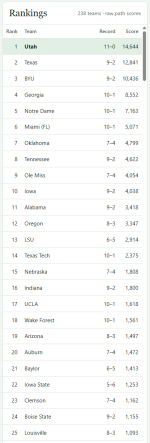
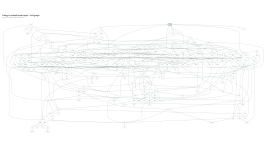
I've always been a fan of the concept of Beat Graphs and Beat Loops (you can read more here: BeatGraphs.com. Basically, if you beat a team, you're better than them. They beat you, they're better than you. Unless... You beat them, they beat another team, and then that team beat you. Now you're all even, and none of those games count towards anything. It can get complicated when when there's 138 teams all playing unique schedules and what not, but lucky for everyone, we live in a time when AI can make things for us relatively simply.

I made a site with AI's help that basically ranks teams purely on who beat who: College Football Beat Graphs. What's interesting is how much even this method LOVES the SEC. LSU's win over Clemson is carrying a lot of weight for an OOC game.

It's a fun experiment, and obviously people will either like the concept, hate it, or be indifferent. But there may be more to the SEC rankings than just bias.

By the way, last year at this time, there was an argument to be made that Illinois was the 5th best team based on record and who they beat/lost to. After the Conference Championships, we would have been ranked 9th under this system. Our two worst loses removed by a transitive loop. The only two losses remaining being to the #1 and #3 teams.

1795647352206.pngBeatGraphs_2026_Standard_all_2026-11-25_4k.png
 
Last edited:
Back