

You are using an out of date browser. It may not display this or other websites correctly.
You should upgrade or use an alternative browser.
You should upgrade or use an alternative browser.
Pregame: Illinois at UCLA, Friday, November 13th, 8:00pm CT, FOX
- Status
- Not open for further replies.


Illinois at No. 4 UCLA a mismatch? In college football this nutty season, there might not be any such thing
Can the Illini pull off a Friday-night upset at the Rose Bowl? Sure … maybe. Here are all our Week 11 picks.
 chicago.suntimes.com


ILL by 11. BOOK IT!!!!! Will be boots on ground!!
Last edited:

My honest prediction would be that this ends up similarly to Indiana last year.
And Iowa will be the big bounce-back game (just like USC).
And Iowa will be the big bounce-back game (just like USC).
TheFlyingIllini1317

- Chicago, IL
It's Gameday!
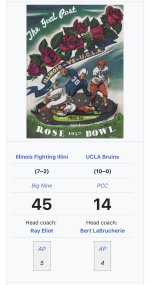
50 cents per ticket, per inflation, would be ~$7.85 today.history repeats?
Wild.


Illinois with a late field goal, 24-23
Curbelo Fanboy

BERTBALL IS LIFE
Not saying we win but I'm fairly confident Bret will have something cooked up where we hang around. If we do stay close I like our chances.

You never know..
lstewart53x3

- Scottsdale, Arizona
Keep this in mind:50 cents per ticket, per inflation, would be ~$7.85 today.
Wild.
Game-Day Staffing: A Lean, Volunteer-Heavy Crew
Modern stadiums are massive hospitality and broadcast machines requiring thousands of ushers, security screeners, chefs, IT technicians, and TV production crews. In the 1940s, the operation was much smaller and heavily reliant on students, local civic groups, and part-time laborers:
- Ushers and Ticket Takers: Rather than professional event-staffing agencies, major programs frequently used Boy Scouts, ROTC cadets, fraternity members, or local high schoolers who worked in exchange for free entry to the game.
- Vendors and Concessions: There were very few permanent concession stands. Instead, roaming hawkers walked the aisles carrying wooden trays or metal boxes strapped around their necks, shouting out items like peanuts, hot dogs, popcorn, and soda.
- Security and Medical: Security consisted mostly of a small detail of local city police officers or campus patrol, without metal detectors, bag checks, or perimeter fencing. Medical staff was usually limited to a single team doctor on the sideline and a small Red Cross first-aid tent.
- Press Box and Broadcast: Television broadcasts were virtually nonexistent until the very end of the decade. The press box held local newspaper beat writers, telegraph operators sending play-by-play updates over the wire, and a tiny radio crew (often just an announcer and an engineer).
If you walked into a 1940s stadium, even a massive 80,000-seat bowl like Michigan Stadium or the Rose Bowl, it felt much closer to a concrete public park than a modern entertainment venue:
- Seating and Weather Protection: Almost every seat in the house was an uncovered, numbered wooden plank bolted to concrete. Luxury suites, club levels, heated concourses, and padded seats did not exist. Fans brought their own wool blankets, seat cushions, and flasks to stay warm.
- Scoreboards and Sound: Scoreboards were basic, manually operated boards or early electromechanical setups showing only the score, quarter, down, and distance. There were no video replay screens, ribbon boards, or booming concert-grade sound systems—just a single public address announcer over tinny horn speakers.
- Food and Drink: Concessions were strictly cash-only and limited to basic ballpark staples like hot dogs, roasted peanuts, coffee, hot chocolate, and bottled soft drinks. Craft beer gardens, gourmet food stands, and stadium-wide alcohol sales were unheard of.
- Restrooms and Concourses: Concourses were often dark, narrow concrete tunnels under the bleachers with minimal lighting, basic trough-style restrooms, and long halftime lines.

College football - Wikipedia
en.wikipedia.org

Go Illini. Not only in basketball, but tonight's game in LA.
Starting to feel really good about this one.
We are the best offense they have seen all year. If Hauser is locked in we win.
We are the best offense they have seen all year. If Hauser is locked in we win.

I am on the road and heading west. I can't wait to see a lot of Orange tonight! ILL
KBLEE

- Montgomery, IL
Starting to feel really good about this one.
We are the best offense they have seen all year. If Hauser is locked in we win.
Who?

UCLA is surrounded by a massive metropolitan community - Pasadena is not. UCLA averaged just over 46k in their last 4 years at the Coliseum and were running -3k less per game over the past 5 years at the Rose Bowl. For those of you that have been to the Rose Bowl the sight lines are terrific and the Rose Bowl and UCLA have spent a lot of money upgrading what is a massive under - structure that for years was known as "not very good."So that explains our student section. I’d regard university employees as just part of the little CU community, whereas UCLA is surrounded by a massive metropolitan area. UCLA has 10-13 million people living within a one-hour drive (depending on traffic), while we have 240,000 (including students and university employees).
For a 60,000 seat sellout with maybe 8-10,000 students, we need to pull fans from far across and beyond the state. Students and employees won’t begin to fill the place. Where’s UCLA’s alumni and community fan base? Puzzling.
Keep in mind that UCLA changed the way the count attendance in 2026, so this year is not comparable to other years. But from LA its 1 - 2 hours to get the Rose Bowl and 30 minutes to get in and 30 mins to get out. Then the ride back is more than 2 hours. That is a large investment of time.
I don’t understand the comment that Pasadena is not surrounded by a massive metro community. It’s all one giant LA area blob. And your description of how long it takes to drive from LA is also confusing. I’m in Pasadena right now and with current traffic it’s 25 minutes to downtown LA. It’s 45 minutes to the ucla main campus right now. There are millions of people adjacent to Pasadena in all directions. Even if most fans had to drive as far as you say how’s that different than what most Big Ten football fans have to do?UCLA is surrounded by a massive metropolitan community - Pasadena is not. UCLA averaged just over 46k in their last 4 years at the Coliseum and were running -3k less per game over the past 5 years at the Rose Bowl. For those of you that have been to the Rose Bowl the sight lines are terrific and the Rose Bowl and UCLA have spent a lot of money upgrading what is a massive under - structure that for years was known as "not very good."
Keep in mind that UCLA changed the way the count attendance in 2026, so this year is not comparable to other years. But from LA its 1 - 2 hours to get the Rose Bowl and 30 minutes to get in and 30 mins to get out. Then the ride back is more than 2 hours. That is a large investment of time.
RabidDawgClassic

- Los Angeles, CA
The key words in your assessment are “right now.” During rush hour coupled with game traffic, the commute will be more than double that.I don’t understand the comment that Pasadena is not surrounded by a massive metro community. It’s all one giant LA area blob. And your description of how long it takes to drive from LA is also confusing. I’m in Pasadena right now and with current traffic it’s 25 minutes to downtown LA. It’s 45 minutes to the ucla main campus right now. There are millions of people adjacent to Pasadena in all directions. Even if most fans had to drive as far as you say how’s that different than what most Big Ten football fans have to do?

Fair. But even with traffic it’s still not different in terms of time commitment than what many BT fans do when going from major metro areas where most fans live to campus. And unlike those remote campuses the Rose Bowl is surround by millions of people. This reason for people not going to the game makes no sense. And if it were the reason then why do people also not go to basketball games that are on campus?The key words in your assessment are “right now.” During rush hour coupled with game traffic, the commute will be more than double that.
Illini2010-11
- Sugar Grove
The key to this game is going to be on the defensive side of the ball. Can the Illini wrap up and tackle, as well as avoid the big play on defense? If the answer is yes, then the Illini will have a real solid shot at pulling off the upset.
If the Illini can keep the game close going into the 4th quarter, I will feel really good about chances of winning. The last few weeks, the Illini offense has really started to wear down the defenses in the second half of games.
If the Illini can keep the game close going into the 4th quarter, I will feel really good about chances of winning. The last few weeks, the Illini offense has really started to wear down the defenses in the second half of games.
- Status
- Not open for further replies.