altgeld88

- Arlington, Virginia
It's a classic, gorgeous stadium, which we're blessed to call home.


It's a classic, gorgeous stadium, which we're blessed to call home.
Those are all good points, but despite the many reasons why, the point remains simple.I think Illinois has the lowest population of any Big Ten school within an hour drive of campus. It is in the middle of the pack if you increase the drive to 3 hours. For Illinois to fill the stadium it needs to get the 3 hour drive people. The game day atmosphere is what will attract those longer distance drivers vs them just sitting at home and watching a game on TV. It is the social experience that drives someone to want to attend in person. Once you are driving 3 hours the price of the ticket is a smaller percentage of the total amount spent.
It is a difficult task, but the DIA is doing the right thing: continue to improve the game day experience, raise ticket prices, get more revenue.
For locals (not necessarily students) the games are literally the only game in town, so there isn't much competition for their entertainment dollar--especially when you think about it in relationship to say UCLA or Rutgers which are in the largest population centers and can't come close to what Illinois is doing.
Good points, but the bolded portion isn’t quite so black and white, to me anyway. When I buy season tickets, I don’t plan to “break even” on any I resell and I’ve never had to “eat the cost”. They can be readily sold for an amount below the single game price, or at worst slightly below my prorated cost. Resale value, whether the game is sold out or not, is somewhere between the underlined extremes, so it’s a bad deal really.Those are all good points, but despite the many reasons why, the point remains simple.
There are more tickets available than people willing to buy them when the season ticket price is $200+
When the price is less than $200 there are more people than tickets.
They won’t be able to meaningfully raise ticket prices until they consistently have sellouts.
Season ticket holders for even the best teams in the world don’t go to every game. They buy season tickets because they want to go to multiple games and generally feel comfortable selling the extra tickets on the resale market for profit or to break even.
Since, the Illini very rarely sell out the only people buying season tickets are those who plan to go to every game, or are comfortable eating the cost of the games they don’t want to go to.
Until they consistently sell out every game they are going to have these same challenges every year.
They’re struggling to capture the 3-hour drive crowd because the season tickets have no resale value. They won’t have resale value until they consistently sellout. They won’t consistently sellout until they lower prices.
It’s a shame they didn’t lower prices mid-season 2022 and figure out how to make the fans who paid a higher price for early purchased tickets.
Sorry. This just looks stupid.

@Fighter of the Nightman, I also support the idea of having banners on the side of the new scoreboard. While the scoreboard was still in the NEZ, it had historical images and sponsorship logos; I suspect that the SEZ banners might be similar.Thanks for posting, Dan, it looks awesome! And on the note of my "anything is better than nothing" attitude when it comes to the Horseshoe, look at this screenshot from that video:
View attachment 50839
The new scoreboard is literally twice or even three times as tall as the Horseshoe stands when standing at field level, and this other photo below makes the difference seem even more extreme:
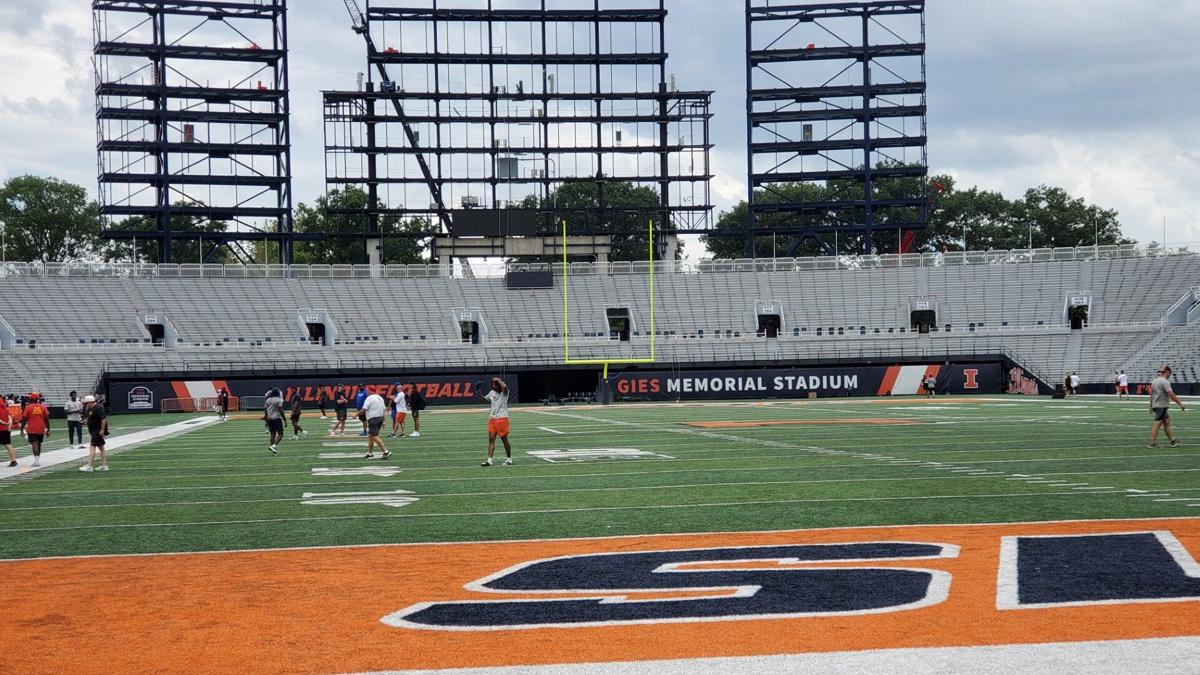
If there is no appetite for an actual SEZ renovation, let's just find S-O-M-E-T-H-I-N-G to put on either side of the new scoreboard to provide similar height on either side! It will help to trap noise and make that end of the stadium look a lot less incomplete. This goes back to my totally over-emphasized point that something is better than nothing, but if there is no plan for the SEZ any time in the foreseeable future, why would we not take this...
Last Year (i.e., Before the new scoreboard)

... and turn it into this?
New Version (i.e., New scoreboard and banners on either side to add height)
View attachment 50842
While acknowledging we would definitely be too cheap to make the wall brick (that was just Chat GPT's preference!), this would be SO easy, would cost almost nothing, would go a LONG way toward trapping more crowd noise / improving our homefield advantage and would give the stadium a finished look it's been begging for on the south end for a century now.
This would cement the current SEZ "skeleton" as permanent, which saves the DIA a lot of money down the line. Then you roughly do these "mini" renovations in order as the (now WAY lower amount of) money becomes available, with each step being both less of an immediate priority, more expensive and more reliant on future demand.
1) Touch up the existing seats as necessary and, in the process, reconfigure the seats to come down to field level and remove the ugly gap in front of the first row.
2) Renovate the concourse area to at least get up to Twenty-First Century standards, lol.
3) Renovate the exterior to be less of an eyesore.
4) If the appetite develops, build some sort of impressive concourse into the exterior (e.g., an "Illini Hall of Fame").
5) If and when the demand is there, take down the inexpensive walls / banners and build some luxury, revenue-generating suites.
6) Finally, if we are bursting at the seems as far as capacity, build a second deck on top of the luxury suites to finally tie together the SEZ look with the west and east sides, creating a true "Horseshoe" ala Ohio State.
EDIT: I noticed that Chat GPT changed the color of the photo I uploaded, but I just noticed that it also changed the clouds ... lol, it is so weird sometimes.

 www.instagram.com
 www.instagram.com
Ranking the Big 10 stadiums
GFed on Instagram: "Ive Been To Every B1G Stadium. This Is My Rank 18-1"
18K likes, 204 comments - gfedgocrazy on July 11, 2026: "Ive Been To Every B1G Stadium. This Is My Rank 18-1".
GFed on Instagram: "Ive Been To Every B1G Stadium. These Are The Top 10"
23K likes, 515 comments - gfedgocrazy on July 11, 2026: "Ive Been To Every B1G Stadium. These Are The Top 10".
Thanks for that. Last weekend @kmunt09 posted a YouTube video from this guy ranking all 18 stadiums:Ranking the Big 10 stadiums
GFed on Instagram: "Ive Been To Every B1G Stadium. This Is My Rank 18-1"
18K likes, 204 comments - gfedgocrazy on July 11, 2026: "Ive Been To Every B1G Stadium. This Is My Rank 18-1".
GFed on Instagram: "Ive Been To Every B1G Stadium. These Are The Top 10"
23K likes, 515 comments - gfedgocrazy on July 11, 2026: "Ive Been To Every B1G Stadium. These Are The Top 10".
 www.illinoisloyalty.com

This conversation got me really curious ... I am not AT ALL commenting on ticket prices here, merely looking at this from the perspective of how many fans a Big Ten program could theoretically get to attend games based on its "population footprint." I won't torture folks with my thoughts upfront, and I will cut straight to the chase and give the lists that Chat GPT came up with (so take it for what it is worth!). All the population numbers are in thousands.I think Illinois has the lowest population of any Big Ten school within an hour drive of campus. It is in the middle of the pack if you increase the drive to 3 hours. For Illinois to fill the stadium it needs to get the 3 hour drive people...
Something is off. Dane County, WI has more people than Champaign, Vermillion and McLean combined.This conversation got me really curious ... I am not AT ALL commenting on ticket prices here, merely looking at this from the perspective of how many fans a Big Ten program could theoretically get to attend games based on its "population footprint." I won't torture folks with my thoughts upfront, and I will cut straight to the chase and give the lists that Chat GPT came up with (so take it for what it is worth!). All the population numbers are in thousands.
Estimated Population Within a 1-Hour Drive of Campus
1. Rutgers: 26,500
2. USC: 16,000
2. UCLA: 16,000
4. Maryland: 13,000
5. Northwestern: 10,500
6. Michigan: 7,000
7. Indiana: 6,000
8. Washington: 5,200
9. Purdue: 5,000
10. Minnesota: 4,700
11. Michigan State: 4,500
12. Ohio State: 4,200
13. Illinois: 3,000
14. Wisconsin: 2,700
15. Penn State: 2,500
16. Iowa: 2,100
17. Nebraska: 1,200
18. Oregon: 1,100

Yeah, those numbers don't seem accurate. This population calculator puts the population within a one hour drive of Champaign at 850,000:Something is off. Dane County, WI has more people than Champaign, Vermillion and McLean combined.
And where are 3 million people within 1 hr? Corn plants, absolutely. People?
We rank 14th and Nebraska and Penn State rank below us. UCLA ranks #2 and USC #3 So there is no correlation between Alumni distance from football venue and attendance.I think Illinois has the lowest population of any Big Ten school within an hour drive of campus. It is in the middle of the pack if you increase the drive to 3 hours. For Illinois to fill the stadium it needs to get the 3 hour drive people. The game day atmosphere is what will attract those longer distance drivers vs them just sitting at home and watching a game on TV. It is the social experience that drives someone to want to attend in person. Once you are driving 3 hours the price of the ticket is a smaller percentage of the total amount spent.
It is a difficult task, but the DIA is doing the right thing: continue to improve the game day experience, raise ticket prices, get more revenue.
For locals (not necessarily students) the games are literally the only game in town, so there isn't much competition for their entertainment dollar--especially when you think about it in relationship to say UCLA or Rutgers which are in the largest population centers and can't come close to what Illinois is doing.
AI is often awful. It also keeps trying to sneak back in when you actually find a solid source.Lol, I guess that’s what I get for trusting AI without verifying! I’ll use that tool and do a follow-up.
They sold out season tickets last year. For the last 2 years the few extra tickets I sometimes have for games have sold above face value for all Big Ten games. Historically you are correct and I just used the extra room instead of selling an extra ticket for nothing.Those are all good points, but despite the many reasons why, the point remains simple.
There are more tickets available than people willing to buy them when the season ticket price is $200+
When the price is less than $200 there are more people than tickets.
They won’t be able to meaningfully raise ticket prices until they consistently have sellouts.
Season ticket holders for even the best teams in the world don’t go to every game. They buy season tickets because they want to go to multiple games and generally feel comfortable selling the extra tickets on the resale market for profit or to break even.
Since, the Illini very rarely sell out the only people buying season tickets are those who plan to go to every game, or are comfortable eating the cost of the games they don’t want to go to.
Until they consistently sell out every game they are going to have these same challenges every year.
They’re struggling to capture the 3-hour drive crowd because the season tickets have no resale value. They won’t have resale value until they consistently sellout. They won’t consistently sellout until they lower prices.
It’s a shame they didn’t lower prices mid-season 2022 and figure out how to make the fans who paid a higher price for early purchased tickets.
I agree. To me, the biggest problem is the permanency of it. Had it been $100 million for 10 or 20 years, that’s one thing. But $100 million for forever is just too small of an amount.I don't feel that strongly about it, but IMHO a permanent renaming for a mere $100 million was a mistake. Yeah, it's a lot, but unless it's shown that this is what got the (yet to publicly materialize) mega-donor snowball rolling, it was an awfully big chip to remove from the table.

Here’s the thing… unless there’s a contract with some form of the words “in perpetuity” written in there, the school could simply remove the Gies name at any time since this was, technically speaking, a gift.I agree. To me, the biggest problem is the permanency of it. Had it been $100 million for 10 or 20 years, that’s one thing. But $100 million for forever is just too small of an amount.
$100 million doesn’t get you very far today, much less 20 years from now. By then, there will be what, $200 million rosters?
People will find anything to complain about, JFC. You think this will be Larry's last gift? Maybe keeping the very few Uber wealthy alumni we have happy and feeling important is bigger deal than 4 letters literally no one will ever force you to say? I still say Assembly Hall and Memorial Stadium and I've yet to be arrested or have my fan card forcibly removed from me.
Would you rather have Monster Energy logos on all our uniforms? Because without big time donors that's where we're headed (I think we're headed there anyway, especially with private equity primed to make every AD's decisions for them, but I digress)
I agree with your comment "I still say Assembly Hall and Memorial Stadium" with onw exception. It is "The Assembly Hall", not "Assembly Hall". The Assembly Hall is on the campus of the beloved. Assembly Hall is in Bloomington Indiana. I'll die on this hill, alone if necessary.People will find anything to complain about, JFC. You think this will be Larry's last gift? Maybe keeping the very few Uber wealthy alumni we have happy and feeling important is bigger deal than 4 letters literally no one will ever force you to say? I still say Assembly Hall and Memorial Stadium and I've yet to be arrested or have my fan card forcibly removed from me.
Would you rather have Monster Energy logos on all our uniforms? Because without big time donors that's where we're headed (I think we're headed there anyway, especially with private equity primed to make every AD's decisions for them, but I digress)
I came here to say the same - there is no way he is done giving.People will find anything to complain about, JFC. You think this will be Larry's last gift? Maybe keeping the very few Uber wealthy alumni we have happy and feeling important is bigger deal than 4 letters literally no one will ever force you to say? I still say Assembly Hall and Memorial Stadium and I've yet to be arrested or have my fan card forcibly removed from me.
Would you rather have Monster Energy logos on all our uniforms? Because without big time donors that's where we're headed (I think we're headed there anyway, especially with private equity primed to make every AD's decisions for them, but I digress)


