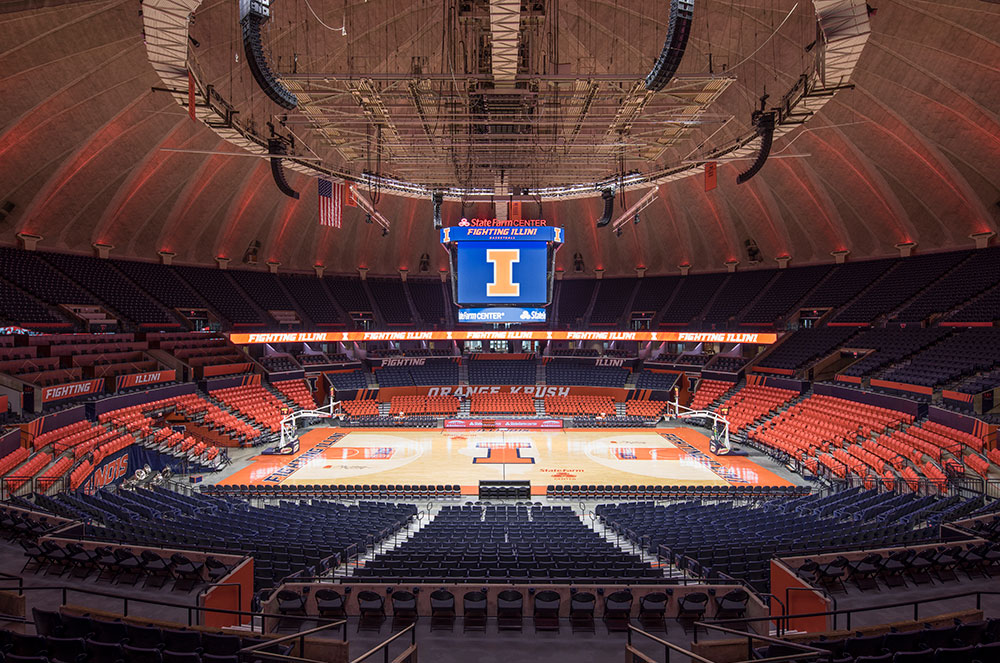
Illini Basketball 2025-2026

Status
Not open for further replies.
#276      
Its been a bit since the last time I made it down to a game in Champaign but I was at the game vs Iowa 2022 when they won the big10 and it was every bit as wild as when I saw them there in 05.
I think at its best, it is still elite. I came down for the game vs. #11 Arizona in the 2021-2022 season, and it was absolutely electric. However, I think where we have slipped is for your average home game vs., say, Minnesota. Even those games got really loud when we would go on a run, and we too often have "off games" at SFC where it seems like there is a real lack of energy. I'll also say that if you look at games from the 2005 era on YouTube and compare it to today, the Krush is just undeniably less "proactive" in influencing the game. They still get loud during big moments, but they used to constantly make noise and try to create atmosphere, filling dead space with chants like "Gooo, Illini, GO!" and stuff like that, not to mention jumping up and down during most possessions where we were on defense. Now they pretty much stand there until there is something to cheer about.
 
#277      
I agree that SFC just seems nowhere near as intimidating as the early and mid-2000s, but I am curious what about the renovation hurt. I mean, we obviously have fewer fans in the building, and that isn't going to help! I also would be sympathetic to the argument that the suites contributed to a more "sterile" vibe. However, it is worth noting that the pre-renovation Assembly Hall had some truly ugly wasted space around the court, and the renovation actually helped to bring fans closer to the court on all sides:
I think you answered it.

Trading seating for suites reduced capacity and attracted a different type of fan who is less likely to act a fool.

Moving Krush off the court and having a small student section (although I don't know how big it was pre-renovation).

The seats we moved closer to the court are as you described earlier, more of a wine and cheese crowd.

It's not all on the renovation though. Our fans are just so passive and reactive to what's happening on the court instead of being a constant source of noise and energy. The crowd at the UC made that especially clear.
 
#278      
I agree that SFC just seems nowhere near as intimidating as the early and mid-2000s, but I am curious what about the renovation hurt. I mean, we obviously have fewer fans in the building, and that isn't going to help! I also would be sympathetic to the argument that the suites contributed to a more "sterile" vibe. However, it is worth noting that the pre-renovation Assembly Hall had some truly ugly wasted space around the court, and the renovation actually helped to bring fans closer to the court on all sides:

251826.jpg

univ-of-illinois-state-farm-2.jpg


Whatever its faults, I really like how the renovation brought the A Section seats as close to the court as possible on all sides. I do kind of miss the Krush being RIGHT on the court, but they are still as close as the vast majority of student sections. I do wish we could have found a way to make the Krush seats that you see on TV go all the way up to the suites and not have that section of navy seats behind them ... they need a few more rows.
We did improve on the dead space. That did used to look ugly especially when it wasn't a full house. I just recall pre renovation the students encircled the court & really helped to generate energy in the building. It may be as much a lack of energy problem as it is a building problem.

We also have more of the immediate courtside area occupied by "fat cats" "blue hairs" or whatever adjective one wants to use. I'm getting closer every day to being a blue hair & can admit that the adult set don't bring the same game to game unbridled enthusiasm as a bunch of lubed up 19-22 year olds sitting courtside.

It's not like SFC is the only building with this issue. Few venues pop like the old ones did once you add in the luxury boxes & premium seating. Not as many people crammed into 1 space & some of them are behind glass. United Center has never buzzed the way the old Chicago Stadium did. It was loud in the MJ days but nothing compared to the old barn. Chicago Stadium gave a visceral feeling of noise even while watching on TV. Boston had the same thing when they left the Boston Garden.
 
#279      
I think you answered it.

Trading seating for suites reduced capacity and attracted a different type of fan who is less likely to act a fool.

Moving Krush off the court and having a small student section (although I don't know how big it was pre-renovation).

The seats we moved closer to the court are as you described earlier, more of a wine and cheese crowd.

It's not all on the renovation though. Our fans are just so passive and reactive to what's happening on the court instead of being a constant source of noise and energy. The crowd at the UC made that especially clear.

At the TT game we sat next to a group of guys who looked like they were in their early 20s. They made not a single sound or facial expression the entire game. It was really bizarre.
 
#280      
I would rather be punched in the mouth in November than not playing at the end of March... ILL the champions begins
 
#281      
I know there is corelation between the level of the program & the overall home court performance. I'd put Duke & UCONN (last night excluded) in that batch as well.

It just seemed from like 2000 to 2006 or so, the Hall was a house of horrors for all who entered in something other than orange & blue. Some of that is team related but we seem to drop more home games than in the past great eras. In that early 00's time frame all our home losses were to the upper echelon of the league. Nowadays we drop home games to decent teams as well as the upper echelon.

Some of that is self inflicted as the building was made somewhat less intimidating in the remodel. Also, at times I have doubts about Brad's in game coaching & I think that has been reflected in the 3 or 4 really mysterious losses we take seemingly every year. The kind of things that leave us as a 6 seed instead of a 4 or a 4 instead of a 2 in March. Not like we are awful at home but way more beatable there than used to be.
I would guess that roster consistency plays a role here, too. Rosters with more experience together are going to perform at a high level (channeling JFG) more consistently. Whereas teams that are still gelling are going to have those off nights that allow a decent team to get out with a win.

I don't highlight roster consistency as a dig towards Brad, necessarily. Inconsistency is the new norm, with a few programs standing out for their roster retention, like Purdue. If there were world enough and time, I'd look through roster consistency data and see how home records for the most consistent rosters compare to other teams. To what degree is consistency correlated to winning at home? How does it compare to AP ranking? Is more strongly correlated than top talent.
 
#282      
I would guess that roster consistency plays a role here, too. Rosters with more experience together are going to perform at a high level (channeling JFG) more consistently. Whereas teams that are still gelling are going to have those off nights that allow a decent team to get out with a win.

I don't highlight roster consistency as a dig towards Brad, necessarily. Inconsistency is the new norm, with a few programs standing out for their roster retention, like Purdue. If there were world enough and time, I'd look through roster consistency data and see how home records for the most consistent rosters compare to other teams. To what degree is consistency correlated to winning at home? How does it compare to AP ranking? Is more strongly correlated than top talent.
You definitely hit on one of the causes. The games I am talking about are the ones in recent years where we lost to Penn State at home, USC last year. Games like that. No shame in losing to the Purdue & MSU programs even at home. It's those kind of middling programs that we NEVER used to lose to in the SFC. And yes, lack of cohesion is an issue. I also suspect that Brad's offensive style of 30 plus 3's every game is part of it as well. So much reliance on the 3 ball leads to great volatility in game to game results. If we hit em, we'd beat anybody at any location. When we miss, we can lose to anyone in the top 100 teams even at home.

Part of my angst is deep down, I haven't really trusted Brad's in game coaching since the Loyola loss. I know on balance he's done lots of great things, I just really wonder if he has the chops to ever win 6 in a row in March/early April. Right or wrong that is the lens thru which these multi million a year coaches are judged. And at IL it's the only thing this program hasn't accomplished. I try not to be a "coach critic" as I am not a genius by any count. And on the other side of the street, I've seen enough of Bret to tell me if he can someday get enough horses, I have no doubt he could win a title. I've never thought that with football before. He will never get OSU talent, just has to get enough to hang with em a little better.
 
#283      
At the TT game we sat next to a group of guys who looked like they were in their early 20s. They made not a single sound or facial expression the entire game. It was really bizarre.

Yeah, I think OpenAI still has some work to do on their M3gan Sports Series(TM)
 
#289      
So, I often harp on too small of a sample size early in the season . But in a stunning bit of hypocrisy, here are some team stats I found interesting, albeit after only 5 games, 2 against then top-15 teams:
Scoring 18th in the country
Scoring defense 153rd
Assist/TO margin 95th (UConn 21, ALA 37, TN 50)
Rebound margin 4th (TN 1, UCONN 153, ALA 266...beating them by only 2 on the boards was a determining factor)
3-point % 113th (UCONN 52, TN 112, ALA 159) This stat is always a wild card from game to game.
3-point defense 79th (UCONN 34, TN 53, ALA 256)
Didn't use FT% as we've beaten that dead horse quite a bit. The Illini are hitting 58% of their shots inside the arc. The battle of the boards when the Illini play Tennessee will be fascinating...and critical. Against both Tennessee and UCONN, it would appear attacking the rim and hitting the boards will determine the outcomes, but I suppose that is Capt. Obvious material. And hitting FTs, of course :)
 
#291      
There was some conversation recently about Purdue potentially pushing us out of the Chicago Region by virtue of them beating us out for a #1 seed, with the presumed logic being that the Committee wouldn't "punish" Purdue by putting Illinois in a Chicago Regional with them. However, I wanted to look if there was precedent for that. A few reminders for those unfamiliar:

--- Skip ahead if you already know all of this or don't care, lol... ---

1. While #1 seeds are obviously the best of the best, the Committee officially takes geographic advantage into account for the top 4 seeds in each reason, hence why these are historically called "protected seeds." So, while there might be a pecking order, the Committee is at least theoretically trying to put a #4 seed on a favorable path, just as they are with a #1 seed.

2. The NCAA Tournament locations are obviously determined in advance for the First Weekend (First and Second Rounds), Second Weekend (Sweet Sixteen and Elite Eight) and the Final Four. While the Second Weekend locations (i.e., the "Regions") obviously correspond to the bracket, the First Weekend locations can be anywhere. As an example, Purdue and Illinois could both play their First Weekend games in St. Louis this year even if one is in the Chicago Region and another is in a different part of the bracket.

3. As is obvious, since the locations are pre-determined, the "home court advantage" a protected seed gets could vary wildly. While overall top seed Illinois' path was Indianapolis and then Chicago in 2005, overall top seed Virginia's path was Charlotte and (what would have been) Atlanta in 2019 ... all just luck of the draw for where the sites were that year.

4. Per my research, the Committee officially added the NET Rankings for the 2019 season. I'm not sure how much that changed the selection process as it relates to location (after all, they still clearly ranked teams within a seed line before that), but I'm including it just as an FYI.

--- My point as it relates to Illinois and the Chicago Region... ---

Back to the point, I wanted to look if there were any similar situations where a #1 seed got put in a Region where a lower-ranked protected seed had a better home court advantage ... as would be the case in the example scenario that the Committee put a #1 seed Purdue and #3 seed Illinois in Chicago this year. Since the Committee just has to sort of find a spot for NON-protected seeds (again, those #5 and below), I am limiting the examples to top 4 seeds only. After all, if Purdue is a #1 seed in the Chicago Region and we are (SUPER disappointingly!!) like a #7 seed and wind up in the same region, that isn't the Committee "rewarding" us alongside Purdue ... it's just an unlucky draw for Purdue.

Anyway, on to the list. Format is the year of the Tournament on top, the Region below that and then a list of the top 4 protected seeds in that region. Teams in green are clear examples of the lower protected seeds having an even better home court advantage there than the supposedly "more protected" higher seeds, thus giving us hope for sharing Chicago with #1 seed Purdue even as a #2 or #3 seed. For fun and to add some subjective element, I made the especially egregious examples in bold font, too.

2025 NCAA Tournament
Indianapolis, IN

#1 Houston
#2 Tennessee
#3 Kentucky
#4 Purdue


2024 NCAA Tournament
Los Angeles, CA

#1 North Carolina
#2 Arizona
#3 Baylor
#4 Alabama

2022 NCAA Tournament
Chicago, IL

#1 Kansas
#2 Auburn
#3 Wisconsin
#4 Providence

2019 NCAA Tournament
Washington, DC

#1 Duke
#2 Michigan State
#3 LSU
#4 Virginia Tech

Louisville, KY

#1 Virginia
#2 Tennessee
#3 Purdue
#4 Kansas State

Kansas City, MO
#1 North Carolina
#2 Kentucky
#3 Houston
#4 Kansas

2016 NCAA Tournament
Chicago, IL

#1 Virginia
#2 Michigan State
#3 Utah
#4 Iowa State

2015 NCAA Tournament
Los Angeles, CA

#1 Wisconsin
#2 Arizona
#3 Baylor
#4 North Carolina

2014 NCAA Tournament
Anaheim, CA

#1 Arizona
#2 Wisconsin
#3 Creighton
#4 San Diego State

Indianapolis, IN
#1 Wichita State
#2 Michigan
#3 Duke
#4 Louisville

2012 NCAA Tournament
S. Louis, MO

#1 North Carolina
#2 Kansas
#3 Georgetown
#4 Michigan

2011 NCAA Tournament
Newark, NJ

#1 Ohio State
#2 North Carolina
#3 Syracuse
#4 Kentucky

Anaheim, CA
#1 Duke
#2 San Diego State
#3 UConn
#4 Texas

2010 NCAA Tournament
Houston, TX

#1 Duke
#2 Villanova
#3 Baylor
#4 Purdue

2008 NCAA Tournament
Houston, TX

#1 Memphis
#2 Texas
#3 Stanford
#4 Pitt

2007 NCAA Tournament
San Antonio, TX

#1 Ohio State
#2 Memphis
#3 Texas A&M
#4 Virginia

2004 NCAA Tournament
St. Louis, MO

#1 Kentucky
#2 Gonzaga
#3 Georgia Tech
#4 Kansas

2003 NCAA Tournament
Albany, NY

#1 Oklahoma
#2 Wake Forest
#3 Syracuse
#4 Louisville

Minneapolis, MN
#1 Kentucky
#2 Pitt
#3 Marquette
#4 Dayton

2002 NCAA Tournament
Madison, WI

#1 Kansas
#2 Oregon
#3 Mississippi State
#4 Illinois

--- TL;DR ---

So in the 25 NCAA Tournaments since 2000 (with 2020 being cancelled), there are 20 examples of a 2/3/4 seed being put in a Region with a #1 seed, where the "worse" seed has a very clearly better home court advantage ... ala a scenario where a #2 seed Illini team is in Chicago with a #1 seed Purdue team this year. I will say that for the especially clear examples (e.g., #3 Syracuse being put in Albany, NY with #1 Oklahoma in 2003), there seems to at LEAST be a sort of pattern of wanting that team on the bottom half of the bracket (i.e., a #2 or #3 seed rather than a #4) so as to not make the #1 seed face them in front of a hostile crowd until the Elite Eight ... so let's shoot for that #2 seed or better!

Of course, the Committee could decide it would be unfair to add #2 Illinois to Chicago with #1 Purdue ... but there is a TON of precedent that they could also prioritize "protecting" a #2 seed Illini and adopting the attitude that if they don't face each other until the Elite Eight, it's fine.

P.S. Funny side note, but I left off the example of #1 Kansas in Las Vegas with #2 UCLA in 2023 because of how thoroughly we dominated the crowd in Vegas that very same year vs. a much closer UCLA. :ROFLMAO:
 
#292      
Thinking more in terms of Bracketology here ... this is nothing more than my opinion, but I think Alabama might be our toughest matchup compared to any of our remaining opponents besides UConn at MSG and Purdue on the road, both of which I have chalked up to accepted losses and "icing on the cake" wins. And yet, SO many of those games are going to be Quad 1 or Quad 2 ... in other words, I still think we have a surprisingly manageable path to getting a #2 seed or even a #1 seed with a few breaks here or there. I know we'll end up dropping some Big Ten games we feel we shouldn't, so I am not saying we will cruise through the conference slate by any means. However, I do think we are built to withstand most of what our conference rivals will throw our way based on what I have seen, and thus this is sort of how I am viewing the remainder of our CY2025 schedule and what it means for us as we enter the heart of conference play. I'll assume for the sake of this exercise that we can beat UTRG, Southern and even Nebraska at home, so an 8-4 record to start the new year is the floor here, and these are the key games, all of which will be Quad 1.

Nov. 28 - vs. UConn (New York, NY)
Dec. 6 - vs. Tennessee (Nashville, TN)
Dec. 9 - at Ohio State
Dec. 22 - vs. Missouri (St. Louis, MO)

It's a long season, of course, but this is what I would view us as "on track for" under the following scenarios:

1. If we go 0-4 in the games listed above, I think we should brace for a season in between last year and 2024. Again, we might get hot down the stretch (let's remember that the 2021 team was cruising for a #5 seed in mid-January and ended up getting a #1!!), but our trajectory would be falling well short of a protected seed. I think we'd have proven ourselves, at least for the moment, as a fringe top 25 team that isn't ready to compete with the big boys, and I think we would all rightfully be very disappointed.

2. If we go 1-3 (doesn't really matter if the one win is at OSU or Braggin' Rights), I think we are solidly in the "We'll be fine ... but this is not ideal" territory. A ton of opportunities left and we avoided a true slide, but we let some big opportunities go. A top seed will be a very tall task without a dramatic shift (which again is always possible!), and I think we would be on a trajectory closer to our 2022 team that ended up as a #4 seed.

3. If we go 2-2 and lose the games to UConn and Tennessee, I will have personally sort of made peace with a 2024-type scenario ... a ton of potential and a truly memorable season could still be in store, but I highly doubt we are a real threat to make it to the Final Four, let alone cut down the nets.

4. However, if we go 2-2 and one of the wins is vs. Tennessee or especially UConn, I will personally maintain my faith that this team's ceiling is as high as it gets and we are simply still working out the kinks. Road losses and rivalry game losses happen, but we will have proven we can go into a big stage that will be similar to an NCAA Tournament environment (as both MSG and Nashville will be) and pull out a W vs. a good team.

5. If we go 3-1 in that stretch, optimism should frankly remain just as high as it was before the 'Bama loss, IMO. If the one loss is to UConn, fine ... they are arguably one of the favorites to win it all. If the one loss is to someone else but we BEAT UConn?? Might be even better!

6. I won't even address 4-0, but ... well, it's safe to say it would more than negate the 'Bama loss.

So with no super concrete logic for me, I am putting a LOT of emphasis on the Tennessee game in Nashville. I'm treating the UConn game at MSG as playing with house money, and I'm treating the OSU/Nebraska/Missouri games as all games we "should win," while acknowledging that sometimes weird things happen in college hoops (especially in early Big Ten games and rivalry games like Braggin' Rights). However, if we can go play in front of a pro-Vols crowd in an NCAAT-like environment and get revenge for the heart breaking loss from last year ... that will send a pretty loud message to me that this team is built for REAL success this year.
 
#293      
There was some conversation recently about Purdue potentially pushing us out of the Chicago Region by virtue of them beating us out for a #1 seed, with the presumed logic being that the Committee wouldn't "punish" Purdue by putting Illinois in a Chicago Regional with them. However, I wanted to look if there was precedent for that. A few reminders for those unfamiliar:

--- Skip ahead if you already know all of this or don't care, lol... ---

1. While #1 seeds are obviously the best of the best, the Committee officially takes geographic advantage into account for the top 4 seeds in each reason, hence why these are historically called "protected seeds." So, while there might be a pecking order, the Committee is at least theoretically trying to put a #4 seed on a favorable path, just as they are with a #1 seed.

2. The NCAA Tournament locations are obviously determined in advance for the First Weekend (First and Second Rounds), Second Weekend (Sweet Sixteen and Elite Eight) and the Final Four. While the Second Weekend locations (i.e., the "Regions") obviously correspond to the bracket, the First Weekend locations can be anywhere. As an example, Purdue and Illinois could both play their First Weekend games in St. Louis this year even if one is in the Chicago Region and another is in a different part of the bracket.

3. As is obvious, since the locations are pre-determined, the "home court advantage" a protected seed gets could vary wildly. While overall top seed Illinois' path was Indianapolis and then Chicago in 2005, overall top seed Virginia's path was Charlotte and (what would have been) Atlanta in 2019 ... all just luck of the draw for where the sites were that year.

4. Per my research, the Committee officially added the NET Rankings for the 2019 season. I'm not sure how much that changed the selection process as it relates to location (after all, they still clearly ranked teams within a seed line before that), but I'm including it just as an FYI.

--- My point as it relates to Illinois and the Chicago Region... ---

Back to the point, I wanted to look if there were any similar situations where a #1 seed got put in a Region where a lower-ranked protected seed had a better home court advantage ... as would be the case in the example scenario that the Committee put a #1 seed Purdue and #3 seed Illinois in Chicago this year. Since the Committee just has to sort of find a spot for NON-protected seeds (again, those #5 and below), I am limiting the examples to top 4 seeds only. After all, if Purdue is a #1 seed in the Chicago Region and we are (SUPER disappointingly!!) like a #7 seed and wind up in the same region, that isn't the Committee "rewarding" us alongside Purdue ... it's just an unlucky draw for Purdue.

Anyway, on to the list. Format is the year of the Tournament on top, the Region below that and then a list of the top 4 protected seeds in that region. Teams in green are clear examples of the lower protected seeds having an even better home court advantage there than the supposedly "more protected" higher seeds, thus giving us hope for sharing Chicago with #1 seed Purdue even as a #2 or #3 seed. For fun and to add some subjective element, I made the especially egregious examples in bold font, too.

2025 NCAA Tournament
Indianapolis, IN

#1 Houston
#2 Tennessee
#3 Kentucky
#4 Purdue


2024 NCAA Tournament
Los Angeles, CA

#1 North Carolina
#2 Arizona
#3 Baylor
#4 Alabama

2022 NCAA Tournament
Chicago, IL

#1 Kansas
#2 Auburn
#3 Wisconsin
#4 Providence

2019 NCAA Tournament
Washington, DC

#1 Duke
#2 Michigan State
#3 LSU
#4 Virginia Tech

Louisville, KY

#1 Virginia
#2 Tennessee
#3 Purdue
#4 Kansas State

Kansas City, MO
#1 North Carolina
#2 Kentucky
#3 Houston
#4 Kansas

2016 NCAA Tournament
Chicago, IL

#1 Virginia
#2 Michigan State
#3 Utah
#4 Iowa State

2015 NCAA Tournament
Los Angeles, CA

#1 Wisconsin
#2 Arizona
#3 Baylor
#4 North Carolina

2014 NCAA Tournament
Anaheim, CA

#1 Arizona
#2 Wisconsin
#3 Creighton
#4 San Diego State

Indianapolis, IN
#1 Wichita State
#2 Michigan
#3 Duke
#4 Louisville

2012 NCAA Tournament
S. Louis, MO

#1 North Carolina
#2 Kansas
#3 Georgetown
#4 Michigan

2011 NCAA Tournament
Newark, NJ

#1 Ohio State
#2 North Carolina
#3 Syracuse
#4 Kentucky

Anaheim, CA
#1 Duke
#2 San Diego State
#3 UConn
#4 Texas

2010 NCAA Tournament
Houston, TX

#1 Duke
#2 Villanova
#3 Baylor
#4 Purdue

2008 NCAA Tournament
Houston, TX

#1 Memphis
#2 Texas
#3 Stanford
#4 Pitt

2007 NCAA Tournament
San Antonio, TX

#1 Ohio State
#2 Memphis
#3 Texas A&M
#4 Virginia

2004 NCAA Tournament
St. Louis, MO

#1 Kentucky
#2 Gonzaga
#3 Georgia Tech
#4 Kansas

2003 NCAA Tournament
Albany, NY

#1 Oklahoma
#2 Wake Forest
#3 Syracuse
#4 Louisville

Minneapolis, MN
#1 Kentucky
#2 Pitt
#3 Marquette
#4 Dayton

2002 NCAA Tournament
Madison, WI

#1 Kansas
#2 Oregon
#3 Mississippi State
#4 Illinois

--- TL;DR ---

So in the 25 NCAA Tournaments since 2000 (with 2020 being cancelled), there are 20 examples of a 2/3/4 seed being put in a Region with a #1 seed, where the "worse" seed has a very clearly better home court advantage ... ala a scenario where a #2 seed Illini team is in Chicago with a #1 seed Purdue team this year. I will say that for the especially clear examples (e.g., #3 Syracuse being put in Albany, NY with #1 Oklahoma in 2003), there seems to at LEAST be a sort of pattern of wanting that team on the bottom half of the bracket (i.e., a #2 or #3 seed rather than a #4) so as to not make the #1 seed face them in front of a hostile crowd until the Elite Eight ... so let's shoot for that #2 seed or better!

Of course, the Committee could decide it would be unfair to add #2 Illinois to Chicago with #1 Purdue ... but there is a TON of precedent that they could also prioritize "protecting" a #2 seed Illini and adopting the attitude that if they don't face each other until the Elite Eight, it's fine.

P.S. Funny side note, but I left off the example of #1 Kansas in Las Vegas with #2 UCLA in 2023 because of how thoroughly we dominated the crowd in Vegas that very same year vs. a much closer UCLA. :ROFLMAO:

Maybe I'm crazy but I don't think Chicago would give Illinois a massive home court advantage over Purdue. The schools are equal driving distance to Chicago and the area is home to plenty of alumni from both schools. It would definitely negate any home court advantage, but at least it wouldn't be as bad as what you listed above.
 
#294      
Maybe I'm crazy but I don't think Chicago would give Illinois a massive home court advantage over Purdue. The schools are equal driving distance to Chicago and the area is home to plenty of alumni from both schools. It would definitely negate any home court advantage, but at least it wouldn't be as bad as what you listed above.
It wouldn't be "massive," I agree ... but this past Wednesday night showed driving distance from the literal campus is far from the main concern for how many Illini fans would be there. I would bet my life that the vast majority of the 18,000 Illini fans in attendance live IN Chicagoland, and thus the distance from campus was irrelevant to the crowd makeup. I do think the fact that Purdue has a very large alumni base in Chicagoland would certainly be the main thing preventing it from being too big of a crowd advantage, but their alumni base is still WAY smaller than Illinois' in the Chicago Area, and there are virtually zero non-alum Purdue fans here while there are non-alum Illini fans (like me!). Basically, of the four factors I think would determine the crowd makeup in an Illini/Purdue Elite Eight game at the United Center...

1. Willingness/enthusiasm of out-of-town fans to travel for the game ---> Tie
2. Distance from campus (i.e., the "core" of fans) ---> Tie
3. Fans actually LIVING in the city where the game is played ---> Significant Illini advantage
4. Number of technically non-local fans within driving distance ---> Fairly even but slight advantage toward Illini

So, overall I would guess that in an even split, the arena would be between 60/40 Illini and 65/35 Illini. That isn't anywhere close to the 95%+ advantage we had against Alabama or anything, but it is significant ... and if the Committee is determined to not "screw over" Purdue more than they are determined to "reward" a #2/3 seed Illini team, they could easily just slot us in another region.
 
#295      
Thinking more in terms of Bracketology here ... this is nothing more than my opinion, but I think Alabama might be our toughest matchup compared to any of our remaining opponents besides UConn at MSG and Purdue on the road, both of which I have chalked up to accepted losses and "icing on the cake" wins. And yet, SO many of those games are going to be Quad 1 or Quad 2 ... in other words, I still think we have a surprisingly manageable path to getting a #2 seed or even a #1 seed with a few breaks here or there. I know we'll end up dropping some Big Ten games we feel we shouldn't, so I am not saying we will cruise through the conference slate by any means. However, I do think we are built to withstand most of what our conference rivals will throw our way based on what I have seen, and thus this is sort of how I am viewing the remainder of our CY2025 schedule and what it means for us as we enter the heart of conference play. I'll assume for the sake of this exercise that we can beat UTRG, Southern and even Nebraska at home, so an 8-4 record to start the new year is the floor here, and these are the key games, all of which will be Quad 1.

Nov. 28 - vs. UConn (New York, NY)
Dec. 6 - vs. Tennessee (Nashville, TN)
Dec. 9 - at Ohio State
Dec. 22 - vs. Missouri (St. Louis, MO)

It's a long season, of course, but this is what I would view us as "on track for" under the following scenarios:

1. If we go 0-4 in the games listed above, I think we should brace for a season in between last year and 2024. Again, we might get hot down the stretch (let's remember that the 2021 team was cruising for a #5 seed in mid-January and ended up getting a #1!!), but our trajectory would be falling well short of a protected seed. I think we'd have proven ourselves, at least for the moment, as a fringe top 25 team that isn't ready to compete with the big boys, and I think we would all rightfully be very disappointed.

2. If we go 1-3 (doesn't really matter if the one win is at OSU or Braggin' Rights), I think we are solidly in the "We'll be fine ... but this is not ideal" territory. A ton of opportunities left and we avoided a true slide, but we let some big opportunities go. A top seed will be a very tall task without a dramatic shift (which again is always possible!), and I think we would be on a trajectory closer to our 2022 team that ended up as a #4 seed.

3. If we go 2-2 and lose the games to UConn and Tennessee, I will have personally sort of made peace with a 2024-type scenario ... a ton of potential and a truly memorable season could still be in store, but I highly doubt we are a real threat to make it to the Final Four, let alone cut down the nets.

4. However, if we go 2-2 and one of the wins is vs. Tennessee or especially UConn, I will personally maintain my faith that this team's ceiling is as high as it gets and we are simply still working out the kinks. Road losses and rivalry game losses happen, but we will have proven we can go into a big stage that will be similar to an NCAA Tournament environment (as both MSG and Nashville will be) and pull out a W vs. a good team.

5. If we go 3-1 in that stretch, optimism should frankly remain just as high as it was before the 'Bama loss, IMO. If the one loss is to UConn, fine ... they are arguably one of the favorites to win it all. If the one loss is to someone else but we BEAT UConn?? Might be even better!

6. I won't even address 4-0, but ... well, it's safe to say it would more than negate the 'Bama loss.

So with no super concrete logic for me, I am putting a LOT of emphasis on the Tennessee game in Nashville. I'm treating the UConn game at MSG as playing with house money, and I'm treating the OSU/Nebraska/Missouri games as all games we "should win," while acknowledging that sometimes weird things happen in college hoops (especially in early Big Ten games and rivalry games like Braggin' Rights). However, if we can go play in front of a pro-Vols crowd in an NCAAT-like environment and get revenge for the heart breaking loss from last year ... that will send a pretty loud message to me that this team is built for REAL success this year.
If I had to chose to win one and lose one between the Bama game and Wiscy game, I'd 100% win the Bama game. If we would've beaten Tennessee last year we would've been at least a 5 seed instead of a 6. I think Bama ends up a 1 seed, the SEC is good but not great.

people think non con games don't matter. It's basically a leap of a seedline if you win these games.
 
#296      
There was some conversation recently about Purdue potentially pushing us out of the Chicago Region by virtue of them beating us out for a #1 seed, with the presumed logic being that the Committee wouldn't "punish" Purdue by putting Illinois in a Chicago Regional with them. However, I wanted to look if there was precedent for that. A few reminders for those unfamiliar:

--- Skip ahead if you already know all of this or don't care, lol... ---

1. While #1 seeds are obviously the best of the best, the Committee officially takes geographic advantage into account for the top 4 seeds in each reason, hence why these are historically called "protected seeds." So, while there might be a pecking order, the Committee is at least theoretically trying to put a #4 seed on a favorable path, just as they are with a #1 seed.

2. The NCAA Tournament locations are obviously determined in advance for the First Weekend (First and Second Rounds), Second Weekend (Sweet Sixteen and Elite Eight) and the Final Four. While the Second Weekend locations (i.e., the "Regions") obviously correspond to the bracket, the First Weekend locations can be anywhere. As an example, Purdue and Illinois could both play their First Weekend games in St. Louis this year even if one is in the Chicago Region and another is in a different part of the bracket.

3. As is obvious, since the locations are pre-determined, the "home court advantage" a protected seed gets could vary wildly. While overall top seed Illinois' path was Indianapolis and then Chicago in 2005, overall top seed Virginia's path was Charlotte and (what would have been) Atlanta in 2019 ... all just luck of the draw for where the sites were that year.

4. Per my research, the Committee officially added the NET Rankings for the 2019 season. I'm not sure how much that changed the selection process as it relates to location (after all, they still clearly ranked teams within a seed line before that), but I'm including it just as an FYI.

--- My point as it relates to Illinois and the Chicago Region... ---

Back to the point, I wanted to look if there were any similar situations where a #1 seed got put in a Region where a lower-ranked protected seed had a better home court advantage ... as would be the case in the example scenario that the Committee put a #1 seed Purdue and #3 seed Illinois in Chicago this year. Since the Committee just has to sort of find a spot for NON-protected seeds (again, those #5 and below), I am limiting the examples to top 4 seeds only. After all, if Purdue is a #1 seed in the Chicago Region and we are (SUPER disappointingly!!) like a #7 seed and wind up in the same region, that isn't the Committee "rewarding" us alongside Purdue ... it's just an unlucky draw for Purdue.

Anyway, on to the list. Format is the year of the Tournament on top, the Region below that and then a list of the top 4 protected seeds in that region. Teams in green are clear examples of the lower protected seeds having an even better home court advantage there than the supposedly "more protected" higher seeds, thus giving us hope for sharing Chicago with #1 seed Purdue even as a #2 or #3 seed. For fun and to add some subjective element, I made the especially egregious examples in bold font, too.

2025 NCAA Tournament
Indianapolis, IN

#1 Houston
#2 Tennessee
#3 Kentucky
#4 Purdue


2024 NCAA Tournament
Los Angeles, CA

#1 North Carolina
#2 Arizona
#3 Baylor
#4 Alabama

2022 NCAA Tournament
Chicago, IL

#1 Kansas
#2 Auburn
#3 Wisconsin
#4 Providence

2019 NCAA Tournament
Washington, DC

#1 Duke
#2 Michigan State
#3 LSU
#4 Virginia Tech

Louisville, KY

#1 Virginia
#2 Tennessee
#3 Purdue
#4 Kansas State

Kansas City, MO
#1 North Carolina
#2 Kentucky
#3 Houston
#4 Kansas

2016 NCAA Tournament
Chicago, IL

#1 Virginia
#2 Michigan State
#3 Utah
#4 Iowa State

2015 NCAA Tournament
Los Angeles, CA

#1 Wisconsin
#2 Arizona
#3 Baylor
#4 North Carolina

2014 NCAA Tournament
Anaheim, CA

#1 Arizona
#2 Wisconsin
#3 Creighton
#4 San Diego State

Indianapolis, IN
#1 Wichita State
#2 Michigan
#3 Duke
#4 Louisville

2012 NCAA Tournament
S. Louis, MO

#1 North Carolina
#2 Kansas
#3 Georgetown
#4 Michigan

2011 NCAA Tournament
Newark, NJ

#1 Ohio State
#2 North Carolina
#3 Syracuse
#4 Kentucky

Anaheim, CA
#1 Duke
#2 San Diego State
#3 UConn
#4 Texas

2010 NCAA Tournament
Houston, TX

#1 Duke
#2 Villanova
#3 Baylor
#4 Purdue

2008 NCAA Tournament
Houston, TX

#1 Memphis
#2 Texas
#3 Stanford
#4 Pitt

2007 NCAA Tournament
San Antonio, TX

#1 Ohio State
#2 Memphis
#3 Texas A&M
#4 Virginia

2004 NCAA Tournament
St. Louis, MO

#1 Kentucky
#2 Gonzaga
#3 Georgia Tech
#4 Kansas

2003 NCAA Tournament
Albany, NY

#1 Oklahoma
#2 Wake Forest
#3 Syracuse
#4 Louisville

Minneapolis, MN
#1 Kentucky
#2 Pitt
#3 Marquette
#4 Dayton

2002 NCAA Tournament
Madison, WI

#1 Kansas
#2 Oregon
#3 Mississippi State
#4 Illinois

--- TL;DR ---

So in the 25 NCAA Tournaments since 2000 (with 2020 being cancelled), there are 20 examples of a 2/3/4 seed being put in a Region with a #1 seed, where the "worse" seed has a very clearly better home court advantage ... ala a scenario where a #2 seed Illini team is in Chicago with a #1 seed Purdue team this year. I will say that for the especially clear examples (e.g., #3 Syracuse being put in Albany, NY with #1 Oklahoma in 2003), there seems to at LEAST be a sort of pattern of wanting that team on the bottom half of the bracket (i.e., a #2 or #3 seed rather than a #4) so as to not make the #1 seed face them in front of a hostile crowd until the Elite Eight ... so let's shoot for that #2 seed or better!

Of course, the Committee could decide it would be unfair to add #2 Illinois to Chicago with #1 Purdue ... but there is a TON of precedent that they could also prioritize "protecting" a #2 seed Illini and adopting the attitude that if they don't face each other until the Elite Eight, it's fine.

P.S. Funny side note, but I left off the example of #1 Kansas in Las Vegas with #2 UCLA in 2023 because of how thoroughly we dominated the crowd in Vegas that very same year vs. a much closer UCLA. :ROFLMAO:

The top 4 teams from each conference are placed into different regions as long as they are top 4 seeds so we would need to be a 5 or lower to be in Chicago with Purdue if they get the Midwest region.
 
#299      
The top 4 teams from each conference are placed into different regions as long as they are top 4 seeds so we would need to be a 5 or lower to be in Chicago with Purdue if they get the Midwest region.
I could be misinterpreting, but I think 2025 shows the "loophole" to this rule with Tennessee and Kentucky getting the 2 and 3 seeds in the same region because the SEC had so many good teams (Auburn, Alabama, and Florida ranked ahead of them). So there is a path, it's just unlikely and requires the Illini to be the fifth best team in the Big Ten, but they could get a higher than 5 seed. For example, if Purdue is a 1-seed and three other Big Ten teams are other high seeds, Illinois could be as high as a 2-seed and still find their way into Purdue's region.
 
Status
Not open for further replies.
Back