
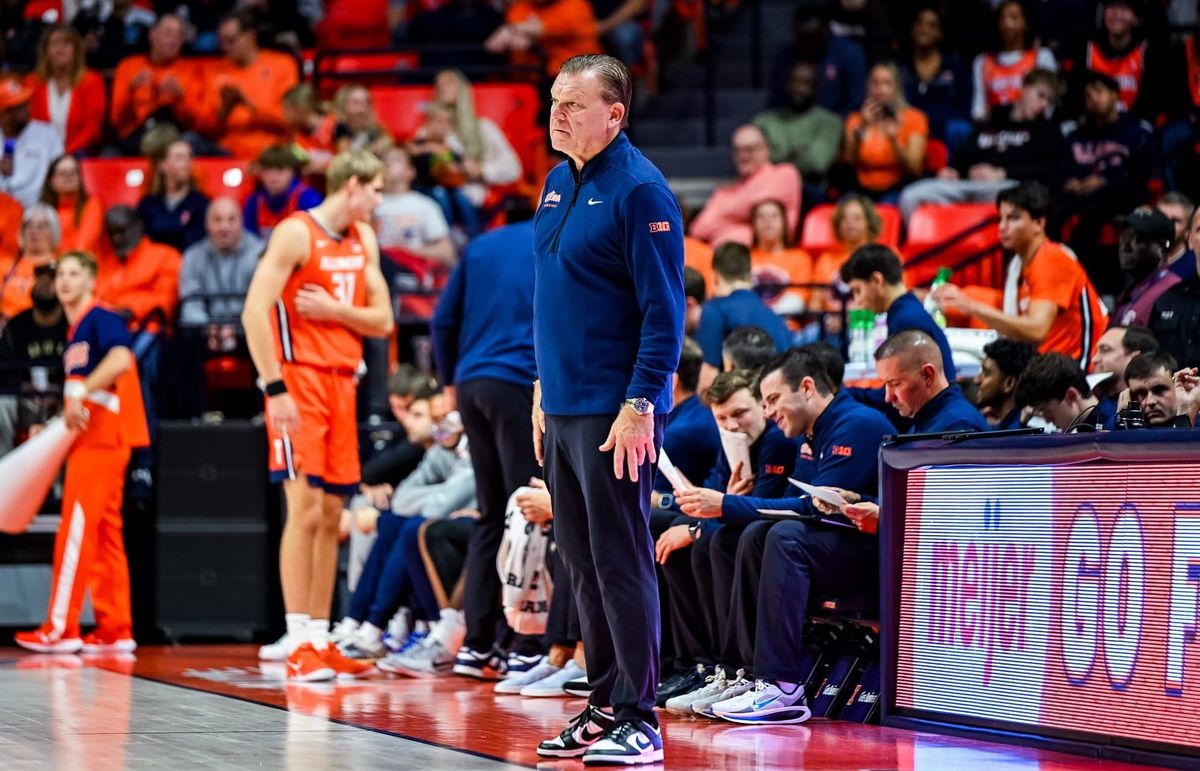
Brad goes after who is most coachable and most competitive because those are the guys that he views as vocal leaders. He did the same to Terrance. It's not a bad thing, if you aren't being coached hard, that's when a player should be concerned. I like when he is a little unhinged, shows he cares.


You are using an out of date browser. It may not display this or other websites correctly.
You should upgrade or use an alternative browser.
You should upgrade or use an alternative browser.
Illini Basketball 2025-2026
- Status
- Not open for further replies.

He candidly states in the first video (the non-film room) that we can't switch as much as we do, and I tend to agree. He mentions Nebby is a tough matchup if you completely don't switch at all, but we need to tweak some things.So, I was as sick of our stale, one size fits all drop coverage as anyone and ready for a change. But watching LaTulip’s film brought me immediately to 2022-23, where we started the season switching everything and scrapped it mid year in favor of drop.
I know LaTulip says it’s all fixable. But given we have so many new pieces, a brand new scheme, a lack of off season practice time due to injuries/illness/getting guys here from overseas,enrolled, etc., and in general don’t really seem to have the personnel to switch effectively (we have positional size but all of our bigs are slow footed and not well suited to guard in space and stay in front of quicker players), and a fairly unique language barrier challenge, I think the staff does need to ask the question if the scheme is salvageable with more reps, or if we need to scrap it in favor of a more straightforward system like we did in 2022-23.
We have an elite offense, currently number 3 and I wouldn’t be surprised if we get better as Tomi plays himself into shape and we firm up role identification. We have 2 7 footers, one of which is one of the elite rim protectors in the country. Would we be better off just hugging 3 pt shooters and funneling guards into contested 2s over Tomi/Z? Even if it’s bland and easy to prep for, I’m not sure teams can score enough to beat us.
I’m not advocating for the switch, but if we were going to do it I think these next two weeks is the time to do it. Difficult question whether this new defense is salvageable. I don’t know.
In all honesty, because Z is so elite as a rim protector, our "funnel into the bigs" idea from a year ago would be much better suited for this team compared to last year.
Not to mention 2 years ago when we funneled everyone into Coleman. But our offense was so good it didn’t matter. And this years offense, at least so far, is better statistically than it was in 23-24.He candidly states in the first video (the non-film room) that we can't switch as much as we do, and I'd agree. He mentions Nebby is a tough matchup if you completely don't switch at all, but we need to tweak some things.
In all honesty, I do think because Z is so elite as a rim protector, our "funnel into the bigs" idea from a year ago would be much better suited for this team compared to last year.


Big Jack

- Decatur
We would never hire a coach who paid players pre-NIL.


There's been more than just him here... trust
Anyway this is a fun way to distract from the Will Wade slurping, so I'm loving this sidebar

There's been more than just him here... trust
Anyway this is a fun way to distract from the Will Wade slurping, so I'm loving this sidebar
I think Will Wade is probably a very good coach, but the fact remains that were actually our coach and what you got was his trajectory at LSU (S16, Covid Year free pass, 2nd Round, First Round), and then graft on his tepid start at NC State this season to that, I don't think there'd be as many people on this board saying such glowing things about him. Very much a "grass is always greener" mentality from a lot of this board with Brad vs. other coaches out in the wild. And I think you could say the exact same about Chris Beard and Sean Miller who also get brought up a lot in these conversations.
Brad underwood has had wins vacated and sanctions at both his previous stops lol. 

Without a grown !!! offer to him no use speculating...I think Will Wade is probably a very good coach, but the fact remains that were actually our coach and what you got was his trajectory at LSU (S16, Covid Year free pass, 2nd Round, First Round), and then graft on his tepid start at NC State this season to that, I don't think there'd be as many people on this board saying such glowing things about him. Very much a "grass is always greener" mentality from a lot of this board with Brad vs. other coaches out in the wild. And I think you could say the exact same about Chris Beard and Sean Miller who also get brought up a lot in these conversations.

I want consistency on getting to the second weekend. That leads to better opportunities on getting to the FF. Yes, there is a bit of luck involved when it comes to upsets. We caught a break in 24 to get to the S16 by playing Duquesne instead of BYU. Winning in march is paramount as it improves recruiting with national exposure, more money by boosters when you produce a winning product. I also do not understand the lame attitude that some have here that they are happy with the status quo
Houston made a final four without playing a single digit seed, Purdue played an 11 seed in the final four, and got gifted a St. Peter’s in the S16 (which they blew) - this is the bites at the apple thing. I legit think we missed the tournament for so long fans forgot how this thing works. The way some of us wear the Loyola game on our sleeves is bizarre - we lost to a nine seed (improperly) and we act like that’s never happened in the history of the sport.
The Duquesne “break” was interesting, because we got screwed over to begin with the committee moved BYU to a 6.
The “lame attitude” seems to be a common sentiment. Do you believe fans who are pro Brad think this is the ceiling or do you think there’s further context there?
If the season ended today, we are what? No worse than a 5 seed? I swear I’d think this team was 5-6 with all losses to bottom feeders
Yes, the Loyola team was better than they were ranked. That is still a terrible loss. We had an absolutely dominant team that was in peak form going into the tournament.Houston made a final four without playing a single digit seed, Purdue played an 11 seed in the final four, and got gifted a St. Peter’s in the S16 (which they blew) - this is the bites at the apple thing. I legit think we missed the tournament for so long fans forgot how this thing works. The way some of us wear the Loyola game on our sleeves is bizarre - we lost to a nine seed (improperly) and we act like that’s never happened in the history of the sport.
The Duquesne “break” was interesting, because we got screwed over to begin with the committee moved BYU to a 6.
The “lame attitude” seems to be a common sentiment. Do you believe fans who are pro Brad think this is the ceiling or do you think there’s further context there?
If the season ended today, we are what? No worse than a 5 seed? I swear I’d think this team was 5-6 with all losses to bottom feeders
We got absolutely outcoached in that game. They refused to let us get into transition, we couldn't figure out Krutwig, and we couldn't do anything on offense with two of the top 15 or so players in college basketball on our team. Maybe it hit harder because it was so unexpected, but it sucked.
To be fair, Loyola was like the absolute worst team for us to play. Their strengths were our weaknesses. They were very tactical and high IQ.
This year's team is good. We have a couple close losses due to free throws and offensive rebounds. I think we get there, but the team needs more fight and hustle. I feel like an 80 year old saying that, but it's true.


Fighter of the Nightman

- Chicago, IL
Maybe I'm really confused with the bolded part and where this conversation is going, but I think he was saying that we undoubtably improve our odds at a deep NCAAT run by getting a protected seed ... and that's objectively true over the long run. There are upsets every year and teams that go on runs as a worse seed because they get hot, but the odds pretty much reset to the default in any given year. And over time, your chance of making the Final Four goes up A LOT if you have a good seed:Houston made a final four without playing a single digit seed, Purdue played an 11 seed in the final four, and got gifted a St. Peter’s in the S16 (which they blew) - this is the bites at the apple thing. I legit think we missed the tournament for so long fans forgot how this thing works. The way some of us wear the Loyola game on our sleeves is bizarre - we lost to a nine seed (improperly) and we act like that’s never happened in the history of the sport.
The Duquesne “break” was interesting, because we got screwed over to begin with the committee moved BYU to a 6.
The “lame attitude” seems to be a common sentiment. Do you believe fans who are pro Brad think this is the ceiling or do you think there’s further context there?
If the season ended today, we are what? No worse than a 5 seed? I swear I’d think this team was 5-6 with all losses to bottom feeders
#1 Seed: 40.1% Chance
#2 Seed: 21.5% Chance
#3 Seed: 11.1% Chance
#4 Seed: 8.1% Chance
#5 Seed: 4.7% Chance
#6 Seed: 3.5% Chance
#7 Seed: 2.3% Chance
I think the dramatic drop-off from a #2 seed to a #4 seed is the most important. Being on that #2/3 seed path on the bottom half of the bracket allows you to avoid the #1 seed until the Elite Eight ... as we all know from years like 2002, 2004, 2006, 2002, etc., it kind of sucks being a #4/5 seed and (A) having to beat an equal team just to make the Sweet Sixteen and (B) likely run into a buzz saw of a #1 seed before you can get to the Elite Eight. The big drop-off from #2 to #3 is surprising, but while their paths are about identical on paper, I think more often than not a #2 seed is significantly better than your average #3 seed.
TL;DR
Whether or not it is appropriate as a direct response to your post, I think it's imperative that we continue to have good enough regular seasons to get a top 3 seed ... you just have a much better chance at trying your luck in March Madness, and over time it will eventually start leading to deep runs. The "figure it out in February and get hot late" method is SO much worse on paper, especially because you have likely already put too many dents in your resume, and your task in March Madness just requires almost zero margin for error. And I think that's why people are on edge this year after "just one loss" ... we desperately want to stay above that #4 seed line.

You've identified the fallacy with the bites of the apple argument. Making it into the tournament as a #16 seed is a bite of the apple, but nobody's sitting here thinking they can make the Final Four.Maybe I'm really confused with the bolded part and where this conversation is going, but I think he was saying that we undoubtably improve our odds at a deep NCAAT run by getting a protected seed ... and that's objectively true over the long run. There are upsets every year and teams that go on runs as a worse seed because they get hot, but the odds pretty much reset to the default in any given year. And over time, your chance of making the Final Four goes up A LOT if you have a good seed:
#1 Seed: 40.1% Chance
#2 Seed: 21.5% Chance
#3 Seed: 11.1% Chance
#4 Seed: 8.1% Chance
#5 Seed: 4.7% Chance
#6 Seed: 3.5% Chance
#7 Seed: 2.3% Chance
I think the dramatic drop-off from a #2 seed to a #4 seed is the most important. Being on that #2/3 seed path on the bottom half of the bracket allows you to avoid the #1 seed until the Elite Eight ... as we all know from years like 2002, 2004, 2006, 2002, etc., it kind of sucks being a #4/5 seed and (A) having to beat an equal team just to make the Sweet Sixteen and (B) likely run into a buzz saw of a #1 seed before you can get to the Elite Eight. The big drop-off from #2 to #3 is surprising, but while their paths are about identical on paper, I think more often than not a #2 seed is significantly better than your average #3 seed.
TL;DR
Whether or not it is appropriate as a direct response to your post, I think it's imperative that we continue to have good enough regular seasons to get a top 3 seed ... you just have a much better chance at trying your luck in March Madness, and over time it will eventually start leading to deep runs. The "figure it out in February and get hot late" method is SO much worse on paper, especially because you have likely already put too many dents in your resume, and your task in March Madness just requires almost zero margin for error. And I think that's why people are on edge this year after "just one loss" ... we desperately want to stay above that #4 seed line.
We would never hire a coach who paid players pre-NIL.
For my own sanity, I’ve avoided the basketball side of Loyalty since Nebraska’s winning shot went in.

We lost to an 8 seeded Loyola team, one they were completed under seeded, an incredible team that we had no business playing in the round of 32. Secondly we refused to switch our defense and they picked our drop coverage apart because they were a team that had players that could hit tough 2's. We could have easily play a 1-3-1 and stopped some of that and forced tough threes but that Loyola team was old and played very well together. I think Underwood knows he messed up bad about that and might be his biggest regret in any game, that Illini team was stacked but drop coverage defense sucks (that's my opinion on that).Houston made a final four without playing a single digit seed, Purdue played an 11 seed in the final four, and got gifted a St. Peter’s in the S16 (which they blew) - this is the bites at the apple thing. I legit think we missed the tournament for so long fans forgot how this thing works. The way some of us wear the Loyola game on our sleeves is bizarre - we lost to a nine seed (improperly) and we act like that’s never happened in the history of the sport.
The Duquesne “break” was interesting, because we got screwed over to begin with the committee moved BYU to a 6.
The “lame attitude” seems to be a common sentiment. Do you believe fans who are pro Brad think this is the ceiling or do you think there’s further context there?
If the season ended today, we are what? No worse than a 5 seed? I swear I’d think this team was 5-6 with all losses to bottom feeders
I think the team ceiling was the Ayo team, that's the type of offense and defense Underwood wants to play. I think we haven't seen Underwood's ceiling as a coach yet, he is pretty stubborn but I think his ceiling hasn't been hit yet.
I would say because you don't have a TSJ or Domask who just flat out refuse to lose. Those types of players are typically what get you over the edge.
At this moment, we will be requiring a true freshmen who is playing about 38 minutes a game to step up in those key moments.
Kylan will be solid but he's already ceding alpha status to Wagler. Andrej isn't very consistent nor a winning player at this point (though he's shown flashes).
IDK man i feel like we fans have a habit of over-romanticizing our old successful teams to a degree
Through 11 games, we are 8-3, that team was 9-2..they lost games early as well and their schedule was MUCH easier to date
This year (kenpom) we played 6 top 50 teams in to date (3-3) beating 15,27, 40. 2024 team played only 3 (1-2) and the one they did beat was 47
This year team played one true cupacke (250+ KP) in the 326th, while 2024 team played 4 (320, 300, 260,270)
Kinda feel given the tougher schedule and similar record, these have been similar starts....not to mention we've had injuries etc
So im kind of choosing to stay optmistic that this team can gel a bit more and key players like tomi get back into form, and take us to a good place like that team did
IDK man i feel like we fans have a habit of over-romanticizing our old successful teams to a degree
Through 11 games, we are 8-3, that team was 9-2..they lost games early as well and their schedule was MUCH easier to date
This year (kenpom) we played 6 top 50 teams in to date (3-3) beating 15,27, 40. 2024 team played only 3 (1-2) and the one they did beat was 47
This year team played one true cupacke (250+ KP) in the 326th, while 2024 team played 4 (320, 300, 260,270)
Kinda feel given the tougher schedule and similar record, these have been similar starts....not to mention we've had injuries etc
So im kind of choosing to stay optmistic that this team can gel a bit more and key players like tomi get back into form, and take us to a good place like that team did
Yeah man, this place is pretty crazy during the season if we're not constantly in the top 10 and also not coming off of a loss...
And in between the complaints or occasional GIFs making fun of said craziness, there's conversely the thinly veiled support of all of it through strawman comments "I don't see whats wrong with airing concerns" when the prevailing conversation is actually something completely wild like firing the coach, or other rhetoric "if we don't get a 1 seed we just probably won't win the championship" that implies the premature label of near complete failure on a team is justified due to early season losses to top 5/10/20 teams despite still having 3 Q1 wins and being #12 in NET, etc etc
lstewart53x3

- Scottsdale, Arizona
Robert pointed out in his latest basketball article that Dusty May once was a student manager for Bobby Knight and wanted the Indiana job.
Could you imagine if Indiana hired May and they were #1 in both football and basketball right now?
 www.illiniboard.com
Could you imagine if Indiana hired May and they were #1 in both football and basketball right now?
Where Do We Stand? December 18th
The return of basketball NERDstats! 43% of subscribers just said "hurray!" 57% read this intro and didn't click on the post because NERDstats aren't their thing. Which is fine. They weren't my thing for a long time, either. But now that I've caught the NERDstats bug,
www.illiniboard.com

That will be nauseating…..Robert pointed out in his latest basketball article that Dusty May once was a student manager for Bobby Knight and wanted the Indiana job.
Could you imagine if Indiana hired May and they were #1 in both football and basketball right now?
Where Do We Stand? December 18th
The return of basketball NERDstats! 43% of subscribers just said "hurray!" 57% read this intro and didn't click on the post because NERDstats aren't their thing. Which is fine. They weren't my thing for a long time, either. But now that I've caught the NERDstats bug,
Big Jack
- Decatur
Robert pointed out in his latest basketball article that Dusty May once was a student manager for Bobby Knight and wanted the Indiana job.
Could you imagine if Indiana hired May and they were #1 in both football and basketball right now?
Where Do We Stand? December 18th
The return of basketball NERDstats! 43% of subscribers just said "hurray!" 57% read this intro and didn't click on the post because NERDstats aren't their thing. Which is fine. They weren't my thing for a long time, either. But now that I've caught the NERDstats bug,

You've identified the fallacy with the bites of the apple argument. Making it into the tournament as a #16 seed is a bite of the apple, but nobody's sitting here thinking they can make the Final Four.
Ya but we’re not making it to the tournament as a 16 seed lol
If we’re continually a 8,9,10,11 then id feel different.

69 1/2 years old. No coaches before Brad should be compared to the current situation. They couldn't bid on players or coax players to leave their team to come play for the Illini. If The past guys could have bought players then the comparisons would make sense. Brad winning more doesn't make him a better coach.
I'm all about what we can do in the tourney. If the Cubs, Bears, Bulls, Blackhawks, lose early in the playoffs, the season wasn't a success. Same with the Illini. Everyone is a professional now. I don't have enough years left to watch us drop out of the tourney the first weekend. I need success now.
Is this what the OP expected age-wise?
Edit: Playing great competition early has worked for Izzo, maybe taking some losses early isn't so bad. Or maybe great coaching has worked for Izzo.
I'm all about what we can do in the tourney. If the Cubs, Bears, Bulls, Blackhawks, lose early in the playoffs, the season wasn't a success. Same with the Illini. Everyone is a professional now. I don't have enough years left to watch us drop out of the tourney the first weekend. I need success now.
Is this what the OP expected age-wise?
Edit: Playing great competition early has worked for Izzo, maybe taking some losses early isn't so bad. Or maybe great coaching has worked for Izzo.
- Status
- Not open for further replies.