

You are using an out of date browser. It may not display this or other websites correctly.
You should upgrade or use an alternative browser.
You should upgrade or use an alternative browser.
Illini Football 2026
- Status
- Not open for further replies.
Just like ChiefGritty said:
The idea of foregoing the opportunity for a single red cent on this quarter's balance sheet in recognition of the need to keep the ecosystem which your industry depends upon healthy and thriving and ensuring future prosperity is no longer allowed in the boardroom door, whether that be for-profit, non-profit, public entities, it doesn't matter.
A lot of gobbledegook here, from both of you.Just like ChiefGritty said:
The idea of foregoing the opportunity for a single red cent on this quarter's balance sheet in recognition of the need to keep the ecosystem which your industry depends upon healthy and thriving and ensuring future prosperity is no longer allowed in the boardroom door, whether that be for-profit, non-profit, public entities, it doesn't matter.
Playing some college football games on a Friday night will have zero impact on HS football beyond talking heads and a few legitimate gripes here and there. But it changes nothing at the HS level.
Maybe I’m just too naive, but I’d like to think a school could say, “hey, that’s Dad’s Day weekend and we would like to keep a Saturday game.”
But I’m sure the networks don’t care based on the money they are pumping into the conference.
They would tell you to go pound sand. After we beat Nebraska they requested not to play anymore Fridays
A lot of gobbledegook here, from both of you.
Playing some college football games on a Friday night will have zero impact on HS football beyond talking heads and a few legitimate gripes here and there. But it changes nothing at the HS level.

I asked my ticket rep last week, here was the response:Anyone know when the parking assignment requests go out? Seems like it's around this time of year
Our parking surveys will be sent after the I-Fund deadline here on May 15th. Be on the lookout for that later this month. Thanks!
They are disappointing several thousand Illinois fans (maybe) while delighting hundreds of thousands of national college football fans. A relative few more butts in the seats does not match the financial value of a televised game.I get the legality of it. What I don't understand is, doesn't NCAA realize they are impeding on a quasi-partner? They should be working with high schools to help nuture the so called feeder system, not take the fans out of their stadiums just because they can.
This situation is turning into a litmus test of political affiliation.People have been saying this for a decade plus. Hasn't affected the sport since.
There isn't a kid in America that stopped playing football or decided not to go to their college of choice because they or their family missed their favorite team playing on a Friday night.
Likewise, there aren't these large swaths of Americans that decided to stop watching college football because they had to miss one game to go watch their son play high school football on Friday night.
No one cares. Or rather, not enough people do.
Notice there is no Michigan or Ohio State games being played on here. They told Fox no….I know for sure Ohio State didMaybe I’m just too naive, but I’d like to think a school could say, “hey, that’s Dad’s Day weekend and we would like to keep a Saturday game.”
But I’m sure the networks don’t care based on the money they are pumping into the conference.
OrangeBlue98

Iowa is not in a great spot right now (LvilleILL1)
- Des Moines, IA
Friday night is probably the weakest viewing night of the week for TV. Many people are out doing other things after working all week. The only reason live sports is on TV Friday nights is because no one wants to watch anything else.Michigan always declined Friday night games when Harbaugh was coaching. But that was under an old broadcasting deal.
I would hope that there is some type of cap on the number of Friday night games that schools are forced to play.
In a weird way, should we be sort of proud that TV wants the U of I on island games? If so, is a Friday night game a prestigious time slot like Sunday Night Football is for the NFL?

the possibility of any of those games going to Friday is essentially ZEROI wonder if this lessens the possibility of UAB / Duke / So. IL. being flexed to a Friday night, or if there isn’t any correlation at all?

Yes... Friday night football is the reason for this data. Correlation without causation at its finest. Although, I wouldn't even say the actual data correlates at all if you actually look at the rate of Friday night college games compared to the total number of games over that span.
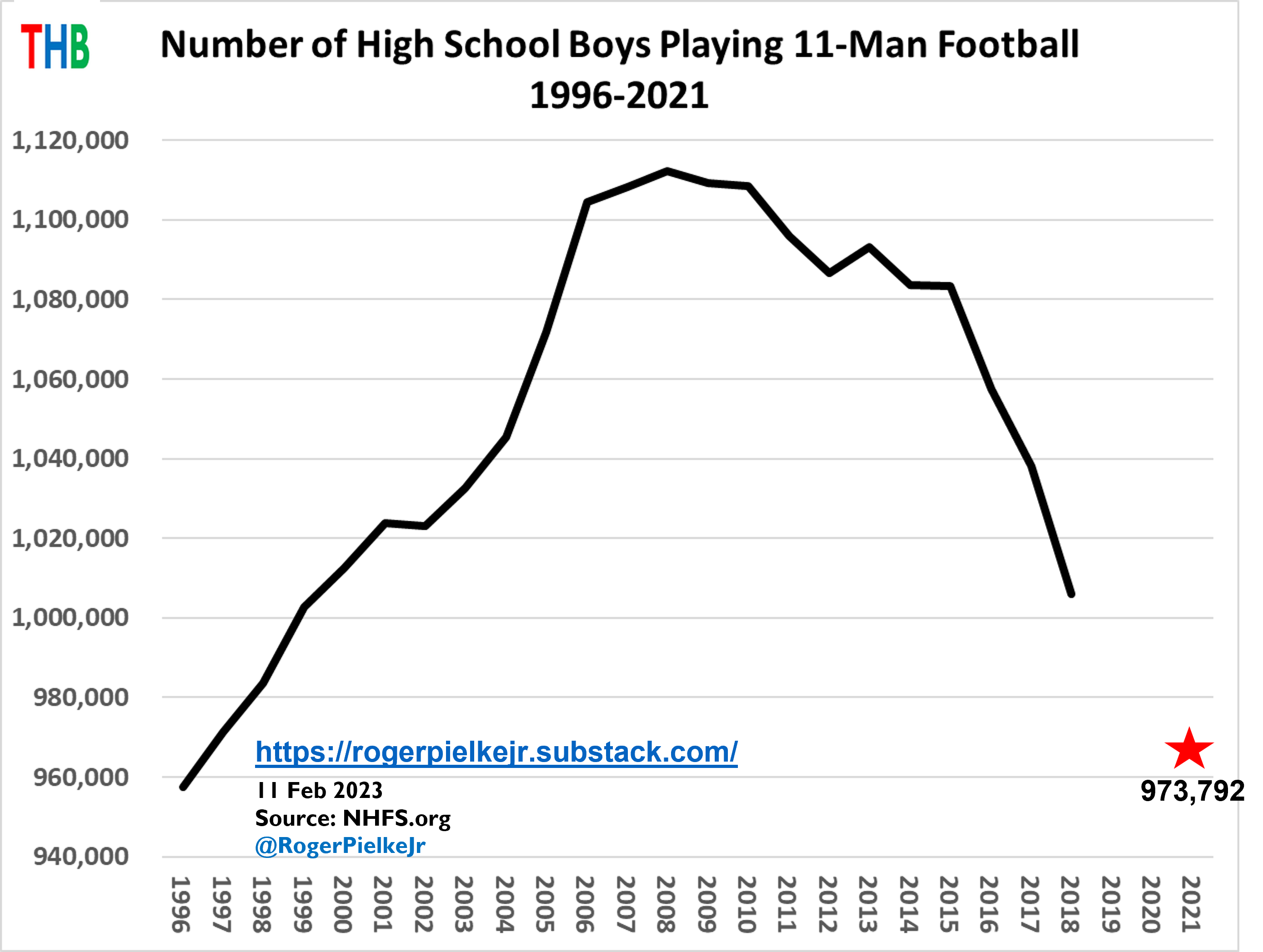
Anyway, in actual response to this though, here are two articles from the same website (NHFS.org). This first one is in direct response to the data that was used to generate graph above: https://nfhs.org/stories/high-school-football-is-thriving-not-dying.
What's interesting, is that the graph above ends at 2018. This article, also form NFHS.org has a follow up to that data with even more recent data. This article is from 2025: https://nfhs.org/stories/high-school-football-continues-to-rebound-from-pre-pandemic-decline.
The best is this last line: "While some college conferences continue to schedule games on Friday nights, it is clear that high school football remains the lifeblood of communities on this special night during the fall." remember, this is from this past September. Not some article 20 years ago.

OrangeBlue98
Iowa is not in a great spot right now (LvilleILL1)
- Des Moines, IA
As someone who was neck deep in this environment for many years, the run of profit-making in youth sports is far more to blame for the issues in the youth sports landscape than some Friday night college games. I’m so glad my kids are now college-aged and I don’t have to deal with that racket anymore.I don't think anyone is saying Friday night college games are ruining everything, but the hyper money-extracting culture behind it.
Youth sports costs soar to $25K as private equity profits
The peak in football participation coincided with the emergence of research of CTE in football players. Dr. Bennet Omalu identified the first case in former Pittsburgh Steelers player Mike Webster in 2002. Subsequent research by Boston University, particularly by Dr. Ann McKee starting around 2008, confirmed CTE in dozens, and eventually hundreds, of retired football players, including college and high school athletes. In 2016 the NFL's top health and safety officer acknowledged Monday there is a link between football-related head trauma and chronic traumatic encephalopathy. A 2017 study found that 110 out of 111 former NFL players examined had CTE. A lot of Moms (the majority?) don't want their sons playing football anymore.
RabidDawgClassic

- Los Angeles, CA
The peak in football participation coincided with the emergence of research of CTE in football players. Dr. Bennet Omalu identified the first case in former Pittsburgh Steelers player Mike Webster in 2002. Subsequent research by Boston University, particularly by Dr. Ann McKee starting around 2008, confirmed CTE in dozens, and eventually hundreds, of retired football players, including college and high school athletes. In 2016 the NFL's top health and safety officer acknowledged Monday there is a link between football-related head trauma and chronic traumatic encephalopathy. A 2017 study found that 110 out of 111 former NFL players examined had CTE. A lot of Moms (the majority?) don't want their sons playing football anymore.
Not gonna lie… I’m glad I never played football (outside of flag football and an occasional game on the beach). I’m at the age right now, or maybe even beyond it, where CTE would be ravaging my brain. I complain enough about a stiff knee as it is.

My 3 boys started playing rec league basketball and little league starting about 2006, and Pop Warner football starting about 2007 or 2008. They liked football but not so much the other sports. Already back then, Pop Warner had banned helmet to helmet contact and helmet tackles (spearing). Running backs still got whacked in the head occasionally, but that was mostly on short yardage plays up the middle, and my kids weren't running backs. As parents, we were more concerned with knee, back or shoulder injuries, which our kids, thankfully, avoided. On the other hand, my kids' experience in football thru HS taught them discipline, teamwork, comeraderie, work ethic, and got them physically fit and strong like nothing else would have. I believe it helped train their bodies (fitness-wise) for the rest of their adult lives. So, if/when I have grandkids, I would strongly encourage them to play also, if that's what they want.The peak in football participation coincided with the emergence of research of CTE in football players. Dr. Bennet Omalu identified the first case in former Pittsburgh Steelers player Mike Webster in 2002. Subsequent research by Boston University, particularly by Dr. Ann McKee starting around 2008, confirmed CTE in dozens, and eventually hundreds, of retired football players, including college and high school athletes. In 2016 the NFL's top health and safety officer acknowledged Monday there is a link between football-related head trauma and chronic traumatic encephalopathy. A 2017 study found that 110 out of 111 former NFL players examined had CTE. A lot of Moms (the majority?) don't want their sons playing football anymore.

good for her .hopefully good for us
in the old days her job was called “Traveling Secretary “

Uh-oh, she's the director of our football ops? So she's really working for Northwestern, scUM, & Iowa??
Joel Goodson

- it's all ball bearings, nowadays
- Status
- Not open for further replies.