
Illinois 66, Oakland 54 Postgame

Status
Not open for further replies.
#151      
He's not quite saying that, haha, but this is the actual argument he's making:

Sometimes adding a 3rd variable, while a worse individual option in a bubble, results in the first 2 options becoming more successful simply through it's introduction that it's actually better overall.

Imagine Illinois only shoots latups or threes and the shoot them at the following clips:

Layups (40%of shots): 57% shooting
Threes (60% of shots): 36% shooting

So overall, you expect 2pts*.57*.4×3pts*.36*.6.= 1.10pts per shot on average.

Now let's introduce those inefficient midrange shots at say a 48% shooting percentage. You seldom do it, only 10% of the time, but in doing so your opponents are forced to defend it and , and as such your 3pt and layup shooters are getting more space and better looks so now you're hitting layups at 61% instead of 57% and threes at 40% instead of 36%. Your shooting now looks like this:

Layups (37% of shots): 61%
Midrange (10% of shots): 48%
Threes (53% of shots): 40%

So now you'd expect 2pts*.61*.37+2pts*.48*.1+3pts*.4*.53= 1.18pts per shot on average

Again, these are fake numbers, but sometimes adding something that by itself is less efficient actually increases overall efficiency by making your other parts more efficient than they previously were.

If I could give a real world example of this, it'd be something like spending time writing and following detailed work instructions for an assembly installation. It's inefficient writing them as it costs time, however, it allows your workers to complete the overall job faster with less mistakes and rework such that it more than makes up for the time spent creating these instructions. Hope that explains things a bit better.

The hole in this though is that I don't think you're going to get teams selling out to stop a midrange shot to the extent they are going to give you open layups and threes. If a team starts mixing in midrange jumpers, the reaction to that is not to change your defense to stop it, and then start letting them have more open looks from 2 feet or the three point line, but rather, the reaction would be to just let them have those shots.
 
#153      
So on 2...sounds like you are missing Terrence Shannon (elite at rushing ball...)
Of course, but we don't have him. I am just talking about not casually walking the ball up the court, or looking for the outlet pass. This is a good passing team. Last year they had to make one pass to TJ and that was 2 points. This year they might need an old fashioned fast break, but when you don't try, you don't get the fast break points. This was especially so with a team like Oakland. If we are slow, we let them set up their defense. Our advantage was in space.
 
#154      
The hole in this though is that I don't think you're going to get teams selling out to stop a midrange shot to the extent they are going to give you open layups and threes. If a team starts mixing in midrange jumpers, the reaction to that is not to change your defense to stop it, and then start letting them have more open looks from 2 feet or the three point line, but rather, the reaction would be to just let them have those shots.
My example wasn't actually recommending anything, it was just trying to be helpful in creating a practical example to explain what the other user was saying mathematically. Because the idea of including something worse so that things improve overall isn't the most intuitive thing for people not all that familiar with probabilities.

In reality it depends on the quality of shot you're getting. Right now we're getting very good looks, so hard to complain about the shot chart in my opinion. If we were taking heavily contested threes at a 60% clip, I'd have concerns. Because while open threes are an extremely efficient shot, contested threes that you hit on average less than 30% of the time are not. Point is, it's both. You want a highly efficient shot chart with high quality attempts. We've gotten both thus far and if we keep it up the entire season, our offensive efficiency numbers will be ridiculously high.
 
#155      
He's not quite saying that, haha, but this is the actual argument he's making:

Sometimes adding a 3rd variable, while a worse individual option in a bubble, results in the first 2 options becoming more successful simply through it's introduction that it's actually better overall.

Imagine Illinois only shoots latups or threes and the shoot them at the following clips:

Layups (40%of shots): 57% shooting
Threes (60% of shots): 36% shooting

So overall, you expect 2pts*.57*.4×3pts*.36*.6.= 1.10pts per shot on average.

Now let's introduce those inefficient midrange shots at say a 48% shooting percentage. You seldom do it, only 10% of the time, but in doing so your opponents are forced to defend it and , and as such your 3pt and layup shooters are getting more space and better looks so now you're hitting layups at 61% instead of 57% and threes at 40% instead of 36%. Your shooting now looks like this:

Layups (37% of shots): 61%
Midrange (10% of shots): 48%
Threes (53% of shots): 40%

So now you'd expect 2pts*.61*.37+2pts*.48*.1+3pts*.4*.53= 1.18pts per shot on average

Again, these are fake numbers, but sometimes adding something that by itself is less efficient actually increases overall efficiency by making your other parts more efficient than they previously were.

If I could give a real world example of this, it'd be something like spending time writing and following detailed work instructions for an assembly installation. It's inefficient writing them as it costs time, however, it allows your workers to complete the overall job faster with less mistakes and rework such that it more than makes up for the time spent creating these instructions. Hope that explains things a bit better.
Excellent argumentation.

I wonder, too, if the mid-range shot becomes relatively more valuable during crunch time, when a defense goes absolutely all out to defend both the rim and the 3-point line. In the NBA, in crunch time, it is interesting to see how many mid-range, tough, tough shots are taken by guys like Jamal Murray or Jalen Brunson.
 
#156      
Only counterpoint I'd make is to the first sentence/statement.

We scored all of our points either in the paint, from the free throw line or from the three point line. I don't recall even one mid-range jump shot from an Illinois player in this game.
In the analytics I've seen, it's at the hoop or 3 pointer. Everything in between is mid-range in the paint or not. Granted there is some debate at the fringes..say 4 ft away.

From that perspective most of Tomi's points came in the mid-range.
 
#157      
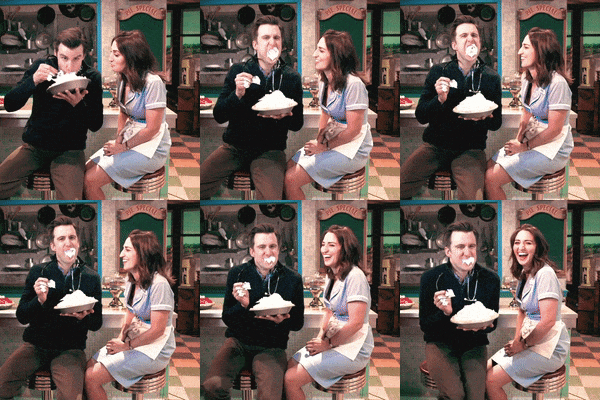
Love coach. One of the Loyalty Insiders should try and get someone to hand him some cottage cheese during media! :ROFLMAO: :sneaky:
Not sure i would want to watch Brad chomping down on cottage cheese like he did the popcorn
Baking Whipped Cream GIF by Waitress The Musical
 
#158      
Domask took a ton of midrange shots last year in the booty ball game. It can work. You just have to have the right guys doing it.

Ivisic taking them against Oakland to break the zone definitely was ok.
 
#159      
In the analytics I've seen, it's at the hoop or 3 pointer. Everything in between is mid-range in the paint or not. Granted there is some debate at the fringes..say 4 ft away.

From that perspective most of Tomi's points came in the mid-range.

Not sure the point you are making, but a 7-foot-1 guy flinging the ball at the basket from 6 to 8 feet away directly in front of the rim does not = mid range jump shot to me.
 
Last edited:
#161      
Not sure the point you are making, but a 7-foot-1 guy flinging the ball at the basket from 6 to 8 feet away directly in front of the rim does not = mid range jump shot to me.
Not sure if im correct but if its in the paint I dont consider it midrange.
 
#162      
I wonder if other sports boards have discussions like this. That’s not a dig; rather, it’s a compliment. I can’t imagine Missouri having this discussion. Or what we saw from the Kansas sports board after the football game. Maybe M.I.T. if they have sports or a sports board
 
Last edited:
#163      
You keep getting hung up on mid-range jump shot. Thats NOT the definition of mid-range with analytics.

I'm not speaking in analytic technicalities, I'm being pragmatic.

There is a huge difference in Tomi's little 6 foot push/fling and an 18 foot jump shot.
 
#166      
I'm not speaking in analytic technicalities, I'm being pragmatic.

There is a huge difference in Tomi's little 6 foot push/fling and an 18 foot jump shot.
I think the broadcast even showed a graphic of points in the paint and it wasn’t counting Tomi’s shots as “in the paint”. I personally would call most of his as in the paint, but 🤷‍♂️
 
#167      
I think the broadcast even showed a graphic of points in the paint and it wasn’t counting Tomi’s shots as “in the paint”. I personally would call most of his as in the paint, but 🤷‍♂️

Yep then that graphic would be wrong lol he was not outside the painted area on any of those attempts
 
#168      
Of course, but we don't have him. I am just talking about not casually walking the ball up the court, or looking for the outlet pass. This is a good passing team. Last year they had to make one pass to TJ and that was 2 points. This year they might need an old fashioned fast break, but when you don't try, you don't get the fast break points. This was especially so with a team like Oakland. If we are slow, we let them set up their defense. Our advantage was in space.
Yes...I hear you....I too would like to see us pick up pace.

Also would love to have a driver who can at least attempt to emulate TSJ on going to basket. Agree that Riley may become that guy...need that driving prowess sooner than later.
 
#169      
Yes...I hear you....I too would like to see us pick up pace.

Also would love to have a driver who can at least attempt to emulate TSJ on going to basket. Agree that Riley may become that guy...need that driving prowess sooner than later.
Me too....but I am not sure Riley can finish after hard contact. Not likely a role anyone on this team can do consistently. White may have the physical skills, but it just is not anything he looks to do or can do.

There is a reason no other player in Illini history, or any team's history for that matter, has driven the ball through every defense and finished like TSJr. If it was easy, everyone would do it.
 
#171      
Of course, but we don't have him. I am just talking about not casually walking the ball up the court, or looking for the outlet pass. This is a good passing team. Last year they had to make one pass to TJ and that was 2 points. This year they might need an old fashioned fast break, but when you don't try, you don't get the fast break points. This was especially so with a team like Oakland. If we are slow, we let them set up their defense. Our advantage was in space.
As EyeoftheIllini pointed out, the Illini had 13 fast break points against Oakland this year vs. only 6 last year. The Illini pushed the pace 10 times against Oakland (including breakaway steals) and scored 5 times. Oakland was getting back very well the other two thirds of the time, but this year's team is pushing the tempo when they get the chance and they are getting good looks as a result.
 
#172      
In general, your points make sense. But when you put them in the context of last year’s game against Oakland — some, not so much. Last year we out rebounded Oakland 36 to 32; this year 37 to 27. This year as you point out, we had 13 fast break points. Last year with TSJ pushing “the ball up the court every opportunity,” we had 6. Bottom line we beat them by 11 last year with Gohlke (only had 6 points in 37 minutes) and by 12 this year. Some opponent’s playing style impacts a game more than others.
Last year's Oakland team was a lot better and not really because of Gohlke. Trey Townsend was a stud but they also lost Lampman, Conway, and Watts.
 
Status
Not open for further replies.
Back