Alabama has elite FT defense.It’s a rather ridiculous discussion overall. But Illinois played 3 days after the Alabama game.
Are you of the opinion that practicing and “coaching free throws” over the course of 3 days is what led to a dramatic improvement? (Even though it was merely just a small sample size)
If so, and shooting is that easy to fix, then every basketball team ever would never miss a shot. This is nonsensical


You are using an out of date browser. It may not display this or other websites correctly.
You should upgrade or use an alternative browser.
You should upgrade or use an alternative browser.
Illinois 73, Penn State 65 Postgame
- Status
- Not open for further replies.

I disagree. Andrej is physically strong and simultaneously fluid. He has -- as you wrote -- elite body control. His ability to shoot off-balance shots -- as you favorably noted -- arises from an uncanny hand-eye coordination. All of those physical traits sum up in to show that Andrej is, I would argue, an elite, elite athlete.
Is he at the ceiling of athletic incredibleness? Is his explosiveness like, say, Dominique Wilkins? Are his shooting mechanics and mental focus like those of the greatest 3-point shooters. Nope, nope and nope. And yet he is an elite athlete, in my judgement.
He could DEFINITELY be an excellent defender in the B1G. No doubt in my mind.
Is he at the ceiling of athletic incredibleness? Is his explosiveness like, say, Dominique Wilkins? Are his shooting mechanics and mental focus like those of the greatest 3-point shooters. Nope, nope and nope. And yet he is an elite athlete, in my judgement.
He could DEFINITELY be an excellent defender in the B1G. No doubt in my mind.

Just wanted to point out for all the doomsayer posts in this thread for a 8pt BIG road win.... Penn State was literally one shot away from beating Michigan without their best player.
Last edited:

This is a very interesting comment. And it shows that different philosophies can have merit. I wish I had the time to really break down my response.But this is exactly what the scheme is designed to protect against. If you have an off shooting night, you give yourself a chance to survive when you rebound 40% of your misses. It’s one of those super obvious things that I’m puzzled how people see the opposite.
But for now: It’s clear that Brad loves the 3, and loves to shoot quick in the shot clock. And as you said we prioritize hitting the glass to get offensive rebounds.
As I’ve said before, it’s a high risk/high reward offense. It can lead to lofty numbers over a season and in specific games, but what about the games where you don’t get your desired number of offensive boards? Or a game where you shoot so badly from 3, it just doesn’t matter? (we’ve seen it before). And can this philosophy be successful over a 6 game stretch in the tournament?
I’m puzzled why we don’t run some hi lo or some old Bo Ryan stuff with the personnel we have. These guys would be perfect for it. Talk about high percentage shots. (If you make the shot, you don’t have to worry about a 40% change if getting an offensive rebound.

This is a very interesting comment. And it shows that different philosophies can have merit. I wish I had the time to really break down my response.
But for now: It’s clear that Brad loves the 3, and loves to shoot quick in the shot clock. And as you said we prioritize hitting the glass to get offensive rebounds.
As I’ve said before, it’s a high risk/high reward offense. It can lead to lofty numbers over a season and in specific games, but what about the games where you don’t get your desired number of offensive boards? Or a game where you shoot so badly from 3, it just doesn’t matter? (we’ve seen it before). And can this philosophy be successful over a 6 game stretch in the tournament?
I’m puzzled why we don’t run some hi lo or some old Bo Ryan stuff with the personnel we have. These guys would be perfect for it. Talk about high percentage shots. (If you make the shot, you don’t have to worry about a 40% change if getting an offensive rebound.
We actually do run a lot of high-low actions, though its obviously set within a broader, more modern offensive system rather than an exclusive staple. Those particular actions may look a little different than what people saw 10, 20, 30+ years ago because of that. Even in this short video of only a handful of offensive plays, you certainly see a few high-low actions.
As far as winning 6 games in a row in March --> April, only one team per season does this. Feel it is important to note that. So, no offensive system is infallible, and no matter what a team runs its fans will always have ideas (many times very good ones!) of how to improve or expand it.
Not much. But this year we have run more than the past IMO. We ran some of the stuff I was talking about in the second half of the Alabama game, so that was encouraging.We actually do run a lot of high-low actions, though its obviously set within a broader, more modern offensive system rather than an exclusive staple. Those particular actions may look a little different than what people saw 10, 20, 30+ years ago because of that. Even in this short video of only a handful of offensive plays, you certainly see a few high-low actions.
As far as winning 6 games in a row in March --> April, only one team per season does this. Feel it is important to note that. So, no offensive system is infallible, and no matter what a team runs its fans will always have ideas (many times very good ones!) of how to improve or expand it.
Another thing with the “high risk/high reward” aspect of our offense is that when you miss long shots, you often give up run outs to the other team and they end up with a great shot. I know we strategize to prevent that, but still.
It was infuriating to me in previous years when we would keep shooting quick jump shots when we had the lead in the final 6-8 minutes of a game. Missing those and giving the other team more possessions with good shots is the best way to let a team back in a game. They mostly fixed that at some point in the B1G season last year.
So I have seen some adjustments.
And of course no system is infallible. My biggest concern in previous years was our coach’s stubbornness or inability to make a change in game. I’ve seen some attempts at improvement.
Best approach is probably what underwood tries to do generally, but know when to slow it down for a real high percentage shot or adapt a little more and more often use the personnel he has in a more conservative way.
Just IMHO
@NarrowJ oh and I watched the video you shared. The play at the 2:00 mark is what I would consider a hi lo that we should use more often. That’s the only play in the video that would reflect what I’m taking about. Figure out how to get a pass into the post. We don’t prioritize getting the ball in the post anyway.
The other stuff in the video are backcuts, at least one pass to the pinch post.
The other stuff in the video are backcuts, at least one pass to the pinch post.
Not much. But this year we have run more than the past IMO. We ran some of the stuff I was talking about in the second half of the Alabama game, so that was encouraging.
Another thing with the “high risk/high reward” aspect of our offense is that when you miss long shots, you often give up run outs to the other team and they end up with a great shot. I know we strategize to prevent that, but still.
It was infuriating to me in previous years when we would keep shooting quick jump shots when we had the lead in the final 6-8 minutes of a game. Missing those and giving the other team more possessions with good shots is the best way to let a team back in a game. They mostly fixed that at some point in the B1G season last year.
So I have seen some adjustments.
And of course no system is infallible. My biggest concern in previous years was our coach’s stubbornness or inability to make a change in game. I’ve seen some attempts at improvement.
Best approach is probably what underwood tries to do generally, but know when to slow it down for a real high percentage shot or adapt a little more and more often use the personnel he has in a more conservative way.
Just IMHO
The "high risk/high reward" thing is a misconception and ties into what I said earlier about the whole philosophy where when the shots are not falling your designed scheme gets 40% of those possessions back for your offense. We shoot 29 threes per game which is not many more than your average D1 team, and when you have 5 guys on the floor at all times that can shoot the 3, you're probably going to shoot more of them than teams that have 3 guys on the floor that can shoot them.
I do agree with concerns about some of the stubbornness. Look at the approach in the E8 game vs UConn. Decent game plan to go at Clingan and try to get him in foul trouble, but you can't continue to do that over and over when its clear that the officials are not going to call the game in a way that makes that an advantage. There are many other instances of this as well. It's a constructive criticism that, over the years with Underwood, I completely agree with.
@NarrowJ oh and I watched the video you shared. The play at the 2:00 mark is what I would consider a hi lo that we should use more often. That’s the only play in the video that would reflect what I’m taking about. Figure out how to get a pass into the post. We don’t prioritize getting the ball in the post anyway.
The other stuff in the video are backcuts, at least one pass to the pinch post.
Then you missed at least 3 or 4 other high-low plays in the video. As I was saying, it looks different than what a lot of folks are used to because it is set within a broader, more modern scheme. It just doesn't look like the stuff we saw back in 2001 or 2013, etc anymore.
Last edited:
We just disagree on some fundamental things. Like what’s a “hi lo” play I guess. 
And what you call a misconception on the high risk high reward. IMHO there’s little doubt we run a high risk/high reward offense bc of the tempo and types of shots we take. You can disagree. But the initial comment of yours that I responded to and quoted was you saying we scheme to get offensive rebounds to protect against an off shooting night. Therefore we are scheming specifically to mitigate the risk our high risk high reward offense present. It’s def a thing.
It’s ok. I’ve enjoyed the discussion. there’s different philosophies. Brad has his. It’s not my favorite but can win. IMO it needs some aspects that I will called “safety nets” to win an NCAA championship. Maybe I’m wrong.
We shall see.
And what you call a misconception on the high risk high reward. IMHO there’s little doubt we run a high risk/high reward offense bc of the tempo and types of shots we take. You can disagree. But the initial comment of yours that I responded to and quoted was you saying we scheme to get offensive rebounds to protect against an off shooting night. Therefore we are scheming specifically to mitigate the risk our high risk high reward offense present. It’s def a thing.
It’s ok. I’ve enjoyed the discussion. there’s different philosophies. Brad has his. It’s not my favorite but can win. IMO it needs some aspects that I will called “safety nets” to win an NCAA championship. Maybe I’m wrong.
We shall see.

And he only wants quick shots if were in transition and its at the rim or open 3.....if not it's get to space in 7 seconds....The "high risk/high reward" thing is a misconception and ties into what I said earlier about the whole philosophy where when the shots are not falling your designed scheme gets 40% of those possessions back for your offense. We shoot 29 threes per game which is not many more than your average D1 team, and when you have 5 guys on the floor at all times that can shoot the 3, you're probably going to shoot more of them than teams that have 3 guys on the floor that can shoot them.
I do agree with concerns about some of the stubbornness. Look at the approach in the E8 game vs UConn. Decent game plan to go at Clingan and try to get him in foul trouble, but you can't continue to do that over and over when its clear that the officials are not going to call the game in a way that makes that an advantage. There are many other instances of this as well. It's a constructive criticism that, over the years with Underwood, I completely agree with.
Then you missed at least 3 or 4 other high-low plays in the video. As I was saying, it looks different than what a lot of folks are used to because it is set within a broader, more modern scheme. It just doesn't look like the stuff we saw back in 2001 or 2013, etc anymore.
Also we are arguing about the 3rd rated ORtg offense in the country.....which means we're getting really good looks...
Last edited:
We just disagree on some fundamental things. Like what’s a “hi lo” play I guess.
And what you call a misconception on the high risk high reward. IMHO there’s little doubt we run a high risk/high reward offense bc of the tempo and types of shots we take. You can disagree. But the initial comment of yours that I responded to and quoted was you saying we scheme to get offensive rebounds to protect against an off shooting night. Therefore we are scheming specifically to mitigate the risk our high risk high reward offense present. It’s def a thing.
It’s ok. I’ve enjoyed the discussion. there’s different philosophies. Brad has his. It’s not my favorite but can win. IMO it needs some aspects that I will called “safety nets” to win an NCAA championship. Maybe I’m wrong.
We shall see.
Exactly
You said it nearly better than I could/did. Risk is mitigated with the scheme (to get nearly half the possessions back when a shot is missed).The rebuttal to that is obviously, "well what happens when you miss shots AND don't get a ton of offensive rebounds" and then that discussion would inevitably end up where we're talking about not all offenses being infallible. If a team fails to achieve multiple main goals within it's offensive scheme, that team (likely) loses. This is something that happens with any scheme and not just isolated to what we do.
Don’t feel like this is an argument, rather a discussion.And he only wants quick shots if were in transition and its at the rim or open 3.....if not it's get to space in 7 seconds....
Also we are arguing about the 3rd rated ORtg offense in the country.....which means we're getting really good looks...
Don’t feel like this is an argument, rather a discussion.
yes this has played out way better than most discussions on here lately lol
I’m so old, I remember when discussion boards were actually used for discussions (some of the time).yes this has played out way better than most discussions on here lately lol
it's the 3rd ORtg offense with the 243rd-ranked tempo. We're not really running a high tempo offense right now.And he only wants quick shots if were in transition and its at the rim or open 3.....if not it's get to space in 7 seconds....
Also we are arguing about the 3rd rated ORtg offense in the country.....which means we're getting really good looks...
I think the "scoring in 7 seconds" thing has been mostly abandoned with Brad's focus on rebounding. He wants everyone crashing the glass, and you can't get out in transition if four guys are under the basket.

Wish Penn State would have won . They missed Mingo.
lstewart53x3

- Scottsdale, Arizona
You’re probably going to get some pushback when the discussion you want to have is criticizing the offense, when the offense is clearly the strength of this team.Don’t feel like this is an argument, rather a discussion.
It’s the #3 ranked offense in the country. You’ve mentioned they shoot too many 3’s, but they shoot just above average 3 point attempts for a D1 team. And we rebound 40% of our misses, so even if we miss a lot of them in a given game, the points per possession on those shots are still good.
You’ve also mentioned it’s a “high risk/high reward” offense. Which games this year would you say the risk has been higher than the reward? We haven’t played a single “bad” offensive game all year. The UConn game was our worst offensive performance of the year and the only game we lost because of offense, but even that game wasn’t that bad.
T-Rank has the UConn game with an AdjO of 109.3. Michigan St has 4 games on offense worse than that (107.8, 106.2, 107.2, 99.3). Michigan St. also has 6 offensive games worse than our 2nd worst and 9 offensive performance that are worse than our 3rd. And we have 6 offensive games that are better than their best.
There’s variance in our offensive in performance game over game, but I’m not sure there’s a single offensive system that doesn’t have variance.
Even Michigan who’s ranked just one spot below us in Torvik’s offensive efficiency and plays through their big men more, still has greater offensive variance than we do. They have 4 offensive performances that are worse than our worst.
Feel free to point out for us though which other games you feel the offense cost us a win:
Here’s Michigan St for context:
Last edited:
I went to my grandson's hs frosh game and for the first quarter and a half he was loafing. Late night prior. Anyway, I started calling him out a bit, yelling for him to move. He finally did and the next two possessions he hit 3s putting the team in the driver's seat for the win. The pont is that being active and engaged brings results.Shoutout Raphael Davis … Dude gets it !!!!!!!!!!!
Play harder !!!!!!!
lstewart53x3
- Scottsdale, Arizona
One other chart I’ll show going over variance / answering the question “is our offense high risk/high reward?”. From Torvik, this chart maps out our adjusted offensive efficiency game over game:
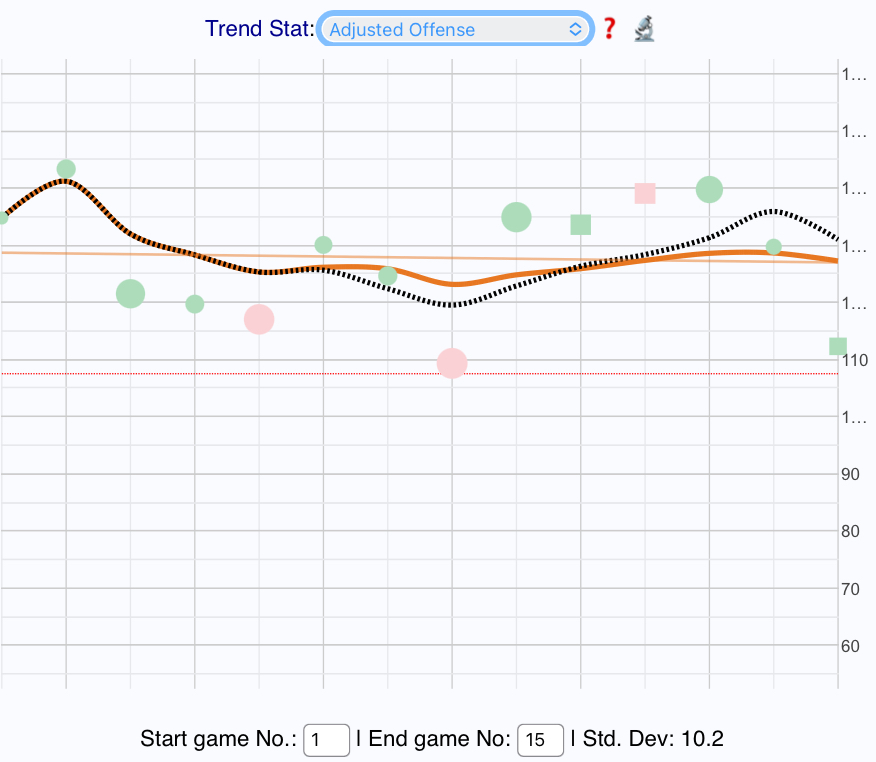
We have a standard deviation of 10.2.
Michigan, ranked just one spot lower in total offensive efficiency and plays through their big men more has a standard deviation of 14.1:
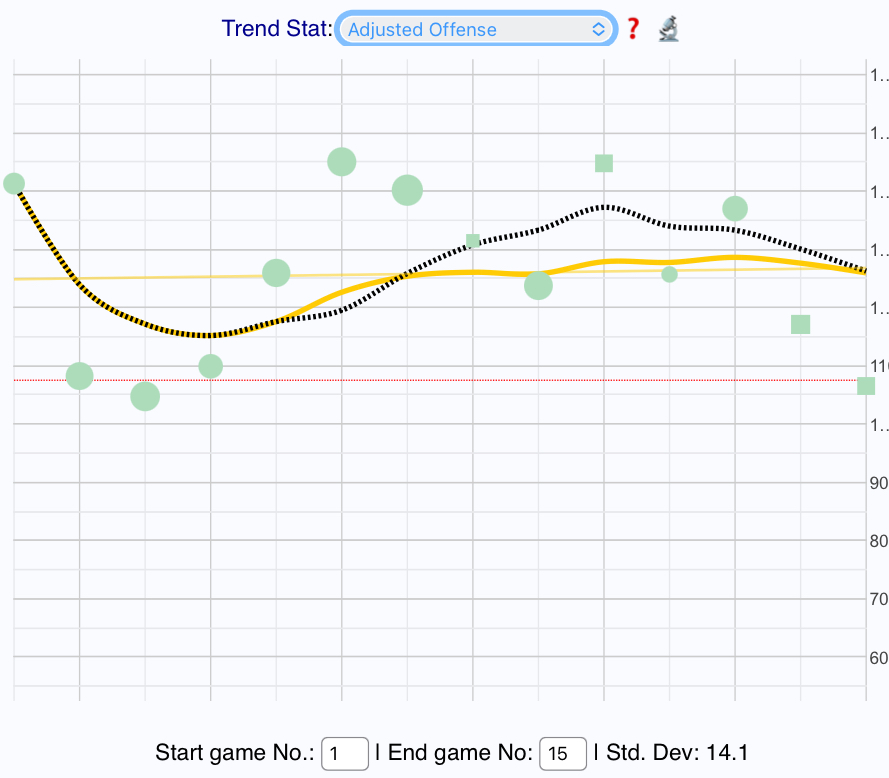
And I’m sure there are plenty of examples of solid offensive teams who have less variance game over game, but I wouldn’t describe our offense as “boom or bust”.
We have a standard deviation of 10.2.
Michigan, ranked just one spot lower in total offensive efficiency and plays through their big men more has a standard deviation of 14.1:
And I’m sure there are plenty of examples of solid offensive teams who have less variance game over game, but I wouldn’t describe our offense as “boom or bust”.
@lstewart53x3 Really good stuff… there’s been a narrative for a while that we shoot far too many 3s and it makes our offense high risk… what you’ve illustrated proves neither statement is true

I have no interest in dog piling and appreciate the decorum of this discussion....You’re probably going to get some pushback when the discussion you want to have is criticizing the offense, when the offense is clearly the strength of this team.
It’s the #3 ranked offense in the country. You’ve mentioned they shoot too many 3’s, but they shoot just above average 3 point attempts for a D1 team. And we rebound 40% of our misses, so even if we miss a lot of them in a given game, the points per possession on those shots are still good.
But on the point of the ORtg Rank being 3rd, this is very statistically relevant for winning a championship, and could be the most statistically relevant stat for pinning the ribbon of "championship caliber".
Since 1997 (past 28 seasons), every team that has won a championship has been top 10 for ORTG except for 2014 UConn, 2011 UConn, and 2003 Syracuse, and 1997 Zona. Further, 68% of Champions are in the Top 5 ORtg.
Defense is important but less statistically relevant. Over the past 28 seasons, only 60% have defenses greater than top 10. Further, in the past 11 seasons, only 5 have been better than top 10, with the average DRtg being 10. It seems like all the pieces are there for our defense to creep into the top 15/10 range, and if our ORtg held, this would put us firmly as a top 5 team.
I want to be careful of being the "if you look over the past 25 years, there has never been a championship team that wore glasses more than twice" kind of guy, but the data shows a pretty direct shot at being a contender. This year's team has a high percentage of shots being from three (we're ranked 93rd in the nation currently) but this team has way more tools to adjust for bad shooting nights compared to teams of the past. I can see why it's frustrating after games we lost last year (and in the 2023 season) dying at the 3-point line, but this year's team seems to have way more chemistry and ability than either of the aforementioned.
Battle89

- Cary-Grove, the better Trojan team
Is his name Demetri?I went to my grandson's hs frosh game and for the first quarter and a half he was loafing. Late night prior. Anyway, I started calling him out a bit, yelling for him to move. He finally did and the next two possessions he hit 3s putting the team in the driver's seat for the win. The point is that being active and engaged brings results.
Didn't see this posted in this thread and people were curious about it:
Joey Wagner in his 247 article from today said that Ty didn't travel to the PSU game because he was sick with the flu.
Sure hope nobody else on the team gets it, obviously.
Edit: Dan confirmed in the Rutgers thread
Joey Wagner in his 247 article from today said that Ty didn't travel to the PSU game because he was sick with the flu.
Sure hope nobody else on the team gets it, obviously.
Edit: Dan confirmed in the Rutgers thread
Last edited:
- Status
- Not open for further replies.