What about Landon?Coleman. Zens. Lucas Morillo, Ethan Brown


You are using an out of date browser. It may not display this or other websites correctly.
You should upgrade or use an alternative browser.
You should upgrade or use an alternative browser.
Illinois Hoops Recruiting Thread
- Status
- Not open for further replies.
Sure hope QC's 3pt% is north of 0.34.His offensive stats don't tell the full story, his defensive impact was huge.
QC will be more efficient and get more assists, but it remains to be seen what his overall impact will be and his volume may be more limited with the other mouths to feed.

In the NIL age, that's just so far from the forgone conclusion people think it is.In regard to ZZ, the Illini will, in all probability, lose the Ivisic brothers, Mirk, and, of course, AS. ZZ will be practicing against players on a top 5 team, and he may be playing some minutes in Big Ten games, so he will get good experience. If he shows promise and plays well against those guys, maybe the staff will sell him on being able to fill in for one of the departing players (although, I admit, at 6’7”, maybe not the Ivisics).
The 5 for 5 wouldn't apply to the Ivisic twins, so they're gone.
Between Mirk and AS, very much a possibility one comes back.
If we're being honest, Mirkovic is basically the perfect candidate to make 20 million playing 4-5 years of CBB. His athletic limitations will hinder his NBA potential (in contrast to a guy like Morez), but could be the NPOY someday if he stays the course.
Last edited:
Thank you. Zens at 104 nationally? Wasn't he Wisconsin Mr. Basketball? And Brown 202? Isn't he better than that? Wasn't he Missouri's POY? If Landon Davis isn't better than this, he won't get many minutes on such a loaded roster.
@Indy Illini Fan just curious, where do you think momcilovic goes?
Are you saying he can't guard anyone? Mirk also looked slow 9 months ago.Zens is a bit slow with my eye test. Don't know if he can guard 4 but doubt he can guard 3.
I think he might be able to guard some 4s and maybe slower 3s. Just don't want to put him on fast playersAre you saying he can't guard anyone? Mirk also looked slow 9 months ago.
That's why is is a "Combo Forward." A lot depends on who the opponent's 3 and 4 are. But he's very versatile on offense and that can put pressure on the opponents's defense.I think he might be able to guard some 4s and maybe slower 3s. Just don't want to put him on fast players
Overall we weren't a very quick or athletic team last year, but we still managed to play good defense.

The “nomadic era” of college basketball. It’s a new term I’m trying out.the paradigm is that all current players will be recruited over. sink or swim
promising players who don't play much their first year (e.g. Lee) are going to weigh the risk of not breaking into the rotation, and, more often than not, bolt to a program that affords much more tick

@Indy Illini Fan just curious, where do you think momcilovic goes?
Think that one is going to come down to Arizona and Kentucky ... And Mark Pope has proven he can't get the job done, so probably Arizona ...

Brady Pettigrew, Bolingbrook , Combo Guard
Brady Pettigrew is a Combo Guard from Bolingbrook, IL.
 247sports.com
Do you think he re-classes to '27?Brady Pettigrew, Bolingbrook , Combo Guard
Brady Pettigrew is a Combo Guard from Bolingbrook, IL.
Do you think he re-classes to '27?
Think it's a real possibility ...
skyIdub

"I can't tell you. Secret."
Respectfully to Adam, Coleman is a much better prospect.
The fact that this has to be said out loud is just part of the charm here.


I agree with this. I can see Mirk with a very similar career path as a Luka Garza. He was a phenomenal college player(NPOY I believe), but the bricks in his shoes have really kept him at the end of an NBA bench. He did get some tick for Boston given their disastrous level of injuries and he will have plenty of tenure. He's stuck around.In the NIL age, that's just so far from the forgone conclusion people think it is.
The 5 for 5 wouldn't apply to the Ivisic twins, so they're gone.
Between Mirk and AS, very much a possibility one comes back.
If we're being honest, Mirkovic is basically the perfect candidate to make 20 million playing 4-5 years of CBB. His athletic limitations will hinder his NBA potential (in contrast to a guy like Morez), but could be the NPOY someday if he stays the course.
If Mirk goes pro, it'll be overseas. If he stays in school, he's going to make a boatload of money and he'll be a target of all blue bloods every off-season.
I think he is slower than Jake Davis, just put it that way. Not sure who is the taller, bigger player.That's why is is a "Combo Forward." A lot depends on who the opponent's 3 and 4 are. But he's very versatile on offense and that can put pressure on the opponents's defense.
Overall we weren't a very quick or athletic team last year, but we still managed to play good defense.

Hell yea. Illinois has the perfect sell to guys like this to be featured in a good offense and get to the league.Brady Pettigrew, Bolingbrook , Combo Guard
Brady Pettigrew is a Combo Guard from Bolingbrook, IL.
This is where Constanza and Coleman were ranked on December 14, 2025:
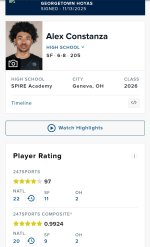
…..
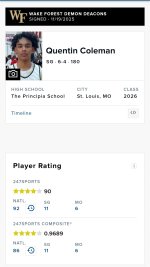
This is where they’re ranked now:
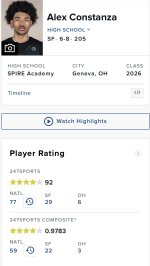
…..
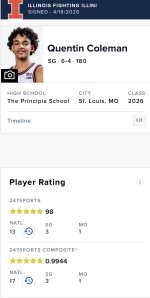
…..
This is where they’re ranked now:
…..

KentuckyThink that one is going to come down to Arizona and Kentucky ... And Mark Pope has proven he can't get the job done, so probably Arizona ...

Not our typical positional size play.

Cayden Daughtry, Calvary Christian Academy , Point Guard
Cayden Daughtry is a Point Guard from Boynton Beach, FL.
247sports.com
Kentucky
Odd considering he said he wanted to play for a contender
Pettigrew is definitely a take for the 27 class unless the 5 for 5 passes. Illinois could return a lot of pieces for the 27-28 season but Underwood won't make the same mistake he did with Fears. I think Pettigrew is more talented and athletic than Fears. Underwood has recruited and signed 6 players that have been or will be drafted in the first round the last 3 years. Yes, I'm including Morez and Podesimski so unlike previous Final Four runs Illinois will not fall of in recruiting especially with Orlando and Alexander.
- Status
- Not open for further replies.