Tennessee's Ziegler sues for 5th year of eligibility

Status
Not open for further replies.
#1      

Illini in Italy

Illini HQ, Florida Panhandle
Tennessee's Ziegler sues for 5th year of eligibility

I'm not going to trot out the "I told you so's", but 'twas foretold

Link

1747830438098.png


1747830878988.png
IMG_1556.jpeg
1747831705019.png


1747831951195.png
 
#3      
NCAA has already been considering doing away with redshirts altogether and just giving everyone 5 years. It's possible the NCAA defers this fight for now and down the line when someone sues for a 6th year, that's when the battle happens.

I think if the NCAA were to fight it, this is the one they'd be in a better position to actually win. The NCAA does have the authority to set eligibility rules. This has been upheld recently, even with regards to the 5 year rule:


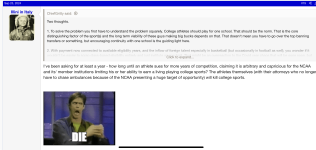
And just on your last post that you screenshotted where you say the consideration of athletes as "employees and not students" would allow them to play 10+ year college careers, I don't think that's accurate. There are plenty of employee positions within a university where being a student is a requirement of employment. The examples that come readily to mind are Resident Assistant (RA) and Teacher's Assistant (TA). Both are almost always students, and especially for RAs, I think being a student is typically a requirement of the job. I don't think as a 40 year old man I could get a job as an RA at FAR, no matter how stellar my qualifications. Whether players are considered employees or not is a separate question from whether there can be limits to their eligibility.
 
#5      
The NCAA should go back to basics. 4 years to play 4, undergrads only, max age of 23. Get rid of the carve outs for injury, redshirt, etc. Mirror the default high school model as close as you can. It is as ridiculous to sue for an extra year of high school eligibility as to sue for more time as an undergrad.
 
#6      
It will be interesting how this lawsuit ends up, I would think the argument that Ziegler had the opportunity to redshirt any year he wanted to and didn't would be a good argument. The rules are fair to everyone in the "voluntary redshirt" rule. I doubt any ruling is done before the season, I'm sure his team is just looking for an injunction so he can play before an actual ruling comes down in the case. So, it would accomplish their objective, I doubt his lawyers think he can actually win the case.
 
#7      
It will be interesting how this lawsuit ends up, I would think the argument that Ziegler had the opportunity to redshirt any year he wanted to and didn't would be a good argument. The rules are fair to everyone in the "voluntary redshirt" rule. I doubt any ruling is done before the season, I'm sure his team is just looking for an injunction so he can play before an actual ruling comes down in the case. So, it would accomplish their objective, I doubt his lawyers think he can actually win the case.
if an injunction is granted, what is stopping us from hitting up CH for one more go around?
 
#9      
I'm so tired of these guys getting 5 years to play. Go on with your life. Rather you play 4, 5 or 6 years your draft status won't change. I was against players getting an extra year because of covid because most players still played 25 -31 games during that season.
 
#10      
The NCAA should go back to basics. 4 years to play 4, undergrads only, max age of 23. Get rid of the carve outs for injury, redshirt, etc. Mirror the default high school model as close as you can. It is as ridiculous to sue for an extra year of high school eligibility as to sue for more time as an undergrad.
This has never been a thing. Never. This isn't going "back" to anything but creating new arbitrary rules that never previously existed.

And the high school example fails too. What if a kid was held back in 3rd grade, and thus a year older than his classmates? Does his HS career end as a junior, because he's aged out?
It will be interesting how this lawsuit ends up, I would think the argument that Ziegler had the opportunity to redshirt any year he wanted to and didn't would be a good argument. The rules are fair to everyone in the "voluntary redshirt" rule. I doubt any ruling is done before the season, I'm sure his team is just looking for an injunction so he can play before an actual ruling comes down in the case. So, it would accomplish their objective, I doubt his lawyers think he can actually win the case.

One of the elements you have to show to get an injunction is a "likelihood" of succeeding on the merits. That doesn't mean that you have to prove your case, you just have to make a showing that you have a good chance of winning. If his lawyers don't think he can win the case, by definition they should also not think they'll get an injunction.

if an injunction is granted, what is stopping us from hitting up CH for one more go around?
1. He's already played 5 due to the Covid year
2. He did not enter the transfer portal.
 
#11      
This has never been a thing. Never. This isn't going "back" to anything but creating new arbitrary rules that never previously existed.

And the high school example fails too. What if a kid was held back in 3rd grade, and thus a year older than his classmates? Does his HS career end as a junior, because he's aged out?


One of the elements you have to show to get an injunction is a "likelihood" of succeeding on the merits. That doesn't mean that you have to prove your case, you just have to make a showing that you have a good chance of winning. If his lawyers don't think he can win the case, by definition they should also not think they'll get an injunction.


1. He's already played 5 due to the Covid year
2. He did not enter the transfer portal.
I completely agree with your point for many reasons. You could have the military vet coming back to the States in his mid-20s for schooling and maybe wants to join college athletes, etc. The only real hard rule that I want to stay enforced forever is that the athletes must maintain enrollment in a university program.

If there was some weird age rule, we will just see fudged age numbers (which makes me go back and wonder how old some of the Dominican baseball players really are).
 
#13      
Tennessee's Ziegler sues for 5th year of eligibility

I'm not going to trot out the "I told you so's", but 'twas foretold

If you foretold the lawsuit, no surprise there. If you foretold him winning, that's quite a bit bolder. I actually think the NCAA has a leg to stand on now that they've got the issue down to eligibility. I googled for a legal analysis but didn't find anything about the merits and don't know enough to comment intelligently. Notice I said intelligently. Doesn't stop me!
 
#14      
And the high school example fails too. What if a kid was held back in 3rd grade, and thus a year older than his classmates? Does his HS career end as a junior, because he's aged out?
You become ineligible to play IHSA sports on the date you turn 20 years old. If you'll turn 20 years old during the sports season you're ineligible to start the season. So yes, if you're held back it is possible to age out.
I think situations like Chris Weinke winning the Heisman at 28 years old is silly for collegiate sports. And if you don't put some limit on this somewhere, you'll potentially have never ending undergrads which will block out the 18-22 year old cohort which this has customarily been about.
 
#15      
You become ineligible to play IHSA sports on the date you turn 20 years old. If you'll turn 20 years old during the sports season you're ineligible to start the season. So yes, if you're held back it is possible to age out.
I think situations like Chris Weinke winning the Heisman at 28 years old is silly for collegiate sports. And if you don't put some limit on this somewhere, you'll potentially have never ending undergrads which will block out the 18-22 year old cohort which this has customarily been about.
Do you have any evidence where older students are somehow blocking the younger students from being able to play? I think you are fishing to solve a problem (age-related) that really doesn't exist.

The Weinke example is also out of context in the argument you have made. He entered college at the age of 25 after his baseball career stalled. It wasn't like he was in college for 7 years before starting his college football career. If anything, your suggestion could actually open up potential lawsuits of age discrimination for people that enter college at an older age.
 
Last edited:
#16      
You become ineligible to play IHSA sports on the date you turn 20 years old. If you'll turn 20 years old during the sports season you're ineligible to start the season. So yes, if you're held back it is possible to age out.
I think situations like Chris Weinke winning the Heisman at 28 years old is silly for collegiate sports. And if you don't put some limit on this somewhere, you'll potentially have never ending undergrads which will block out the 18-22 year old cohort which this has customarily been about.
20 years old still gives basically 2 years of leeway to every kid. If you start school on time and don't get held back you won't even hit the age 19 before you graduate. And even within that rule, if you turn 20 during a sport season you still get to finish out the season.

And basically the reason for that rule is that by law in Illinois you can't attend High School once you hit the age of 21. So yeah, if you can't be a student, you can't play sports. There is a very small window in which a student could turn 20 before a sports season starts, but won't turn 21 until after the school year, where you could have someone age out of sports but not school.
 
Last edited:
#17      
And the high school example fails too. What if a kid was held back in 3rd grade, and thus a year older than his classmates? Does his HS career end as a junior, because he's aged out?
Why not, if the intention is to maintain boundaries of general age and physical size, for player safety (especially at the HS level).

I'd think this would be more enforceable at the HS level, where NIL is not (yet) a thing and the restriction of commerce argument is weaker, and the player safety (won't someone protect the children!!!) argument is stronger.

1747858000707.png
 
#18      
Why not, if the intention is to maintain boundaries of general age and physical size, for player safety (especially at the HS level).

I'd think this would be more enforceable at the HS level, where NIL is not (yet) a thing and the restriction of commerce argument is weaker, and the player safety (won't someone protect the children!!!) argument is stronger.

View attachment 42465
I agree, it would be more enforceable.

But I think my question is whether we would really want that. Should a kid who gets held back for academic reasons, and then gets himself back to the point where he is doing ok be ineligible to play sports because he got held back at a younger age (which if we're being honest usually means he didn't have the support at home, and is really the victim here)? To what end?

And on the "age and physical size, for player safety" piece, I don't even think age is the primary determinant of size by the time you're in HS. Certainly not to the degree that one additional year of age makes a huge safety difference. Otherwise you wouldn't let Juniors play with Seniors, or Sophomores play with Juniors, and so on. And if it's just a safety thing, then you'd have kids "size out" instead of "age out." "Sorry Sophomore Kofi, you're too big, you're going to have to sit out the next two years. Good thing AAU basketball exists"

 
Last edited:
#19      
I agree, it would be more enforceable.

But I think my question is whether we would really want that. Should a kid who gets held back for academic reasons, and then gets himself back to the point where he is doing ok be ineligible to play sports because he got held back at a younger age (which if we're being honest usually means he didn't have the support at home, and is really the victim here)? To what end?

And on the "age and physical size, for player safety" piece, I don't even think age is the primary determinant of size by the time you're in HS. Certainly not to the degree that one additional year of age makes a huge safety difference. Otherwise you wouldn't let Juniors play with Seniors, or Sophomores play with Juniors, and so on. And if it's just a safety thing, then you'd have kids "size out" instead of "age out." "Sorry Sophomore Kofi, you're too big, you're going to have to sit out the next two years. Good thing AAU basketball exists"

Starting out replies with friendly and reasonable statements like 'I agree' is not conducive to fight-picking. :ROFLMAO:

But yes, I don't think we're that far apart, just debating where to draw the line. Football is of course a dangerous sport in its own right, and every player must assume some personal risk in playing. I'm just not sure it's any fairer to line up that 19- or 20-year-old held back kid across from a much younger kid (I was 13 the fall of my freshman year and I'm sure would have been annihilated in such an encounter).

Edit: and no fair editing in a second paragraph while I'm replying to your original! :LOL:
 
#20      
Do you have any evidence where older students are somehow blocking the younger students from being able to play? I think you are fishing to solve a problem (age-related) that really doesn't exist.
If Ziegler loses his lawsuit, then I agree with you. If Ziegler wins his lawsuit, then I think it is clear that with roster spots and playing time being a zero sum game that 5th year players would limit the spots of younger players. If each grade level takes 20% vs 25% of spots that alone is a difference. If Ziegler can win, then the slippery slope is why not 6 years or 7 years or more. And at some point, if that happens, a bunch of players in their mid 20's or older doesn't seem to be in the spirit of what college sports has usually been, to me at least.
 
#21      
If a school is forced to provide a roster spot for a player such as Ziegler when the school is ready to move on, give him the final roster slot, $0 in NIL and 0 minutes playing time... And this practice will die a quick death.
 
#23      
If a school is forced to provide a roster spot for a player such as Ziegler when the school is ready to move on, give him the final roster slot, $0 in NIL and 0 minutes playing time... And this practice will die a quick death.

Being eligible is not the same as being forced to offer a scholarship or an amount of NIL, so I don't see how that would be an issue. If the rules say players can get unlimited years of eligibility, then coaches will continue to look for the best players, some of whom will be older. We've already seen that in the transfer portal.

I'm curious how the court rules. The landscape is in total chaos with no one really having final say other than the courts. A wide variety of legislators, conferences, athletes and agents, the NCAA, and somewhere in there fans, all have different agendas.
 
#24      
If Ziegler loses his lawsuit, then I agree with you. If Ziegler wins his lawsuit, then I think it is clear that with roster spots and playing time being a zero sum game that 5th year players would limit the spots of younger players. If each grade level takes 20% vs 25% of spots that alone is a difference. If Ziegler can win, then the slippery slope is why not 6 years or 7 years or more. And at some point, if that happens, a bunch of players in their mid 20's or older doesn't seem to be in the spirit of what college sports has usually been, to me at least.
I've been of this opinion a few years now, but I think once the 4 year eligibility is sufficiently legally challenged it will fall. I expect Ziegler to win the lawsuit and this runaway train of NCAA ball basically becoming a low pro league with no age or eligibility requirements other than they must be enrolled at the college to continue steadily downhill. NCAA has played fast and loose with the eligibility requirement for years now that I don't think they can prove they've applied that requirement consistently. I'd be surprised if it doesn't get struck down, personally.

And then on the horizon is the challenge of amateur vs pro definition due to the cloudy nature of how the NCAA is granting eligibility to international players who have played on pro international teams. Once that's challenged in court, that will fall too.
 
#25      
Wished Boswell could get a 5th year, as the landscape has changed rapidly. He was the youngest D1 player I believe at the time he started college.
 
Status
Not open for further replies.
Back