

You are using an out of date browser. It may not display this or other websites correctly.
You should upgrade or use an alternative browser.
You should upgrade or use an alternative browser.
Illinois Hoops Recruiting Thread
- Status
- Not open for further replies.


What a ride man! I never thought I'd see the day we'd beat an SEC team in an elite bowl game out South. I've been watching since '97. Fortunately, basketball has been a beast under coach and there is no looking back.I am now carrying over my excitement of Citrus Bowl win in to hopes for bball commits soon
The common denominator?What a ride man! I never thought I'd see the day we'd beat an SEC team in an elite bowl game out South. I've been watching since '97. Fortunately, basketball has been a beast under coach and there is no looking back.

Mikel Brown to Louisville
the snap of a few sparks, a quick whiff of ozone

New state law going into effect this new year.
Is this good or bad for us?New state law going into effect this new year.
IlliniKat91

- Chicago, IL
Good, I'd imagine. It lets us complete with schools in states who already allow this, and gives us an edge over schools in states who don'tIs this good or bad for us?
With the media exposure we’ve gotten this week in both programs, this is perfect timing and fantastic for us.Is this good or bad for us?

drsmitty74

- Rochester
I thought Missouri's law had something to do with high schoolers being able to recieve NIL once they commit. Maybe I am mis-remebering.Does this put us on part w Missouri state laws that allow this?

sacraig

- The desert
I'm not entirely opposed to this if only because many college degrees also take 5 years these days.
skyIdub

"I can't tell you. Secret."
I'm not entirely opposed to this if only because many college degrees also take 5 years these days.

Do you have a source? I just went looking for data on this and seemed to find the opposite. The time per undergrad seems pretty steady. The number of four year combined BS/MS degrees seems higher.I'm not entirely opposed to this if only because many college degrees also take 5 years these days.
UIUC:
4-year graduation rate: 72%, 5-years: (I could not find it), 6-years: 85%
So 80%+ of the students who are going to graduate do so in 4 years.
Looking at national studies:
65% of the students who go to college straight out of high school, or after a year gap, and are still considered dependents are graduating in 4 years. (Some take 5 years, many never graduate.)
The people taking 5+ years seem to be one or more of:
1) Older (24+), going back to school, and with other responsibilities. e.g. self-supporting.
2) Part time students
3) Taking a year or more off during their matriculation.
In the CA system: 5 years has become common due to the inability to get into all the classes needed for graduation. The schools decided that if everyone who takes 12+ hours pays full tuition, then the university gets the most money per student by accepting more students and having each student only able to take 12-14hrs at a time vs. 16-18hrs. Students pay 5 years of tuition for those same 4 years of classes. As a bonus, most of the "extra" students are out of state (out of country) students who pay the highest freight.
I don't think Gilfillan is reading this right. This is more like the Missouri law which allows high schoolers to get NIL. There's language in there that allows the university to cooperate in the arrangements.
I think the Missouri law wasn't necessary. If the NCAA can't bar students from receiving NIL there's no reason to believe that a similar restriction at the high school level would be legal. But this will clarify that it's fine so that will be nice.
I think the Missouri law wasn't necessary. If the NCAA can't bar students from receiving NIL there's no reason to believe that a similar restriction at the high school level would be legal. But this will clarify that it's fine so that will be nice.
IlliniKat91
- Chicago, IL
Wasn't the Missouri law just for local kids who committed to Missouri schools? I thought it was primarily meant to help keep talent in-state. I also thought that by couching it under NIL they were trying to prevent any arguments about them not being amateurs, which might have impacted their NCAA eligibility. But I could be mistakenI don't think Gilfillan is reading this right. This is more like the Missouri law which allows high schoolers to get NIL. There's language in there that allows the university to cooperate in the arrangements.
I think the Missouri law wasn't necessary. If the NCAA can't bar students from receiving NIL there's no reason to believe that a similar restriction at the high school level would be legal. But this will clarify that it's fine so that will be nice.
Do you have a source? I just went looking for data on this and seemed to find the opposite. The time per undergrad seems pretty steady. The number of four year combined BS/MS degrees seems higher.
UIUC:
4-year graduation rate: 72%, 5-years: (I could not find it), 6-years: 85%
So 80%+ of the students who are going to graduate do so in 4 years.
Looking at national studies:
65% of the students who go to college straight out of high school, or after a year gap, and are still considered dependents are graduating in 4 years. (Some take 5 years, many never graduate.)
The people taking 5+ years seem to be one or more of:
1) Older (24+), going back to school, and with other responsibilities. e.g. self-supporting.
2) Part time students
3) Taking a year or more off during their matriculation.
In the CA system: 5 years has become common due to the inability to get into all the classes needed for graduation. The schools decided that if everyone who takes 12+ hours pays full tuition, then the university gets the most money per student by accepting more students and having each student only able to take 12-14hrs at a time vs. 16-18hrs. Students pay 5 years of tuition for those same 4 years of classes. As a bonus, most of the "extra" students are out of state (out of country) students who pay the highest freight.
madillini4

Ozamataz Buckshank
- Millywaukee
This was my understanding as well.Wasn't the Missouri law just for local kids who committed to Missouri schools? I thought it was primarily meant to help keep talent in-state. I also thought that by couching it under NIL they were trying to prevent any arguments about them not being amateurs, which might have impacted their NCAA eligibility. But I could be mistaken
I don’t think this is good data though because it still counts all the people who just don’t finish. Of the people who do finish, I bet 80%+ graduate in 4 years
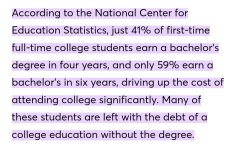
According to this only 44% of bachelor's degree recipients finish in 48 months or less.I don’t think this is good data though because it still counts all the people who just don’t finish. Of the people who do finish, I bet 80%+ graduate in 4 years
Fast Facts: Time to degree (569)
The NCES Fast Facts Tool provides quick answers to many education questions (National Center for Education Statistics). Get answers on Early Childhood Education, Elementary and Secondary Education and Higher Education here.
nces.ed.gov
For 23 and younger, the age range of most athletes, that rate is a bit higher at 65%. That still leaves a significant number taking 4.5, 5, or even more years.
Last edited:
- Status
- Not open for further replies.