Not just ISO offense. Effective ISO offense. It's great to have multiple shot creators.Lot of iso offense


You are using an out of date browser. It may not display this or other websites correctly.
You should upgrade or use an alternative browser.
You should upgrade or use an alternative browser.
Illini Basketball 2025-2026
- Status
- Not open for further replies.
Anyone know BU's record on the road in Big Ten play?Not just ISO offense. Effective ISO offense. It's great to have multiple shot creators.
First two years
From year three to present.
Underwood joined The Field of 68 to kick off the show for those interested.
2-16 first two years.Anyone know BU's record on the road in Big Ten play?
First two years
From year three to present.
36-27 since.
Thank you. Forgot those first two years. +9 is very good.2-16 first two years.
36-27 since.
foby

- Bonnaroo Land
"I'm gonna meet his #$% in the Pizza Hut parking lot."
Underwood joined The Field of 68 to kick off the show for those interested.
Bigtex

- DFW
Lot of iso offense in reference to lower number of assists by IllinoisNot just ISO offense. Effective ISO offense. It's great to have multiple shot creators.
RabidDawgClassic

- Los Angeles, CA
If he can get wins at USC and UCLA this year, he will have road wins at all 17 B1G opponents’ home arenas.2-16 first two years.
36-27 since.

Enjoy your nap, it's gonna be over soon.Final Four potential? Not good enough. Wake me up when we’re title contenders.
Fighter of the Nightman

- Chicago, IL
I posted about this before, but it really is amazing how good we have been on the road in Underwood's tenure. While it frustrates me that we have had some dud home losses which I think often now keeps SFC off of top home court advantage lists, we are much better on the road now than we were in the 2000 to 2006 stretch overall.2-16 first two years.
36-27 since.
It's also worth noting that Underwood's third year (2019-20) was when we short of shifted from rebuild mode to being "back," so we started off 0-2 on the road in Big Ten play. Our 71-70 win at Wisconsin on January 8, 2020 was such a seismic shift in our program's momentum, as we proved we could go into an environment like that as an underdog and win, and it broke a 15-game losing streak vs. the Badgers. So if you choose that game as a sort of turning point, it gets even better ... started 2-18 and have gone 36-25 since!
Fighter of the Nightman
- Chicago, IL
The previous post about the road record made me want to look this up, so I give you our wins vs. top 25 teams "away from home" (which here is defined as road or neutral site games, excluding our annual UC games, Braggin' Rights or the Big Ten Tournament) since the 2000 season.
Lon Kruger Era
1999-2000
N/A
Bill Self Era
2000-2001
W 90-80 vs. #6 Maryland (Maui) [ILL #8]
W 80-64 vs. #12 Kansas (NCAAT Sweet Sixteen in San Antonio, TX) [ILL #4]
2001-2002
N/A
2002-2003
N/A
Bruce Weber Era
2003-2004
W 92-68 vs. #11 Cincinnati (NCAAT Second Round in Columbus, OH) [ILL #13]
2004-2005
W 89-72 vs. #24 Gonzaga (Indianapolis, IN) [ILL #5]
W 67-45 vs. #22 Cincinnati (Las Vegas, NV) [ILL #1]
W 75-65 at #18 Wisconsin (ILL #1)
W 81-68 at #12 Michigan State (ILL #1)
W 90-89 in OT vs. #9 Arizona (NCAAT Elite Eight in Rosemont, IL) [ILL #1]
W 72-57 vs. #4 Louisville (NCAAT Final Four in St. Louis, MO) [ILL #1]
2005-2006
W 75-68 at #25 Michigan State (ILL #10)
2006-2007
N/A
2007-2008
N/A
2008-2009
W 71-67 in OT at #9 Purdue
2009-2010
W 76-74 at #18 Clemson
W 63-56 at #11 Wisconsin
2010-2011
N/A
2011-2012
N/A
John Groce Era
2012-2013
W 85-74 at #10 Gonzaga (ILL #13)
W 57-53 at #18 Minnesota
2013-2014
W 53-46 at #18 Michigan State
W 66-63 at #24 Iowa
2014-2015
N/A
2015-2016
N/A
2016-2017
N/A
Brad Underwood Era
2017-2018
N/A
2018-2019
W 78-67 vs. #13 Maryland (New York, NY)
2019-2020
W 62-56 at #9 Penn State
2020-2021
W 83-68 at #10 Duke (ILL #6)
W 74-69 at #23 Wisconsin (ILL #5)
W 76-53 at #2 Michigan (ILL #4)
W 73-68 at #7 Ohio State (ILL #4)
2021-2022
W 79-74 at #19 Michigan State (ILL #12)
2022-2023
W 79-70 vs. #8 UCLA (Las Vegas, NV) [ILL #19]
W 85-78 in OT vs. #2 Texas (New York, NY) [ILL #17]
2023-2024
W 98-89 vs. #11 FAU (New York, NY) [ILL #20]
W 72-69 vs. #4 Iowa State (NCAAT Sweet Sixteen in Boston, MA) [ILL #10]
2024-2025
W 90-77 vs. #19 Arkansas (Kansas City, MO)
W 109-77 at #9 Oregon (ILL #22)
W 93-73 at #15 Michigan
2025-2026
W 75-62 vs. #13 Tennessee (Nashville, TN) [ILL #14]
W 75-69 at #19 Iowa (ILL #16)
So, the Underwood Era has 16 of the 33 ... or 48% of the wins in like 30% of the seasons (given that 2026 is not over yet). Pretty darn good!
Lon Kruger Era
1999-2000
N/A
Bill Self Era
2000-2001
W 90-80 vs. #6 Maryland (Maui) [ILL #8]
W 80-64 vs. #12 Kansas (NCAAT Sweet Sixteen in San Antonio, TX) [ILL #4]
2001-2002
N/A
2002-2003
N/A
Bruce Weber Era
2003-2004
W 92-68 vs. #11 Cincinnati (NCAAT Second Round in Columbus, OH) [ILL #13]
2004-2005
W 89-72 vs. #24 Gonzaga (Indianapolis, IN) [ILL #5]
W 67-45 vs. #22 Cincinnati (Las Vegas, NV) [ILL #1]
W 75-65 at #18 Wisconsin (ILL #1)
W 81-68 at #12 Michigan State (ILL #1)
W 90-89 in OT vs. #9 Arizona (NCAAT Elite Eight in Rosemont, IL) [ILL #1]
W 72-57 vs. #4 Louisville (NCAAT Final Four in St. Louis, MO) [ILL #1]
2005-2006
W 75-68 at #25 Michigan State (ILL #10)
2006-2007
N/A
2007-2008
N/A
2008-2009
W 71-67 in OT at #9 Purdue
2009-2010
W 76-74 at #18 Clemson
W 63-56 at #11 Wisconsin
2010-2011
N/A
2011-2012
N/A
John Groce Era
2012-2013
W 85-74 at #10 Gonzaga (ILL #13)
W 57-53 at #18 Minnesota
2013-2014
W 53-46 at #18 Michigan State
W 66-63 at #24 Iowa
2014-2015
N/A
2015-2016
N/A
2016-2017
N/A
Brad Underwood Era
2017-2018
N/A
2018-2019
W 78-67 vs. #13 Maryland (New York, NY)
2019-2020
W 62-56 at #9 Penn State
2020-2021
W 83-68 at #10 Duke (ILL #6)
W 74-69 at #23 Wisconsin (ILL #5)
W 76-53 at #2 Michigan (ILL #4)
W 73-68 at #7 Ohio State (ILL #4)
2021-2022
W 79-74 at #19 Michigan State (ILL #12)
2022-2023
W 79-70 vs. #8 UCLA (Las Vegas, NV) [ILL #19]
W 85-78 in OT vs. #2 Texas (New York, NY) [ILL #17]
2023-2024
W 98-89 vs. #11 FAU (New York, NY) [ILL #20]
W 72-69 vs. #4 Iowa State (NCAAT Sweet Sixteen in Boston, MA) [ILL #10]
2024-2025
W 90-77 vs. #19 Arkansas (Kansas City, MO)
W 109-77 at #9 Oregon (ILL #22)
W 93-73 at #15 Michigan
2025-2026
W 75-62 vs. #13 Tennessee (Nashville, TN) [ILL #14]
W 75-69 at #19 Iowa (ILL #16)
So, the Underwood Era has 16 of the 33 ... or 48% of the wins in like 30% of the seasons (given that 2026 is not over yet). Pretty darn good!

Really good watch-


IMO, it’s less about the overall percentage and more about what you shoot on a game to game basis. If we shoot at least 30% EVERY game, I don’t think we’ll lose many games this year.many said it pre-season - Need to shoot better from distance
Team = 35% and need at least 2 individuals above 40%
16 games in
team 34.8%
Davis 42%
KW 41%
Z 38%
We’re in January of 2026.
Since February 10, 2024 (at Michigan State), we have lost only ONE game when shooting 30% from 3 and 70% from the foul line. That’s almost two years, and only one loss (Nebraska).
The problem last year was there were so many games in 20% range. Almost every other night that was the case.
This year we’ve been above 30% in every game other than PSU, UCONN, and UTRGV.
We can nitpick all the nitty gritty, but to me the three biggest improvements from last season: turnovers, shooting, and improved defensive efficiency.
Last edited:
I just wanted to say how much following these University of Illinois sports teams means to me. I watch over the years as players come and go. Each with their own life story and background. We get to see the kids who were fortunate enough to have the best of the best when it came to training, schooling, housing all the liberties most dream of. We also see the kids who have come from an area or upbringing most of us cannot even fathom, yet that inspired them and drove them to want better and more in life. We have watched as single parents sacrificed everything they could so their child could have better than they had. We get to see the background and upbringing show on the stage. Each kid with a dream and hope. You see a kid like Wagler come along and the way he carries himself, you can see the parenting show through out on the floor. The way he plays and carries himself, is a direct reflection of his parents and upbringing. Not everyone of these student-athletes were that fortunate but we can see it unfold in front of us...they are FAMILY...we are their family. I cannot imagine some of the pressure these kids get placed upon them and they place upon themselves, knowing they might be the best hope their family has of bettering itself. We simply pick up a remote and turn the TV on and just expect our teams to play great. We get to have the liberty of looking at it as a game...a sport. For many of these players, this is their life, their one big chance to "cash in", so it's a lot more than a sport or game to them. I try to remind myself of all of this as I watch. I truly appreciate how from the AD down this administration has preached FAMILY and how each and everyone of these student athletes allow us to be a small part of that, as we help THEM achieve their goals. Just a random thought and opinion.
I think at minimum 2 of the 3 has to do with improved personnel.IMO, it’s less about the overall percentage and more about what you shoot on a game to game basis. If we shoot at least 30% EVERY game, I don’t think we’ll lose many games this year.
We’re in January of 2026.
Since February 10, 2024 (at Michigan State), we have lost only ONE game when shooting 30% from 3 and 70% from the foul line. That’s almost two years, and only one loss (Nebraska).
The problem last year was there were so many games in 20% range. Almost every other night that was the case.
This year we’ve been above 30% in every game other than PSU, UCONN, and UTRGV.
We can nitpick all the nitty gritty, but to me the three biggest improvements from last season: turnovers, shooting, and improved defensive efficiency.
We add a game-changer of a rim protector in Z — that itself has its value. On the perimeter, Keaton and Stoj are unquestionably upgrades defensively from KJ and Riley.
The turnovers — yes there’s other factors involved, but I think mostly it’s just going from KJ to Keaton at the PG spot.
JMO, but I think the shooting last season had some bad luck involved. Yes those guys took some bad ones, but KJ had the wrist problem, and we also missed so many uncontested, wide open shots. This year we are better, but I think we’re also less dependent on the ball going in.

I remain curious how the perception of this team would be different had, say, that buzzer beater 3 rimmed out and Illinois beat Nebby in OT. Since that moment, fan engagement in nearly every game has been unnecessarily negative, despite effectively played 5 solid games since then. Here's the average game score, compliments of Torvik:
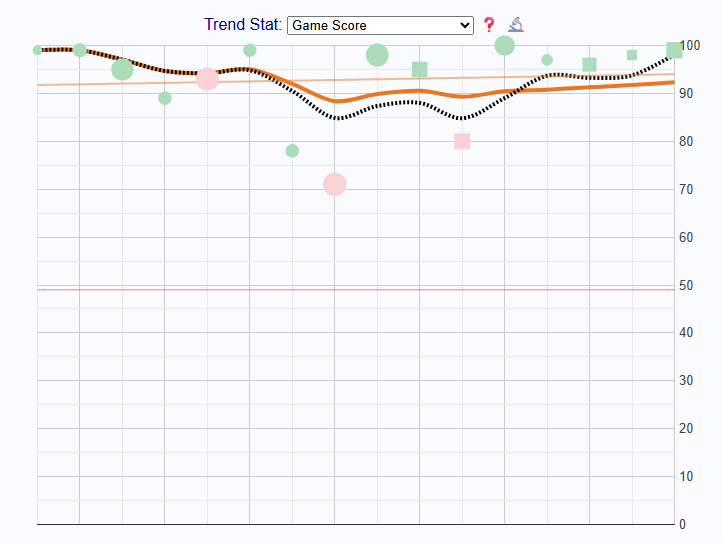
100 is effectively a "perfect" game (meaning it'd be difficult to project playing better than that), and you could effectively treat the score as a "grade" for the game. So far this season, I don't think they've had a no show game, and it plays out in the game scores. Even their worst game here (the UConn game, in case you couldn't guess from the dot placements), they played well defensively and got the shots they wanted, just couldn't buy a bucket and weren't dominant on the boards enough to make up for it. But so many A-level performances thus far that while not perfect, are much better than most teams are performing this season.
If that red square flips to green and Illinois is 14-2 and undefeated in the B1G (and probably ranked at least where Nebby is if not higher), I have a feeling that everyone would be over the moon for this team, despite an effectively identical performance.
100 is effectively a "perfect" game (meaning it'd be difficult to project playing better than that), and you could effectively treat the score as a "grade" for the game. So far this season, I don't think they've had a no show game, and it plays out in the game scores. Even their worst game here (the UConn game, in case you couldn't guess from the dot placements), they played well defensively and got the shots they wanted, just couldn't buy a bucket and weren't dominant on the boards enough to make up for it. But so many A-level performances thus far that while not perfect, are much better than most teams are performing this season.
If that red square flips to green and Illinois is 14-2 and undefeated in the B1G (and probably ranked at least where Nebby is if not higher), I have a feeling that everyone would be over the moon for this team, despite an effectively identical performance.

I remain curious how the perception of this team would be different had, say, that buzzer beater 3 rimmed out and Illinois beat Nebby in OT. Since that moment, fan engagement in nearly every game has been unnecessarily negative, despite effectively played 5 solid games since then. Here's the average game score, compliments of Torvik:
View attachment 46459
100 is effectively a "perfect" game (meaning it'd be difficult to project playing better than that), and you could effectively treat the score as a "grade" for the game. So far this season, I don't think they've had a no show game, and it plays out in the game scores. Even their worst game here (the UConn game, in case you couldn't guess from the dot placements), they played well defensively and got the shots they wanted, just couldn't buy a bucket and weren't dominant on the boards enough to make up for it. But so many A-level performances thus far that while not perfect, are much better than most teams are performing this season.
If that red square flips to green and Illinois is 14-2 and undefeated in the B1G (and probably ranked at least where Nebby is if not higher), I have a feeling that everyone would be over the moon for this team, despite an effectively identical performance.
Careful here, I can feel a completely unhinged 17 paragraph "That Guy" meta-rant incoming.
On a more serious note, game score is interesting because it offers a quick, single-number summary of the overall performance on a game-by-game basis. It moves far beyond the surface-level analysis that gives way to 'why did we get outscored in this 8 minute stretch?' types of conversations that can paint an overall good-to-great performance as majorly lacking in various areas (because naturally we focus on those areas as fans).
There's more to most games than just the final score, or the first half score, or the second half score. A single score which is based on a totality of score control/pace, kill shots/runs, clutch performance and other factors is a nice tool that, in essence, uncovers the stories behind the final scores.
I'm unable to find the exact calculation for Torvik's game score, but from what I can gather by reading about it, seems it is some aggregate of the adjusted efficiency, combined with some game script components such as minimizing impact of data from possessions that occur after a game has a mathematically decided outcome. Would love to know more about it, so if anyone has any blogs or anything like that, please share.
Is Keaton going to win every B1G freshman of the week from now on? There should be a Vegas line about this.
Here's Torvik's blog about game score: https://adamcwisports.blogspot.com/2015/11/introducing-g-score.htmlCareful here, I can feel a completely unhinged 17 paragraph "That Guy" meta-rant incoming.
On a more serious note, game score is interesting because it offers a quick, single-number summary of the overall performance on a game-by-game basis. It moves far beyond the surface-level analysis that gives way to 'why did we get outscored in this 8 minute stretch?' types of conversations that can paint an overall good-to-great performance as majorly lacking in various areas (because naturally we focus on those areas as fans).
There's more to most games than just the final score, or the first half score, or the second half score. A single score which is based on a totality of score control/pace, kill shots/runs, clutch performance and other factors is a nice tool that, in essence, uncovers the stories behind the final scores.
I'm unable to find the exact calculation for Torvik's game score, but from what I can gather by reading about it, seems it is some aggregate of the adjusted efficiency, combined with some game script components such as minimizing impact of data from possessions that occur after a game has a mathematically decided outcome. Would love to know more about it, so if anyone has any blogs or anything like that, please share.
You can also see game by game win probability flow by clicking on a game score, like for example Penn State: https://barttorvik.com/box.php?muid=IllinoisPenn+St.1-3&year=2026
Here's the image of the game flow for that game:
As you can see, the lowest the win probability ever got was at the start of the game. From there, the game was consistently 95+% in hand, though the lead was never completely safe until a Stojakovic 3 with 90 seconds left to make it a 13 point game. So, in essence, what we saw. The Illini got out to a solid early lead and sat on it, coasting to the end of the game, though it was never really in doubt. Other games they've secured a safe lead earlier (the Rutgers game was secured with 7:30 remaining and a 25 point lead), but they've largely played well in the vast majority of their games.
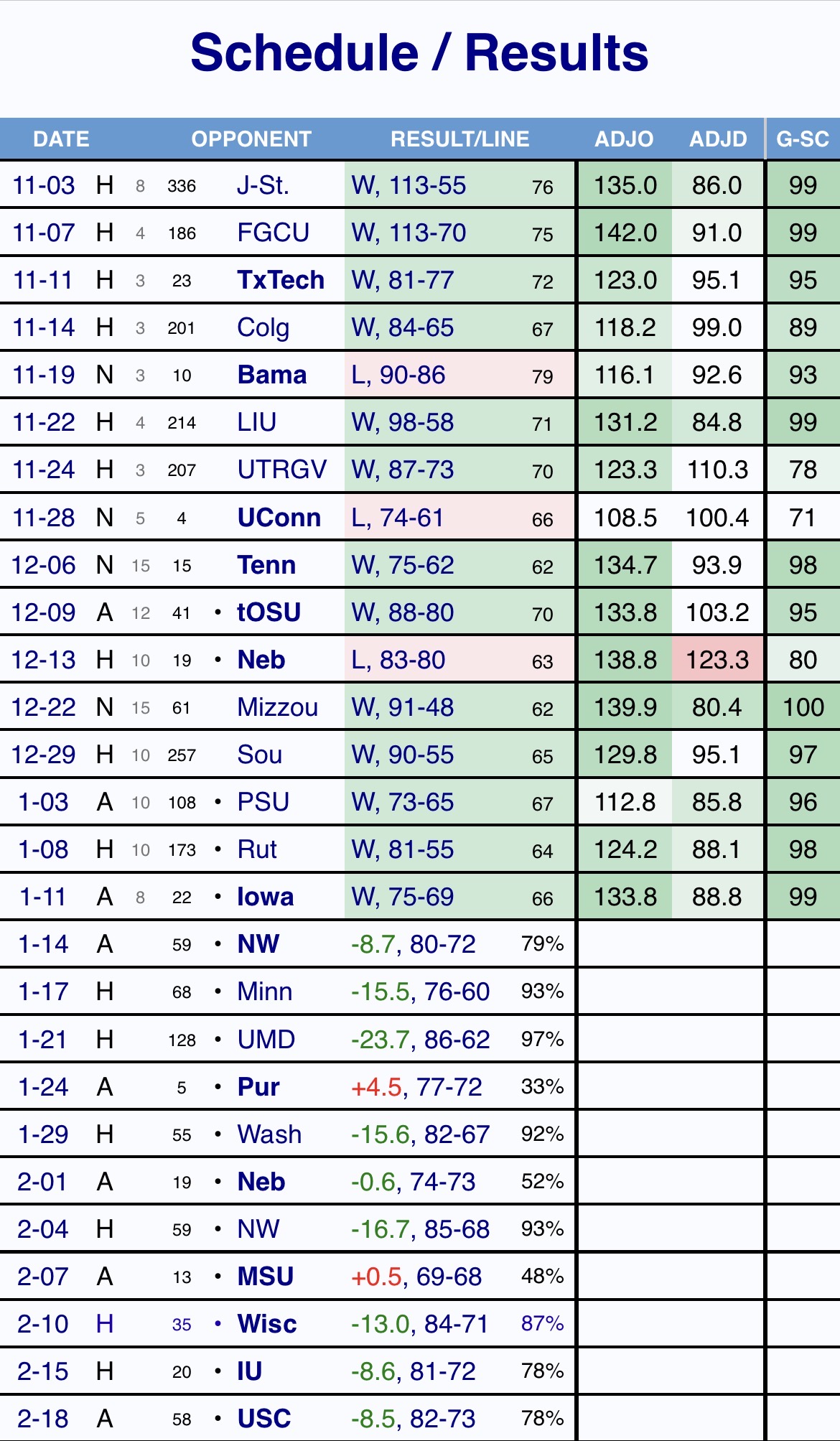
Here’s all our game scores from this season, as well as the offensive and defensive ratings for each game:

Imagine seeing this image on March 27th, 2025 (the day before the Morez announcement) lol
I feel like around this time every year I lose the meaning of what NET is.
Can someone explain how your own NET ranking isn’t a definitive ranking of your team, but only a representation of how good your opponents are?
Also, no one can convince me that it isn’t counterintuitive. I’m ranked 10th and if a team ranked 50th beats me, they have a top 10 NET win, but I can’t claim I’m the 10th best team?
Can someone explain how your own NET ranking isn’t a definitive ranking of your team, but only a representation of how good your opponents are?
Also, no one can convince me that it isn’t counterintuitive. I’m ranked 10th and if a team ranked 50th beats me, they have a top 10 NET win, but I can’t claim I’m the 10th best team?
Joel Goodson

- 9th man conundrum
title piece incoming:
- Status
- Not open for further replies.