Illinois Basketball Historic Standards

Status
Not open for further replies.
#51      
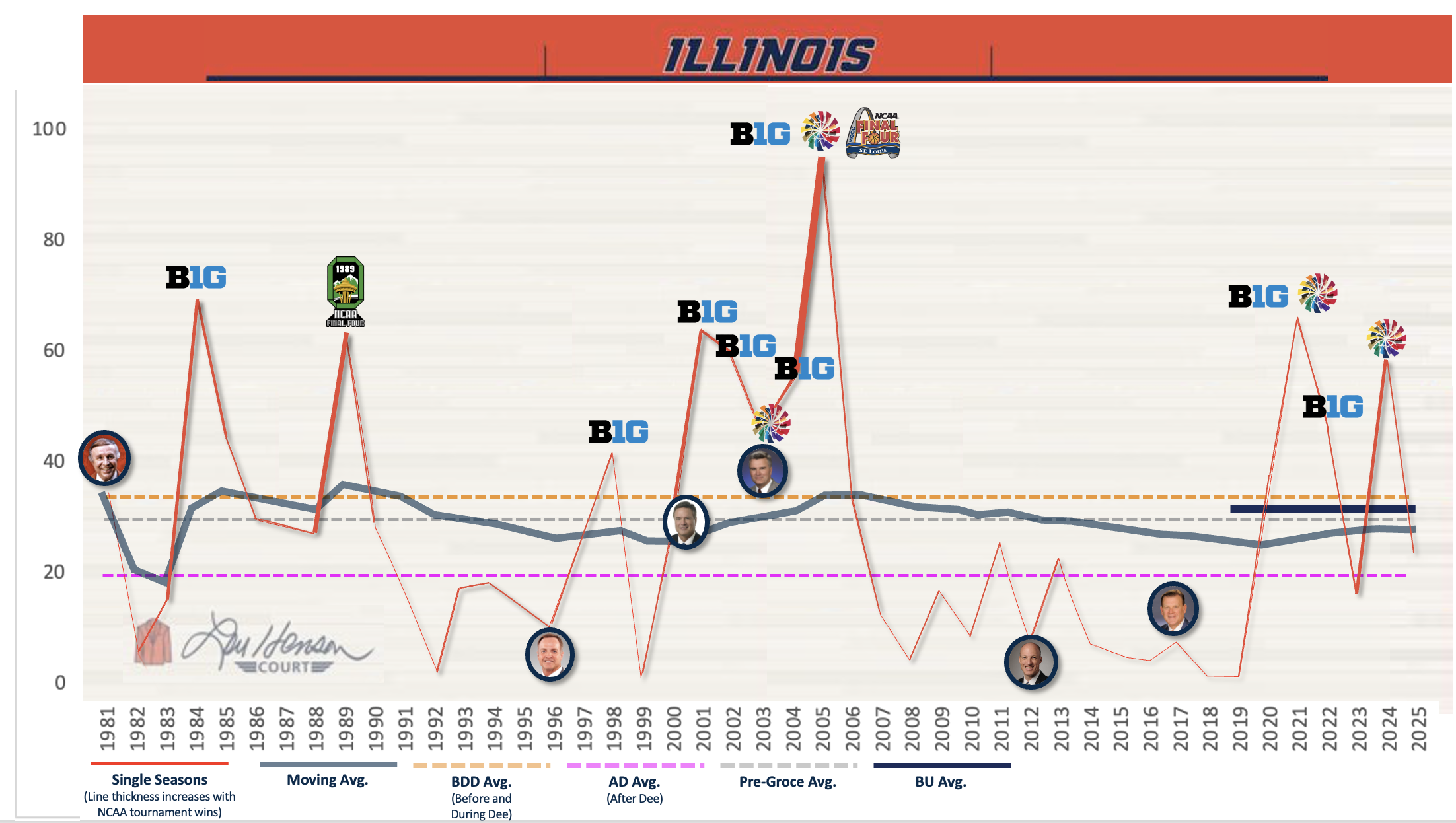
Updated infographic.

Not many insights to add.

By my methodology, this year ranked as the 23rd best season of the last 45 years. It's most similar to 2011 and 2013.

Illinois under Brand Underwood continues to be in a better place than it was when Groce took over and miles better than the Groce and post-Dee Weber years. We are just under where the program was in 2006.

Reminder - this measures the results of a season so we can see how a specific season / era stacks up against all the others from our modern history. It does NOT necessarily measure how good / talented a team was.

Screenshot 2025-04-15 at 6.12.25 PM.png


Methodology:
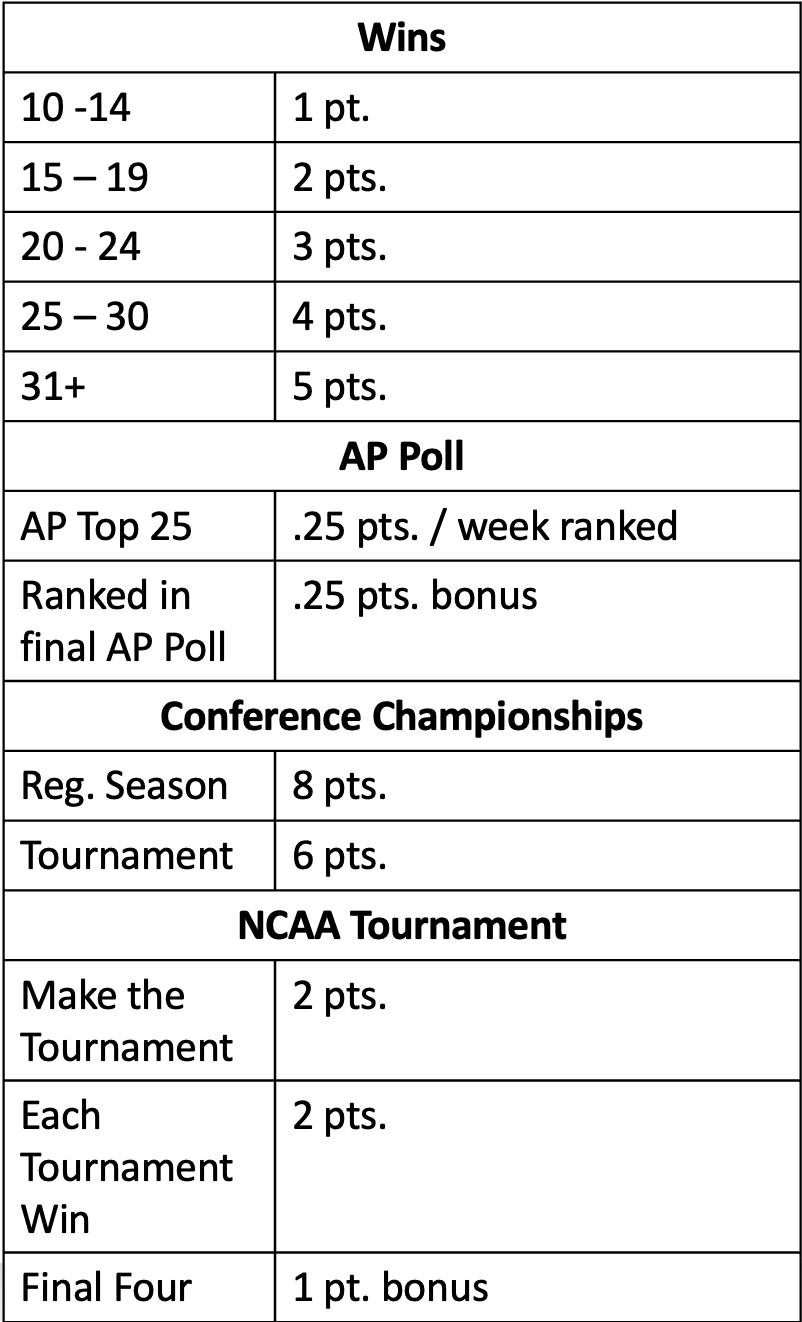
Each season is given a score based on the below scoring system. That score is divided by the total points possible for that season. The resulting percentage is what is measured on the Y axis. A score of 100 would be the perfect season.

Screenshot 2025-04-15 at 6.41.46 PM.png
 
#52      
1. I think you should put the coach’s face on their starting year and not their ending year
2. WOW! This makes it quite clear that Weber killed this program, not Groce. He just happened to do so after coaching Self’s players to the best year in team history. Groce basically just poked a corpse with a stick and got no response.
3. Nice work
Number 2 is pretty apparent to anyone who followed the program at all. Bruce inherited a Ferrari and left Groce a hooptie.
 
#53      
I have argued with my fellow alum friends for 30 years that we are too slow to fire coaches, mostly in football, but certainly for Weber and Groce. My point has always been that we will never achieve higher goals if we don’t have higher aspirations. We can’t we strive for FFs in hoops on a regular basis? What makes Kansas or even NC inherently better than us?

So I know that I am just a nattering nabob of negativity, but my view is that we won’t take the next step toward a Natty until we replace the current coaching staff. Those who think the seat should not be red hot now are just enablers willing to settle for above average.
 
#54      
I have argued with my fellow alum friends for 30 years that we are too slow to fire coaches, mostly in football, but certainly for Weber and Groce. My point has always been that we will never achieve higher goals if we don’t have higher aspirations. We can’t we strive for FFs in hoops on a regular basis? What makes Kansas or even NC inherently better than us?

So I know that I am just a nattering nabob of negativity, but my view is that we won’t take the next step toward a Natty until we replace the current coaching staff. Those who think the seat should not be red hot now are just enablers willing to settle for above average.
That's a thought . . . I do agree we were slow to fire both Weber and Groce (and Beckman, and Lovie, etc). However, there are roughly 364 Division 1 basketball teams, all of whom strive for FF's. Only 4 make it every year (notice the deductive reasoning there /joke). The graph below shows how difficult it is for teams to make the FF. The five teams in the upper right paid more for their players than everyone else below them prior to NIL.

Now that things are more evenly distributed in terms of money, this year's FF included only one of those four - Duke. Florida, Auburn & Houston now have competitive teams because they are paying for them. UCLA (2nd rd exit), NC (1rd exit), UK (S16 exit), and Kansas (1rd exit) didn't even have a sniff of the FF. We have a competitive program because we are paying for good players and we have coaches that know how to develop players. Given that we have three players in the NBA today, have two players that are slated to be drafted this year, and have multiple players forecasted for next year's team that will make drafts lists, I'd say the coaching staff knows how to spot talent.

I'm on record on Loyalty as clearly stating my opinion that college money sports (FB and BB) are on their way out due to "professionalization" of a subpar product (when compared to the pro leagues). Until that happens, we have the Wild, Wild West in terms of colleges and coaches trying to maneuver their way around the minefield that the NCAA has left them. Granted the playing field is completely different today in college basketball due to player portability and NIL in terms of how long it takes a team to rebuild. But anyone that's been around the program for more than the past 25 years (given your username, I'd assume you've been around even long than me) knows that the past five years have been the best five years since 2001-2006. I have no desire to spend my remaining years on this earth going through what we went through from 2007-2018 with Illini basketball.

.
Screenshot 2025-04-15 at 8.34.11 PM.png
 
#55      
Updated infographic.

Not many insights to add.

By my methodology, this year ranked as the 23rd best season of the last 45 years. It's most similar to 2011 and 2013.

Illinois under Brand Underwood continues to be in a better place than it was when Groce took over and miles better than the Groce and post-Dee Weber years. We are just under where the program was in 2006.

Reminder - this measures the results of a season so we can see how a specific season / era stacks up against all the others from our modern history. It does NOT necessarily measure how good / talented a team was.

View attachment 41531

Methodology:
Each season is given a score based on the below scoring system. That score is divided by the total points possible for that season. The resulting percentage is what is measured on the Y axis. A score of 100 would be the perfect season.

View attachment 41532
This seems about right to me. The second worst year under Brad since we started contending, but not ultimately as bad as 2023.
 
#56      
Were you a statistician in school? I was, masters at Purdue, this is really nice work. We can always grapple with season vs. post season, for example I would place the 50/50 value on post season vs. season as in the 80’s and into the 90’s winning the league was very very important (at least to me).

What I see in this is a historic trend that’s says we are for the most part an over performing regular season team, but historically an underperforming post season team?

I would love to see what Floridas graph would look like. No historic history or culture in basketball yet threw NCAA titles in less than 20 years. Pretty much shows that winning in the tournament has proven to be an utter failure for the UofI in that aspect of determining “yearly success”.

This is an excellent start at looking at team and coaching performance. You used to would have said Josh should use something like this in his determination of job performance, but alas as now you just buy your team none of this really has any relevance past say 2023 maybe?

Well done!
 
#57      
the past five years have been the best five years since 2001-2006. I have no desire to spend my remaining years on this earth going through what we went through from 2007-2018 with Illini basketball.
To this point, based off my made up methodology, the 6 year stretch since 2020 is the 5th best 6 year stretch since at least 1981. (Most likely 5th best since the Whiz Kids.)

Here they are in order:
01-06
00-05
84-89
99-04
20-25
 
#58      
That's a thought . . . I do agree we were slow to fire both Weber and Groce (and Beckman, and Lovie, etc). However, there are roughly 364 Division 1 basketball teams, all of whom strive for FF's. Only 4 make it every year (notice the deductive reasoning there /joke). The graph below shows how difficult it is for teams to make the FF. The five teams in the upper right paid more for their players than everyone else below them prior to NIL.

Now that things are more evenly distributed in terms of money, this year's FF included only one of those four - Duke. Florida, Auburn & Houston now have competitive teams because they are paying for them. UCLA (2nd rd exit), NC (1rd exit), UK (S16 exit), and Kansas (1rd exit) didn't even have a sniff of the FF. We have a competitive program because we are paying for good players and we have coaches that know how to develop players. Given that we have three players in the NBA today, have two players that are slated to be drafted this year, and have multiple players forecasted for next year's team that will make drafts lists, I'd say the coaching staff knows how to spot talent.

I'm on record on Loyalty as clearly stating my opinion that college money sports (FB and BB) are on their way out due to "professionalization" of a subpar product (when compared to the pro leagues). Until that happens, we have the Wild, Wild West in terms of colleges and coaches trying to maneuver their way around the minefield that the NCAA has left them. Granted the playing field is completely different today in college basketball due to player portability and NIL in terms of how long it takes a team to rebuild. But anyone that's been around the program for more than the past 25 years (given your username, I'd assume you've been around even long than me) knows that the past five years have been the best five years since 2001-2006. I have no desire to spend my remaining years on this earth going through what we went through from 2007-2018 with Illini basketball.

A lot I agree with here. It would be interesting to put the AD on the chart as well, since we know there were different ideas about aspirations and profitability coming from above the coach. Firing coaches has a lot to do with the AD and resources --top programs demand fast turn-arounds and sustained success, and generally poach proven coaches at lesser funded programs. I think historically we've been in a second tier, worried about our best coaches getting targeted by a handful of schools that had the lure or the cash to poach.

In the old world, you can see how Cinderella made noise in the tournament, even up to the FF. 4 year players developing at a school and peaking the roster with some red-shirts, along with an undervalued coach rising up the ranks. In this world, there just isn't that path. Any player that does well in the lower ranks will be called up to the big leagues for a substantial payday, and with rosters turning over so fast, coaches need to be more plug-n-play than ever before. It's a win now world in ways it wasn't previously, and the cultural shift just adds to the sense that the best athletes have to go where they can get a bag before their eligibility runs out.

I have too much faith in the market to believe college sports are on their way out. It's flat out entertaining and in some ways the transfer season is part of the interest. Will the game have to adapt to what fans want? Are there serious problems that if left unaddressed could kill the sport or reduce it's overall footprint? Will the financial interests force those to get corrected? I suspect the answer is mostly yes to all of them.
 
#59      
To this point, based off my made up methodology, the 6 year stretch since 2020 is the 5th best 6 year stretch since at least 1981. (Most likely 5th best since the Whiz Kids.)

Here they are in order:
01-06
00-05
84-89
99-04
20-25
You realize three of those stretches overlap right? You're talking about this then being the third best stretch in the NCAA tournament era. Forget the six-year part.
 
#60      
I have too much faith in the market to believe college sports are on their way out.
It's "the market" that's weakening college sports.

The reason college sports are never going to die is that there are millions of fans who love their teams, who are connected to those Universities, and separate headwinds in higher ed notwithstanding, the Universities are not-for-profits that aren't going anywhere.

But are college sports going to remain at their peak of popularity of 10-15-20 years ago? I doubt that very highly. I don't think any of the legacy big American sports have a positive growth trajectory from their cable bubble-era highs frankly, and college sports is doing the most to harm itself on top of that.

That doesn't mean they disappear, just that they loom less large in the national consciousness.
 
#61      
It's "the market" that's weakening college sports.

The reason college sports are never going to die is that there are millions of fans who love their teams, who are connected to those Universities, and separate headwinds in higher ed notwithstanding, the Universities are not-for-profits that aren't going anywhere.

But are college sports going to remain at their peak of popularity of 10-15-20 years ago? I doubt that very highly. I don't think any of the legacy big American sports have a positive growth trajectory from their cable bubble-era highs frankly, and college sports is doing the most to harm itself on top of that.

That doesn't mean they disappear, just that they loom less large in the national consciousness.
I definitely see a world where there will still be college sports fanatics, but I also see a very clear path to a world where the inferior product produced by the lower paying league (all the superior talent is still going to go to the NBA or NFL) is just not interesting to the much larger segment of American society that does not follow college sports. Without that interest, TV revenue will plummet, pretty much ending the popular era of college sports as we've known it. The athletes, lawyers, and the NCAA have pretty much killed the golden goose.
 
#62      
I have argued with my fellow alum friends for 30 years that we are too slow to fire coaches, mostly in football, but certainly for Weber and Groce. My point has always been that we will never achieve higher goals if we don’t have higher aspirations. We can’t we strive for FFs in hoops on a regular basis? What makes Kansas or even NC inherently better than us?

So I know that I am just a nattering nabob of negativity, but my view is that we won’t take the next step toward a Natty until we replace the current coaching staff. Those who think the seat should not be red hot now are just enablers willing to settle for above average.
We were slow because Guenther was just watching the calander waiting to retire and collect his pension. He didnt care about the success of the program.

You're absolutely right though. We stuck with Weber and Groce WAY TOO LONG.... Many of us saw the writing on the wall after Illinois has such a storied run in 05-06 and had an awful class the year afterwards and subsequent year. I fondly remember many "Weber will coach 'em up posts" at the time and all the proceeding recruiting cycles.
 
Last edited:
#63      
Thanks for this objective information. Highly appreciated! At the end of the day it comes down to expectations. Many on the believe our baseline should be before/during Dee and many believe it is after Dee. The reality is that it should be smack in the middle.

I will say - this is probably the most we've ever paid a coaching staff relatively speaking - so this is something that I also take into consideration.
 
#64      
We were slow because Guenther was just watching the calander waiting to retire and collect his pension. He didnt care about the success of the program.
The amazing truth is that RG in fact INTENSELY cared about the success of the program. He was just wedded to an ideology that was rotting it from the inside.

There was nothing evil about Ron Guenther, he was and is a lovely, charming guy who dedicated his life to his alma mater. He was just dead wrong about every development in his industry while he had power.
 
#65      
The amazing truth is that RG in fact INTENSELY cared about the success of the program. He was just wedded to an ideology that was rotting it from the inside.

There was nothing evil about Ron Guenther, he was and is a lovely, charming guy who dedicated his life to his alma mater. He was just dead wrong about every development in his industry while he had power.
Warren Carter may disagree.
 
#66      
You realize three of those stretches overlap right? You're talking about this then being the third best stretch in the NCAA tournament era. Forget the six-year part.
Lol Well yeah. I'm the one who pulled the data.

Yes, third best stretch is accurate. And really, the 80s weren't that much better. They just had one really high high that we've yet to reach in this era.
 
#67      
Updated infographic.

Not many insights to add.

By my methodology, this year ranked as the 23rd best season of the last 45 years. It's most similar to 2011 and 2013.

Illinois under Brand Underwood continues to be in a better place than it was when Groce took over and miles better than the Groce and post-Dee Weber years. We are just under where the program was in 2006.

Reminder - this measures the results of a season so we can see how a specific season / era stacks up against all the others from our modern history. It does NOT necessarily measure how good / talented a team was.

View attachment 41531

Methodology:
Each season is given a score based on the below scoring system. That score is divided by the total points possible for that season. The resulting percentage is what is measured on the Y axis. A score of 100 would be the perfect season.

View attachment 41532
I'm not a fan of the AP poll's inclusion in the metric. Just don't like something beyond the team's control being included when it's subject to all sorts of external factors.
 
#68      
I'm not a fan of the AP poll's inclusion in the metric. Just don't like something beyond the team's control being included when it's subject to all sorts of external factors.
It's been the standard for like 80 years. It's the best way we have to evaluate how good a team was or was preceived to be relative to the field for that year.

I would also argue that the AP poll gets too much flack. By the second week of December, 3 of the 4 Final Four teams were ranked in the top 10. The only one that wasn't was Houston, who was preseason top 5 before dropping 3 of their first 7 games. Think about that. 330+ teams to choose from and they identified early on that those four teams are among the nation's best. 11 of the S16 teams were ranked preseason. 14 out of 16 were ranked in the final poll before the tournament. In general, they get close enough to add value, IMO.
 
#69      
I definitely see a world where there will still be college sports fanatics, but I also see a very clear path to a world where the inferior product produced by the lower paying league (all the superior talent is still going to go to the NBA or NFL) is just not interesting to the much larger segment of American society that does not follow college sports. Without that interest, TV revenue will plummet, pretty much ending the popular era of college sports as we've known it. The athletes, lawyers, and the NCAA have pretty much killed the golden goose.

Don't get me wrong, I see the financialization happening all around us, and it almost universally waters down the original service or product. The plus side is sometimes overlooked though. For example, greed gave us the CFP and its expansion so teams rather than voters determine the champion. And yes, someone from 1958 is screaming about back in the day, but the rest of us prefer watching the playoff.
 
#70      
Mostly the overlap just tells me 99-06 was the golden era or Illini men's basketball (to this point).
 
#71      
I've been thinking more about this, and the undeniable truth that must be considered is that March Madness is an absolute crapshoot. Yes, you can make the argument that when the sample size gets large enough, things should average out and we should play to our seed ... and on that, Illinois has SEVERELY underperformed historically. However, I think the more important metric to look at is how "healthy" is the program? Loyola disaster or not, the program felt very healthy to me in 2021. We were the type of program that was way more than nationally relevant, and we were doing all of the right things to put ourselves in the POSITION to be fighting for a national title within the foreseeable future - which will ALWAYS be the goal at this program.

With that said, I will actually put forward two metrics that some fans might poo-poo but I actually think are sneakily essential indicators of the general health of a program over a 5+ year period:
(1) AP ranking
(2) NCAA Tournament seed

Do these things mean squat at the end of the day? No. However, they are indicators of whether or not our team is putting itself in a position to make a run in March. Forget Big Ten championship banners or trips to the Second Weekend for a second and consider these stretches, with the following lay out:

Year: Preseason AP Rank - Highest AP Rank - End AP Rank - NCAAT Seed

Kruger/Self/Weber "Golden Era"
2000:
#16 - #15 - #21 - #4 seed
2001: #8 - #3 - #4 - #1 seed
2002: #3 - #2 - #13 - #4 seed
2003: NR - #7 - #11 - #4 seed
2004: #13 - 11 - #13 - #5 seed
2005: #5 - #1 - #1 - #1 seed
2006: #17 - #6 - #13 - #4 seed

Weber Downfall
2007:
NR - NR - NR - #12 seed
2008: NR - NR - NR - No NCAAT
2009: NR - #18 - NR - #5 seed
2010: #23 - #20 - NR - No NCAAT
2011: #13 - #12 - NR - #9 seed
2012: NR - #19 - NR - No NCAAT

Underwood Resurgence
2020:
NR - #19 - #21 - #6 seed*
2021: #8 - #2 - #2 - #1 seed
2022: #11 - #10 - #19 - #4 seed
2023: #23 - #16 - NR - #9 seed
2024: #25 - #6 - #6 - #3 seed
2025: NR - #13 - NR - #6 seed

Right off the bat, let's recertify those people who were dragging down our program's prestige in a desperate attempt to defend Weber circa 2012 as insane ... that stretch was unacceptable for many, many programs with a worse history and fewer resources than we have.

Second, while some might label the 2000-2006 stretch as unrealistically elite, it is important to note that three different coaches contributed to that ... the program ITSELF was healthy, and we were not reliant on, say, Bill Self strolling in and bringing us back from the dead. Additionally, if we forget for a moment the Big Ten championship banners and the magic memories of our run in 2005, that stretch doesn't look like something that just simply cannot be replicated ever again ... we just FINALLY (mostly) avoided too many choke jobs in the NCAA Tournament.

Third, it is of course important to note that Underwood's stretch involves transfer portal, NIL and COVID mania that his predecessors simply did not have to deal with. While there is more volatility than I would like to see there and perhaps more than we "should expect," it also might be true that programs simply need to brace themselves for more of that until someone starts regulating all of this (if that ever even happens).

Summary
While there is a lot of nuance in these discussions and obviously many more factors (e.g., recruiting) that must be considered, it appears patently obvious to me that it is not "difficult" to build a "good" team at Illinois, and that is what we should expect the VAST majority of years. What does that mean, exactly? I'm not 110% sure, but I would say as far as NCAAT seeding goes...
(A) Rarely if ever not a top 6 seed
(B) "Reasonably expect" to be a top 4 seed "most years"
(C) Ability to "break through" with a special #1-2 seed team every 5-6 years or so.

I think that is optimistic but realistic. A "standard" is not the same as an "average" of past results; it is what you are shooting for as a type of baseline success. And while acknowledging that there will always be statistical noise for some years (e.g., 2023), I think it is reasonable for us to expect to regularly be putting ourselves in the POSITION to compete for Big Ten titles and earn top 4 seeds, with the very realistic hope of building toward a 2001, 2005, 2021 or 2023 team every few years.

* For 2019-20 with the NCAA Tournament cancelled, I made an educated guess that we would have been a #6 seed or so to try to better illustrate a trend.

 
#72      
I've been thinking more about this, and the undeniable truth that must be considered is that March Madness is an absolute crapshoot. Yes, you can make the argument that when the sample size gets large enough, things should average out and we should play to our seed ... and on that, Illinois has SEVERELY underperformed historically. However, I think the more important metric to look at is how "healthy" is the program? Loyola disaster or not, the program felt very healthy to me in 2021. We were the type of program that was way more than nationally relevant, and we were doing all of the right things to put ourselves in the POSITION to be fighting for a national title within the foreseeable future - which will ALWAYS be the goal at this program.

With that said, I will actually put forward two metrics that some fans might poo-poo but I actually think are sneakily essential indicators of the general health of a program over a 5+ year period:
(1) AP ranking
(2) NCAA Tournament seed

Do these things mean squat at the end of the day? No. However, they are indicators of whether or not our team is putting itself in a position to make a run in March. Forget Big Ten championship banners or trips to the Second Weekend for a second and consider these stretches, with the following lay out:

Year: Preseason AP Rank - Highest AP Rank - End AP Rank - NCAAT Seed

Kruger/Self/Weber "Golden Era"
2000:
#16 - #15 - #21 - #4 seed
2001: #8 - #3 - #4 - #1 seed
2002: #3 - #2 - #13 - #4 seed
2003: NR - #7 - #11 - #4 seed
2004: #13 - 11 - #13 - #5 seed
2005: #5 - #1 - #1 - #1 seed
2006: #17 - #6 - #13 - #4 seed

Weber Downfall
2007:
NR - NR - NR - #12 seed
2008: NR - NR - NR - No NCAAT
2009: NR - #18 - NR - #5 seed
2010: #23 - #20 - NR - No NCAAT
2011: #13 - #12 - NR - #9 seed
2012: NR - #19 - NR - No NCAAT

Underwood Resurgence
2020:
NR - #19 - #21 - #6 seed*
2021: #8 - #2 - #2 - #1 seed
2022: #11 - #10 - #19 - #4 seed
2023: #23 - #16 - NR - #9 seed
2024: #25 - #6 - #6 - #3 seed
2025: NR - #13 - NR - #6 seed

Right off the bat, let's recertify those people who were dragging down our program's prestige in a desperate attempt to defend Weber circa 2012 as insane ... that stretch was unacceptable for many, many programs with a worse history and fewer resources than we have.

Second, while some might label the 2000-2006 stretch as unrealistically elite, it is important to note that three different coaches contributed to that ... the program ITSELF was healthy, and we were not reliant on, say, Bill Self strolling in and bringing us back from the dead. Additionally, if we forget for a moment the Big Ten championship banners and the magic memories of our run in 2005, that stretch doesn't look like something that just simply cannot be replicated ever again ... we just FINALLY (mostly) avoided too many choke jobs in the NCAA Tournament.

Third, it is of course important to note that Underwood's stretch involves transfer portal, NIL and COVID mania that his predecessors simply did not have to deal with. While there is more volatility than I would like to see there and perhaps more than we "should expect," it also might be true that programs simply need to brace themselves for more of that until someone starts regulating all of this (if that ever even happens).

Summary
While there is a lot of nuance in these discussions and obviously many more factors (e.g., recruiting) that must be considered, it appears patently obvious to me that it is not "difficult" to build a "good" team at Illinois, and that is what we should expect the VAST majority of years. What does that mean, exactly? I'm not 110% sure, but I would say as far as NCAAT seeding goes...
(A) Rarely if ever not a top 6 seed
(B) "Reasonably expect" to be a top 4 seed "most years"
(C) Ability to "break through" with a special #1-2 seed team every 5-6 years or so.

I think that is optimistic but realistic. A "standard" is not the same as an "average" of past results; it is what you are shooting for as a type of baseline success. And while acknowledging that there will always be statistical noise for some years (e.g., 2023), I think it is reasonable for us to expect to regularly be putting ourselves in the POSITION to compete for Big Ten titles and earn top 4 seeds, with the very realistic hope of building toward a 2001, 2005, 2021 or 2023 team every few years.

* For 2019-20 with the NCAA Tournament cancelled, I made an educated guess that we would have been a #6 seed or so to try to better illustrate a trend.

I'm mostly aligned to this. Wins, banners, ap ranking, seeding, tournament success are all tied together. So, high AP and low seeds will often be associated with banners and tourney success. They're good shortcut metrics. But as you said, if you focus only on those metrics, you lose some nuance. Which makes the useless activity of comparing seasons to one another more difficult.

Semantics but I'd also argue that the "standards" you outlined are aspirational. A standard is more similar to an average than it is to an aspiration or a goal. In fact, "average" is a synonym of "standard".
 
#73      
One way to measure program success is how far above the bottom we are. Another is how far from the top. One more is how close are we to reaching the peak of NCAA basketball. None are wrong, and I think any view of this is entirely legitimate.

But for me, the measure is the third one: how close are we to the top.
 
#74      
One way to measure program success is how far above the bottom we are. Another is how far from the top. One more is how close are we to reaching the peak of NCAA basketball. None are wrong, and I think any view of this is entirely legitimate.

But for me, the measure is the third one: how close are we to the top.
Interesting perspective that I would say I mostly agree with. However, I would add these caveats:

1. On a yearly basis, I expect to be VERY far above the bottom. Years like 2023 where we are middling should be somewhat rare, and years like 2017-2019 where we are a doormat should be an anomaly.
2. Over a stretch of 5+ years, I expect our aggregate "program resume" to be "not very far" from the top. We shouldn't be bewildered with joy when we hear a stat like, "Illinois has the 10th most wins in the nation since 2020." Even if we are clearly still looking up at the Blue Bloods, we should feel confident that we are solidly in the tier below them, with aspirations to one day break through and pull a UConn.
3. The "ultimate long-term goal" for the program should always be to reach the peak ... we are arguably the best program to never win a title, and we've had three teams that were easily good enough to get it done and ran into some bad luck. Thus, the goal for this program is actually quite simple long-term ... win that damn title.

And I think these categories build upon each other. If you aren't consistently far above the cellar of the Big Ten, you likely are nowhere close to getting in the top tier of programs. If you are not finding yourself statistically in that top tier, there is VERY little chance you ever find yourself at the peak, or even really realistically fighting to get there. And that is where my expectation/goal of simply consistently fielding top 25 teams that are near the top of the league and getting top 4 seeds is so important, at least IMO ... if we are putting ourselves in the position to make a run in the NCAAT, eventually the stars will align.
 
#75      
Fans like Bruce because he was a "nice guy" but his ineptitude at recruiting completely drove the program into the ground.
 
Status
Not open for further replies.
Back