Honestly guys, the more research I do, the closer I am to moving off the "I'm skeptical but you do still take Miami (OH) if they lose in the conference tournament" take. I mean, I think you can make an argument that Belmont has more deserving resume (Yes, they have 4 Q3 losses, but they also have a Q1 win and 5 Q2 wins), and they are not even considered a bubble team.


You are using an out of date browser. It may not display this or other websites correctly.
You should upgrade or use an alternative browser.
You should upgrade or use an alternative browser.
Bracketology
- Status
- Not open for further replies.
Fighter of the Nightman

- Chicago, IL
This makes our Groce Era 2015 team missing the Tournament seem all the more pathetic in hindsight, haha. At the time, it felt like we were a team that "showed flashes" but needed a couple BTT wins to secure a bid, and instead we faceplanted vs. Michigan. In reality, we were 19-12 on Selection Sunday for a reason and we really weren't all that close to being on the right side of one of the worst Bubbles ever (ended up a #3 seed in the NIT and got embarrassed by Alabama, lol).According to Evan Miya, this is the weakest bubble ever:

I will continue to respond to this take with this: WAB is the committes shiny new toy, they have explicitly stated it's their primary tool this year for deciding which teams get into the field (less so seeding), and Miami OH has a WAB of 2.59, good for 31st and a single bad loss won't drop it far enough to get them out of the field, so they are going to make the tournament.Honestly guys, the more research I do, the closer I am to moving off the "I'm skeptical but you do still take Miami (OH) if they lose in the conference tournament" take. I mean, I think you can make an argument that Belmont has more deserving resume (Yes, they have 4 Q3 losses, but they also have a Q1 win and 5 Q2 wins), and they are not even considered a bubble team.
Where they get seeded from there is up to the committee, but an auto bid Miami could feasibly be seeded 12th so an at-large Miami could be a play-in.
Eh, bracket matrix has them as a 10 and puts them between an 8 and a 12 currently. So yes, 6 or 7 would definitely be an overseed, but I was merely saying, I would take no issue if they were given a 6 or 7 seed whereas I would take major issue if they were given a 4 seed or better. I simple disagree they're a bubble team or anywhere close to it or undeserving. If they were to lose in their conference tournament, I'd probably have them as an 11. Still in but closer to the bubble.Well if they go undefeated, then they are automatically in. The hypothetical is them losing in their conference tourney, which makes them a 1 loss team. That likely puts them in bubble territory (likely the right side of the bubble but close to play in territory).
6 or 7 seed. Come on now. That is crazy. 10/11 seeds would be jumping up and down to face Miami right now.
It's not bad for us. We want St. Louis regardless of whether it's a 2 or 3.View attachment 48179
lol, not optimal for Illinois. Hurley's team mailing-it-in is an insult to the USPS.
Do we really need another qu
We aren't worried about Iowa St for us to get to St. Louis. It's Nebraska and Purdue. As long as we get ahead of them in the BTT, we're going to St. Louis. 2 top seeded teams will go there and none of the #1's or other #2's prefer St. Louis. It's us, Iowa State, Purdue and Nebraska. And honestly, Nebraska may want Oklahoma City.View attachment 48179
lol, not optimal for Illinois. Hurley's team mailing-it-in is an insult to the USPS.
If we win on Friday, we're the 2 in St. Louis. Plain and simple. If we lose on Friday, we could be in Oklahoma City if Nebraska or Purdue make a run.
The Miami argument is so insanely dumb to me.
Sometimes, very very very rarely, statistics need to be thrown out and common sense needs to take over.
Sure is Auburn higher in efficiency metrics or has better wins, did Miami almost lose a handful of games to crappy teams, did they schedule poorly. Yes to all the above. To me all that is noise once a team loses 16 vs 0. Or even 1. Heck I might even say 2 if that second loss was the last of the regular season. There’s grey areas, but 0 losses no matter the schedule you play should be an instant bid.
An undefeated regular season, whether it be by Kentucky or Alabama St shouldn’t matter. Auto bid every single time and I know it’s easy to say in my position but I cannot imagine being an Indiana or auburn or another crap P4 bubble team and think I deserve it over Miami.
Sometimes, very very very rarely, statistics need to be thrown out and common sense needs to take over.
Sure is Auburn higher in efficiency metrics or has better wins, did Miami almost lose a handful of games to crappy teams, did they schedule poorly. Yes to all the above. To me all that is noise once a team loses 16 vs 0. Or even 1. Heck I might even say 2 if that second loss was the last of the regular season. There’s grey areas, but 0 losses no matter the schedule you play should be an instant bid.
An undefeated regular season, whether it be by Kentucky or Alabama St shouldn’t matter. Auto bid every single time and I know it’s easy to say in my position but I cannot imagine being an Indiana or auburn or another crap P4 bubble team and think I deserve it over Miami.
Illini2010-11
- Sugar Grove
It already is...it is called being the autobid for your conference.The Miami argument is so insanely dumb to me.
Sometimes, very very very rarely, statistics need to be thrown out and common sense needs to take over.
Sure is Auburn higher in efficiency metrics or has better wins, did Miami almost lose a handful of games to crappy teams, did they schedule poorly. Yes to all the above. To me all that is noise once a team loses 16 vs 0. Or even 1. Heck I might even say 2 if that second loss was the last of the regular season. There’s grey areas, but 0 losses no matter the schedule you play should be an instant bid.
An undefeated regular season, whether it be by Kentucky or Alabama St shouldn’t matter. Auto bid every single time and I know it’s easy to say in my position but I cannot imagine being an Indiana or auburn or another crap P4 bubble team and think I deserve it over Miami.
If Miami loses, then they will have one loss. Then they get thrown into the at-large pool. With the extremely weak bubble this year, it is highly likely that Miami will still get selected to the tourney based on their WAB. Their other metrics are very shaky, so it would not be surprising that they get selected as a play-in team if they don't win the MAC tourney.
It is crazy that Akron is actually ranked higher in NET than Miami, and they are not in consideration if they don't win the tourney. A testament to the weak schedule and relatively underwhelming performances in the wins for Miami.
Last edited:
I don't think I said anything to offend anyone. I'm sorry if so. We're just random people on the internet who won't actually make this decision, so let's all be friendly.This team is an outlier. Undefeated teams are few and far between in this sport. They should be celebrated for what they've achieved. What you've pinpointed continues to be your opinion rather than concrete proof to support that you don't believe they made an effort to schedule major conference schools. The color TV analyst appears to have done more research than you have done on the matter so I will take his word for it. Maybe you should too
Yes, they are an outlier. If they lose a game, they will have the efficiency of a ~#90 team but the resume/record of a ~#40 team. It isn't that they just haven't run up the score- they almost lost a handful of games (and will have lost 1). So are they a top-40 team that has some special ability that kicks in when the game is close, and is almost always enough to overcome 50/50 bounces or calls, etc? If so, why didn't they use that ability sooner? Or are they a #100 team that was lucky to win almost all those close/OT games? Metrics and betting markets both think it's the latter, and so do I.
I think you misunderstood what I said about their scheduling efforts or TV analysts, since I said I don't even care that they have a weak schedule (just how they play relative to it), much less what they tried to do. My skepticism is directed at the claims I've heard that efficiency metrics are the reason for the rejections, since it's the resume rankings and quad system (not efficiency rankings) that provide an incentive for P5 teams to refuse mid-majors*. The irony is that MOH (if they lose) will depend on those same resume rankings or the subjective opinion of the committee to get them in.
I also acknowledge that efficiency rankings are less accurate in comparing teams with very few common matchups between them and their opponents. Now this could even help some non-majors, but there's a reasonable argument that we "know" the P5 bubble teams aren't that good, but we are less certain whether the non-P5 bubble teams are good or not. So I could support something like: after the 31 auto-bids, take the rest of the top 30 in the efficiency metrics (that's typically ~53 teams), then take an equal number of P5 and non-P5 in order from the efficiency rankings. So a typical year would get the best 7-8 non-P5 that weren't already top 30 or automatically qualify.
* Illinois apparently rejected them, saying "I need to get two high NET games 300+ before I would think about playing you." Meaning the available slot in the schedule was early on, but we wanted those to be warmup games that had no chance of hurting our resume. If we only cared about efficiency, then any game is a potential blemish regardless of opponent quality, so we wouldn't prefer #300+ opponents to start the year.
One last bit on Miami OH for now. Here is the official NCAA team sheet for Miami OH as of today, exactly as the committee will see it, aside from me highlighting the thing to key on:
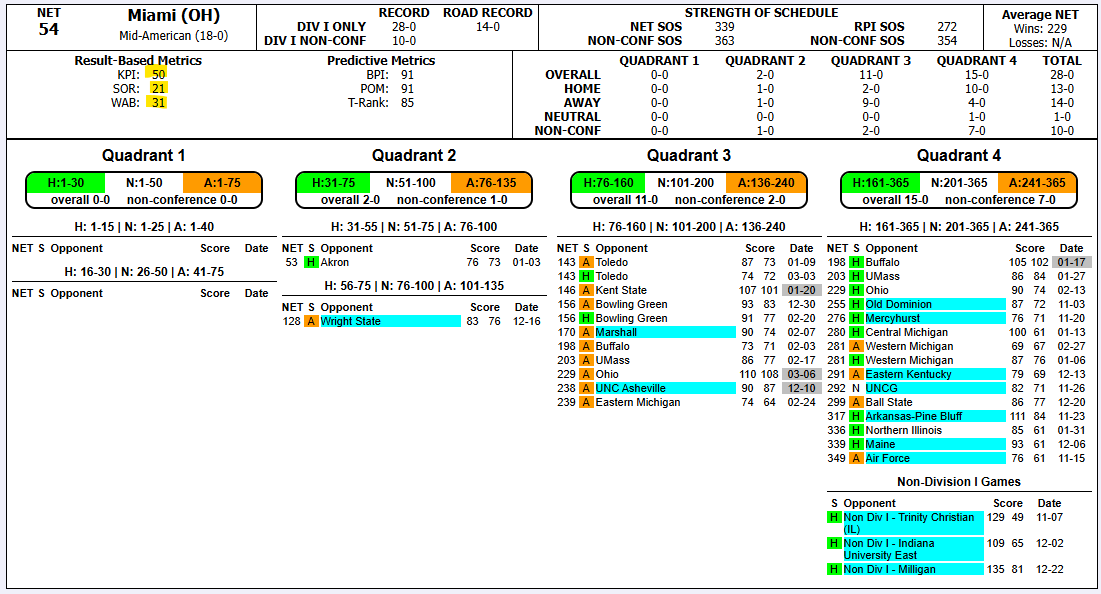
Due to those result-based metrics, they are in the tournament, regardless of a loss. Losing to UMass would make that take a hit (and would be a likely Q4 loss unless they lose by enough to boost UMass's NET rating enough to absorb a future loss), but those result-based metrics will still be above the cut line, and soundly so. Interestingly enough, Wright State's win last night helped their profile, as it boosted them into a second Q2 win.
Due to those result-based metrics, they are in the tournament, regardless of a loss. Losing to UMass would make that take a hit (and would be a likely Q4 loss unless they lose by enough to boost UMass's NET rating enough to absorb a future loss), but those result-based metrics will still be above the cut line, and soundly so. Interestingly enough, Wright State's win last night helped their profile, as it boosted them into a second Q2 win.

"TNT Sports and CBS Sports Present the 2026 NCAA Men’s Basketball Championship Selection Show on CBS, this Sunday at 6:00 PM ET, with Adam Zucker, Clark Kellogg, Bruce Pearl and Seth Davis."
Way to f*cking ruin the selection show, CBS.
Way to f*cking ruin the selection show, CBS.
Look on the bright side, if Auburn doesn't get in, you get to watch Bruce Pearl melt down live."TNT Sports and CBS Sports Present the 2026 NCAA Men’s Basketball Championship Selection Show on CBS, this Sunday at 6:00 PM ET, with Adam Zucker, Clark Kellogg, Bruce Pearl and Seth Davis."
Way to f*cking ruin the selection show, CBS.
Look on the bright side, if Auburn doesn't get in, you get to watch Bruce Pearl melt down live.

You missed the point I was trying to make: I explicitly said an undefeated regular season Miami should get an at large bid which implies they lose somewhere in their tournament.It already is...it is called being the autobid for your conference.
If Miami loses, then they will have one loss. Then they get thrown into the at-large pool. With the extremely weak bubble this year, it is highly likely that Miami will still get selected to the tourney based on their WAB. Their other metrics are very shaky, so it would not be surprising that they get selected as a play-in team if they don't win the MAC tourney.
It is crazy that Akron is actually ranked higher in NET than Miami, and they are not in consideration if they don't win the tourney. A testament to the weak schedule and relatively underwhelming performances in the wins for Miami.
My point was regular season undefeated teams should make the tournament regardless of conference tournament outcome. Without prejudice and without someone saying a P4 conference team whose got a better SOR/WAB or whatever flavor of stat you prefer making any sort of legitimate claim to make it in over them.
I don’t believe there’s a single CBB fan outside of whichever fan base makes it in hypothetically over a 3X-1 Miami that actually wants to see that crappy team in over Miami, regardless of if they’re better.
That being said I didn’t expect it to be a popular opinion and I fully acknowledge it’s illogical but it’s just a game at the end of the day and fun/cool teams deserve some sort of bump outside of stats IMO. Plus it sucks being a mid major give teams something to root for outside of conf tournaments.
I think you also have to keep in mind that these kids are not robots. They have clearly been playing tight and feeling the pressure with the weight of the world on their shoulders to try to keep this winning streak going because unlike a high major team, they know that 1 loss could be the difference between getting an at-large bid and having to rely on winning their conference tournament b/c their metrics aren't strong enough. I look at their close victories as proof that they have learned the art of winning the close game. They have come up clutch time after time...game after game...regardless of strength of opponent. Teams always play down to their opponents...see Illinois' last game at Maryland as proof of this. You may look at their close games as a negative. I look at it the other way. These are conference foes that know their strengths/weaknesses so the conference matchups are often times going to be closer battles just like the ones Illinois had with certain lesser teams like Northwestern or Maryland or Washington. It happens. What's important though is did they win each of those games? Did they fight through and find a way to win including in hostile road environments? The answer is yes. That cannot and should not be ignored or discredited. They are battle tested and I believe they are more deserving than the mediocre bubble teams who have proven they don't deserve a seat at the table.I don't think I said anything to offend anyone. I'm sorry if so. We're just random people on the internet who won't actually make this decision, so let's all be friendly.
Yes, they are an outlier. If they lose a game, they will have the efficiency of a ~#90 team but the resume/record of a ~#40 team. It isn't that they just haven't run up the score- they almost lost a handful of games (and will have lost 1). So are they a top-40 team that has some special ability that kicks in when the game is close, and is almost always enough to overcome 50/50 bounces or calls, etc? If so, why didn't they use that ability sooner? Or are they a #100 team that was lucky to win almost all those close/OT games? Metrics and betting markets both think it's the latter, and so do I.
I think you misunderstood what I said about their scheduling efforts or TV analysts, since I said I don't even care that they have a weak schedule (just how they play relative to it), much less what they tried to do. My skepticism is directed at the claims I've heard that efficiency metrics are the reason for the rejections, since it's the resume rankings and quad system (not efficiency rankings) that provide an incentive for P5 teams to refuse mid-majors*. The irony is that MOH (if they lose) will depend on those same resume rankings or the subjective opinion of the committee to get them in.
I also acknowledge that efficiency rankings are less accurate in comparing teams with very few common matchups between them and their opponents. Now this could even help some non-majors, but there's a reasonable argument that we "know" the P5 bubble teams aren't that good, but we are less certain whether the non-P5 bubble teams are good or not. So I could support something like: after the 31 auto-bids, take the rest of the top 30 in the efficiency metrics (that's typically ~53 teams), then take an equal number of P5 and non-P5 in order from the efficiency rankings. So a typical year would get the best 7-8 non-P5 that weren't already top 30 or automatically qualify.
* Illinois apparently rejected them, saying "I need to get two high NET games 300+ before I would think about playing you." Meaning the available slot in the schedule was early on, but we wanted those to be warmup games that had no chance of hurting our resume. If we only cared about efficiency, then any game is a potential blemish regardless of opponent quality, so we wouldn't prefer #300+ opponents to start the year.
If you go undefeated in regular season action with how little that happens historically speaking, I think that earns you a seat at the table much like winning 3 games in a conference tournament earns you a seat at the table. They're ranked in the top 25 and have been for several weeks now. Clearly, the media and coaches believe they've earned their spot at the tournament. Their NET ranking and metrics may not be that of a top 25 team but I think the media and coaches respect what they've done and that's why I think the committee would do the same
I respect your stance though and appreciate you coming at me in a less combative way unlike the other poster who I've been exchanging back and forths with
Last edited:

UT-Rio Grand Valley had not one, but 3 final shots (end of regulation, 1st OT and 2nd OT) to beat McNeese State last night…and missed all 3, two of which just fell off the rim. UT-RGV of course is the team the Illini beat early in the year.
Appreciate the response.I think you also have to keep in mind that these kids are not robots. They have clearly been playing tight and feeling the pressure with the weight of the world on their shoulders to try to keep this winning streak going because unlike a high major team, they know that 1 loss could be the difference between getting an at-large bid and having to rely on winning their conference tournament b/c their metrics aren't strong enough. I look at their close victories as proof that they have learned the art of winning the close game. They have come up clutch time after time...game after game...regardless of strength of opponent. Teams always play down to their opponents...see Illinois' last game at Maryland as proof of this. You may look at their close games as a negative. I look at it the other way. These are conference foes that know their strengths/weaknesses so the conference matchups are often times going to be closer battles just like the ones Illinois had with certain lesser teams like Northwestern or Maryland or Washington. It happens. What's important though is did they win each of those games? Did they fight through and find a way to win including in hostile road environments? The answer is yes. That cannot and should not be ignored or discredited. They are battle tested and I believe they are more deserving than the mediocre bubble teams who have proven they don't deserve a seat at the table.
If you go undefeated in regular season action with how little that happens historically speaking, I think that earns you a seat at the table much like winning 3 games in a conference tournament earns you a seat at the table. They're ranked in the top 25 and have been for several weeks now. Clearly, the media and coaches believe they've earned their spot at the tournament. Their NET ranking and metrics may not be that of a top 25 team but I think the media and coaches respect what they've done and that's why I think the committee would do the same
I respect your stance though and appreciate you coming at me in a less combative way unlike the other poster who I've been exchanging back and forths with
And as Piotyr keeps saying, they'll probably be in regardless because of resume rankings (WAB/SOR/KPI). This is just a discussion of what we think "should" be.
Here's a list of their nine closest games. Many of them were when the pressure of being undefeated was lower. I can accept that they're good at late-game situations, so I'm not saying these should necessarily be 50/50 games, but they could easily be 6-3 through no fault of their own, especially the highlighted ones where the outcome was uncertain (if not unlikely) in the final minute of regulation and/or OT.
I think that for a truly "deserving" at-large team with a lot more close wins than losses, we could hypothetically flip a few of their close wins to a close losses and they'd be just slightly less deserving. What they proved over thousands of possessions dwarfs how a few balls happened to bounce in some close games. If we do that for Miami OH, I don't think anyone is talking about them. It's the aura of being undefeated that makes them stand out from their poor efficiency metrics. But there's a reason efficiency metrics are very good at measuring true ability (and why we were all angry when we drew Loyola as our 8 seed).
If you prefer humans (polls) over efficiency metrics, those who are much better than coaches/media (betting markets) have their championship odds at/below similar teams that are less likely to even get an at-large selection, like Akron (meaning their odds of winning if they are selected will be even higher than they are now). I understand not wanting some P5 team with a bad record to get in, but there are other "deserving" non-P5s too.
a crappy team better than Miami. lol. You come up with some really funny takes.You missed the point I was trying to make: I explicitly said an undefeated regular season Miami should get an at large bid which implies they lose somewhere in their tournament.
My point was regular season undefeated teams should make the tournament regardless of conference tournament outcome. Without prejudice and without someone saying a P4 conference team whose got a better SOR/WAB or whatever flavor of stat you prefer making any sort of legitimate claim to make it in over them.
I don’t believe there’s a single CBB fan outside of whichever fan base makes it in hypothetically over a 3X-1 Miami that actually wants to see that crappy team in over Miami, regardless of if they’re better.
That being said I didn’t expect it to be a popular opinion and I fully acknowledge it’s illogical but it’s just a game at the end of the day and fun/cool teams deserve some sort of bump outside of stats IMO. Plus it sucks being a mid major give teams something to root for outside of conf tournaments.
fwiw My opinion is Miami does not deserve a bid over a team that actually plays good competition and loses. Especially if they are a better team.
Bethune-Cookman won the SWAC by 3 games and were looking for their first ever tournament berth. Unfortunately, they lost in the quarterfinals today.
They were the already the 68th team in the field and would have gone to the play-in, but the rest of the league is significantly worse, and is certainly going to the play-in.
They were the already the 68th team in the field and would have gone to the play-in, but the rest of the league is significantly worse, and is certainly going to the play-in.
Lehigh wins the Patriot League (Navy was the top seed). I think they'll be in the play-in but will have to re-evaluate at end of the night.
Top seed Liberty upset by 9 seed Missouri State in the CUSA quarterfinals.
We're already at 5 of 14 conference tournaments being won by the 1 seed (McNeese was the 2 seed).
Top seed Liberty upset by 9 seed Missouri State in the CUSA quarterfinals.
We're already at 5 of 14 conference tournaments being won by the 1 seed (McNeese was the 2 seed).
What cracks me up is that the further you get from an "ideal" predictive ranking (not that we have one, but some are closer than others), the more it can be "gamed" (either intentionally or unintentionally). The NCAA has used sub-optimal analytics for a variety of reasons, but they're just playing whack-a-mole with unintended incentives/consequences.Sounds like the NCAA has come up with the real winner in WAB. If it says Miami is soundly in, then it is garbage just like RPI was.
Setting aside WAB, if being undefeated (or close to it) in the regular season should be an automatic bid, then Miami OH is lucky none of the good teams accepting their request to play, and teams like them shouldn't bother scheduling good opponents in the future.
Hey...resident Husker fan lurker...
Saw this thought you might enjoy

 www.facebook.com
Saw this thought you might enjoy
490K views · 2.7K reactions | How do we feel about these takes from Brent Stover? | CBS Sports College Basketball
How do we feel about these takes from Brent Stover?
www.facebook.com
- Status
- Not open for further replies.