Likely, other than Ethan himself (along with friends and family), there is no one who wants him to surprise us all and become an Illini star and favorite more than me. But having seen some tape of his play, he is way below B1G standard for strength and speed for that level of contribution this year. Nevertheless, he has passing and shooting skills that could get there. Now, developing his handle and defense becomes the challenge. He may get there and I hope he does....but it will take a while. It will all depend on his patience and work ethic...not common in 18 yo kids today. But to get to where he is, it takes more of those virtues than most.I'd also like to add this context, for those who refuse to look down the bench farther than our "Top 100" guys.
Ethan Brown as a prep is rated on par with Trent Frazier, Alan Griffin, Coleman Hawkins, DGL, and Luke Goode. All were quite playable as freshmen.


You are using an out of date browser. It may not display this or other websites correctly.
You should upgrade or use an alternative browser.
You should upgrade or use an alternative browser.
Illini Basketball 2026-2027
- Status
- Not open for further replies.

In an off-season with so few questions, this will be fun. The staff will quickly get a good idea of who can compete now, as opposed to down the road, since these guys will be practicing daily against, perhaps, the best team they will play all season.Those towards the end of the bench will be in a "yet to be determined" situation. If nothing else, all the practices before the first season game will show us who's who as far as the pecking order. It will also definitely provide a lot to talk about regarding a story for each player and their progression or not. Will be looking forward to it since there may be someone who may surprise all of us with the competitive team challenges ahead.
The pedigree of these guys is better than many seem to realize. We'd have been absolutely pumped to have guys like Zens, Brown, and Davis in Brad's first couple of years. Are they one and done superstars? Highly unlikely. Are they D1 caliber players? Almost certainly. Could you mix any one of them into a game for 5-8 minutes along with the studs we know we already have, and not get blown out the gym? I'd bet my orange and blue beach house you could.
If the staff doesn't like what they see this summer, there is space to add.
This entire thread is a great illustration of how far we've come in the Underwood era.

Likely, other than Ethan himself (along with friends and family), there is no one who wants him to surprise us all and become an Illini star and favorite more than me. But having seen some tape of his play, he is way below B1G standard for strength and speed for that level of contribution this year. Nevertheless, he has passing and shooting skills that could get there. Now, developing his handle and defense becomes the challenge. He may get there and I hope he does....but it will take a while. It will all depend on his patience and work ethic...not common in 18 yo kids today. But to get to where he is, it takes more of those virtues than most.
I’ve come to trust our staff’s evaluation of players.
We’re watching tape of him that’s probably quite dated by now, while they’ll be sitting front row in summer workouts.
Did we all watch Wagler vids last year and determine he’d be a top 10 pick? Brown/Zens don’t need to be that- merely must be capable of soaking up a couple minutes here and there.
Let’s not forget how quickly we can transform players bodies in this program either.
wettsten

- Chicago
Ok...you got 99 examples. Begin.

I've been on the site since the beginning. Many posters would discuss meaningful opinions, but not get into a social media opinion that looks like reading a book. Send an opinion and let it go. This is the closest thing I have to a social meeting gathering, and now I know why. It's like you like to see yourself type. Have an opinion and let it go.

Absolutely. That's precisely what the #9thMam debate is centered around.Did we all watch Wagler vids last year and determine he’d be a top 10 pick? Brown/Zens don’t need to be that- merely must be capable of soaking up a couple minutes here and there..
No. 1: Stefan Vaaks, Illinois
"Imagine the highest volume shooter in a power conference who also happens to be its most efficient. So, in every sense of the word, we're talking about the very best shooter in one of the premier conferences in college hoops. Now, think of a pick-and-roll maestro who led his squad in assists per game – same high-major level. Blend those two players together, and you would have the archetype perimeter player, right?
That would be Illinois’ incoming transfer Stefan Vaaks, who led the Big East in three-pointers made, attempted and percentage while pacing his squad with 3.2 assists per game.
To make non-Illini Big Ten fans even more anxious, consider this: Vaaks isn’t just a sharpshooter. A 6-foot-7 guard, he is a true three-level scorer – and an efficient one (shot 51.7 percent on two-pointers). Oh, and did we mention that he did all of that as a freshman?
There are areas for improvement in Vaaks’ game – namely his rebounding (2.5 boards per game isn’t cutting it) and his defense. But Illinois head man Brad Underwood has already proven capable of extracting every ounce of ability from most every player who comes through Champaign."
New 9th man sighting?
I hear he can really dominate in the lane.
I hear he can really dominate in the lane.
Is it crazy to say Vaaks could be a version of 2022 Alfonso Plummer? Just from a shooting and scoring standpoint. People forget just how good that guy was.
Last edited:
I had Claude write a script that takes past incoming Illini composite ratings and their freshman year Torvik ratings (avg of PRPG! and D-PRPG) to take a stab at some probabilities based on this year's incoming freshman class. Here's what our past recruits with Brad looked like (for reference, on a great team, starters are typically 3+ and reserves are 2-3):
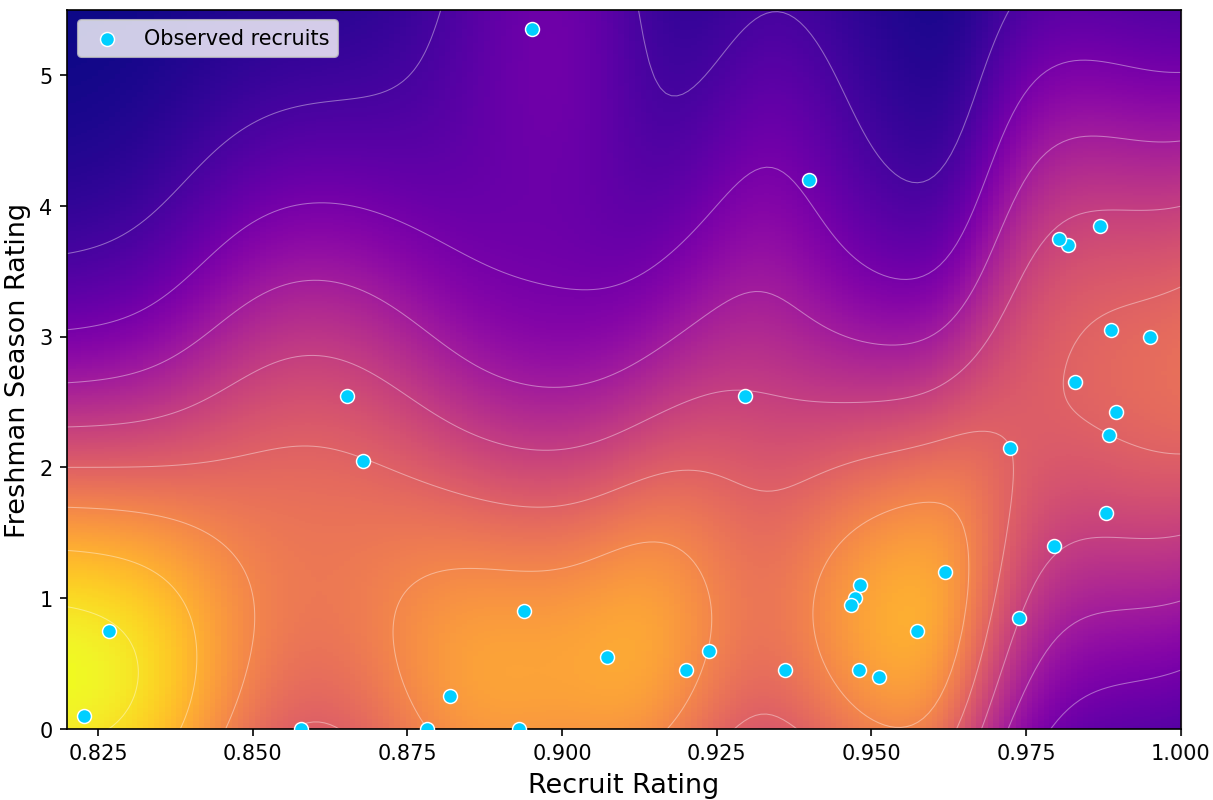
I had the script estimate the probability that our entire freshman class will yield at least:
- one good starter and one solid reserve: 57%
- one borderline starter and one solid reserve: 66%
- one borderline starter and one borderline reserve: 78%
- one solid reserve and one borderline reserve: 86%
And if you're dying to know what it says about a 9th man:
- one solid reserve and two borderline reserves: 59%
This is based on a small sample size (35 recruits), so I'm just throwing it out there for fun. I think we all want better than a 66% chance of getting at least a borderline starter and solid reserve, and the coaches know these guys better than any of us, so hopefully enough of the guys coming in end up on the higher side of these predictions.
I had the script estimate the probability that our entire freshman class will yield at least:
- one good starter and one solid reserve: 57%
- one borderline starter and one solid reserve: 66%
- one borderline starter and one borderline reserve: 78%
- one solid reserve and one borderline reserve: 86%
And if you're dying to know what it says about a 9th man:
- one solid reserve and two borderline reserves: 59%
This is based on a small sample size (35 recruits), so I'm just throwing it out there for fun. I think we all want better than a 66% chance of getting at least a borderline starter and solid reserve, and the coaches know these guys better than any of us, so hopefully enough of the guys coming in end up on the higher side of these predictions.
Well, I'm not sure why it sounds that what I'm asking for is so abstract.What you're not grasping as part of the major issue is that NIL and the portal have changed the ability to get the kind of player you, specifically you, want.
You want a proven commodity to come in and give you a guaranteed, quality, 8 to 10 minutes. Why come here when you can go somewhere else and start AND get paid more?
Sophomore Jake, Freshman DGL, Freshman Ty, Freshman Sencire, Freshman Goode, Freshman Melendez, Freshmen Coleman Hawkins. Every one of those guys played in over 74% of our games and averaged 2.0 points while doing so.
Is it crazy to say a similar asset would be nice for this year's team, in the 9th man role?
It's just an extra safety blanket when you endure injuries/other absences. Big difference playing 6 guys versus 7 (and even 7 guys versus 8). It's called depth!
Last edited:
DGL, 149 compositeWell, I'm not sure why it sounds that what I'm asking for is so abstract.
Sophomore Jake, Freshman DGL, Freshman Ty, Freshman Sencire, Freshman Goode, Freshman Melendez, Freshmen Coleman Hawkins. Every one of those guys played in over 74% of our games and averaged 2.0 points while doing so.
Is it crazy to say a similar asset would be nice for this year's team, in the 9th man role?
It's just an extra safety blanket when you endure injuries/other absences. Big difference playing 6 guys versus 7 (and even 7 guys versus 8). It's called depth!
Ty Rodgers, 59 composite
Sencire Harris, 113 composite
Luke Goode, 103 composite
RJ Melendez, 94 composite
Coleman Hawkins, 167 composite
And Zens coming in this year is #104.

Every transfer we've had over the last 2 season has experienced a significant 3pt% dip in their first season after arriving.Is it crazy to say Vaaks could be a version of 2022 Alfonso Plummer? Just from a shooting and scoring standpoint. People forget just how good that guy was.
Ben Humrichous - 41% down to 34%
Kylan Bowell - 38% down to 24%
Andrej Stojakovic - 32% down to 24%
Zvonimir Ivisic - 38% down to 28%
Even Jake Davis was 39% at Mercer and down to 34% his first year at IL.
*The lone exception to this is Tre White
Seeing Vaaks at 35% while shooting 8.4 threes per game, I absolutely thought 37% on 6.5 would be a realistic yardstick. Better percentage = less volume and better shots.
But our recent history makes me temper expectations.
Last edited:
Every transfer we've had over the last 2 season has experienced a significant 3pt% dip in their first season after arriving.
Ben Humrichous - 41% down to 34%
Kylan Bowell - 38% down to 24%
Andrej Stojakovic - 32% down to 24%
Zvonimir Ivisic - 38% down to 28%
Even Jake Davis was 39% at Mercer and down to 34% his first year at IL.
*The lone exception to this is Tre White
Seeing Vaaks at 35% while shooting 8.4 threes per game, I absolutely thought 37% on 6.5 would be a realistic yardstick. Better percentage = less volume and better shots.
But our recent history makes me temper expectations.
Here's the full sample:
I think with nearly half of them jumping up a level in play, might explain the 1% difference overall
Editing to add that actually none of these are reliable samples. Its widely accepted that 750 attempts is where a 3 point shooter's percentage fully stabilizes statistically.
Last edited:
I said over the last two seasons - their first year at Illinois compared to their last year at said school they transferred from.Here's the full sample:
View attachment 50478
I think with nearly half of them jumping up a level in play, might explain the 1% difference overall
Editing to add that actually none of these are reliable samples. Its widely accepted that 750 attempts is where a 3 point shooter's percentage fully stabilizes statistically.
There's undeniably been a major dip for a lot of guys.
I said over the last two seasons - their first year at Illinois compared to their last year at said school they transferred from.
There's undeniably been a major dip for a lot of guys.
2 seasons is a completely worthless sample size
6 seasons (what I posted), while far better than 2 seasons, is still not 100% usable given that none of the players had reached 750 attempts
The thing that's undeniable is that none of this really tells us a whole lot due to the size of the dataset
Last edited:
Not sure why they'd need to hit 750 attempts. We're measuring production; not someone's 100% absolute shooting prowess.2 seasons is a completely worthless sample size
5-6 seasons is nearly worthless as well anyway given that none of the players had reached 750 attempts
The thing that's undeniable is that none of this really tells us much
Last edited:
Not sure why they'd need to hit 750 attempts. We're measuring production; not someone's 100% absolute shooting prowess.
High variance + binomial nature of shooting. There's only two outcomes: make or miss. In stats, small samples of binary events suffer from massive swings. Its volatile not only due to the small number of attempts but also the small number of outcomes for each attempt.
Here's an example of how a real world situation can influence a player's shooting data at a small sample size:
A player's raw percentage over, lets say, 100 attempts can be artificially inflated by getting mostly wide-open uncontested looks in that player's most efficient shooting spot on the floor due to having a great playmaker. A player's raw percentage can also be artificially deflated by being placed in a role where they need to manufacture 3 point looks in end-of-clock situations.
There's just way more context than "there's a curse" -- that's frankly a weird thing to think (unless you actually believe in curses, I dunno? I don't believe that's a real, actual thing that affects college basketball players).
You make good points in the time/length of the sample size. However, that still doesn’t clearly define anything more than a smaller sample size.High variance + binomial nature of shooting. There's only two outcomes: make or miss. In stats, small samples of binary events suffer from massive swings. Its volatile not only due to the small number of attempts but also the small number of outcomes for each attempt.
Here's an example of how a real world situation can influence a player's shooting data at a small sample size:
A player's raw percentage over, lets say, 100 attempts can be artificially inflated by getting mostly wide-open uncontested looks in that player's most efficient shooting spot on the floor due to having a great playmaker. A player's raw percentage can also be artificially deflated by being placed in a role where they need to manufacture 3 point looks in end-of-clock situations.
There's just way more context than "there's a curse" -- that's frankly a weird thing to think (unless you actually believe in curses, I dunno? I don't believe that's a real, actual thing that affects college basketball players).
The findings of a longer sample size could be flawed more than small one. There is no clear or definitive qualifying measure other than being behind the 3 point line. For example both sample sizes of multiple seasons or just a couple seasons include early season or late season shots, wide open shots, hand in the face shots, transition 3s, set 3s, catch-and-shoot 3s, half court buzzer beaters, etc.
That’s a bunch of mumbo jumbo, but I say that to ask does a high sample size tell more than a smaller sample size in terms of recency in this instance?
Well, again, you're looking to measure the player's absolute shooting ability (in experimental manners).High variance + binomial nature of shooting. There's only two outcomes: make or miss. In stats, small samples of binary events suffer from massive swings. Its volatile not only due to the small number of attempts but also the small number of outcomes for each attempt.
Here's an example of how a real world situation can influence a player's shooting data at a small sample size:
A player's raw percentage over, lets say, 100 attempts can be artificially inflated by getting mostly wide-open uncontested looks in that player's most efficient shooting spot on the floor due to having a great playmaker. A player's raw percentage can also be artificially deflated by being placed in a role where they need to manufacture 3 point looks in end-of-clock situations.
There's just way more context than "there's a curse" -- that's frankly a weird thing to think (unless you actually believe in curses, I dunno? I don't believe that's a real, actual thing that affects college basketball players).
But measuring someone's absolute ability has zero to do with helping our team win games; it production and efficiency in that particular setting that matters.
Take Vaaks for example: he will likely shoot a higher percentage 1) if he decreases a bit on the 8.4 3ptA per game and 2) due to our large variety of sufficient playmakers.
Does that skew his outcome away from his experimental, absolute percentage? Yes. But it doesn't matter because he's being more efficient and productive, which is all that matters.
.....
Also, if you'd like to experiment the data, truth is 750 still isn't enough.
Law of Large Numbers is infinite: the more you repeat the experiment, the closer and closer your results will be to the true, expected average.
Last edited:
Sample size can also be a confounding variable. A guy shoots a lot more or less in a different context is going to make it more difficult to compare apples to apples...Every transfer we've had over the last 2 season has experienced a significant 3pt% dip in their first season after arriving.
Ben Humrichous - 41% down to 34%
Kylan Bowell - 38% down to 24%
Andrej Stojakovic - 32% down to 24%
Zvonimir Ivisic - 38% down to 28%
Even Jake Davis was 39% at Mercer and down to 34% his first year at IL.
*The lone exception to this is Tre White
Seeing Vaaks at 35% while shooting 8.4 threes per game, I absolutely thought 37% on 6.5 would be a realistic yardstick. Better percentage = less volume and better shots.
But our recent history makes me temper expectations.
Attempts % change
PREV ILL
BH 128 181 141%
KB 174 143 82%
AS 129 82 63%
ZI 125 100 80%
JD 155 64 41%
All of these guys had a significant change in the number of attempts, Only Ben shot them more frequently. Variance in sample size is going to give you variance in results. Doesn't mean there is something in the water making guys shoot worse here. Andre, Z, and especially Davis all accepted a smaller share of the minutes and the offensive load here.
Vaaks will have a similar role and minutes. Usage could be lower. I doubt he takes 8 3's a game again, but he won't have a problem maintaining 30 mpg. I'd bet my beach house he will get more open looks here, as the Providence offense was a 2 man show. He had to take a lot of contested shots.
Here's the full sample:
View attachment 50478
I think with nearly half of them jumping up a level in play, might explain the 1% difference overall
Editing to add that actually none of these are reliable samples. Its widely accepted that 750 attempts is where a 3 point shooter's percentage fully stabilizes statistically.
You make good points in the time/length of the sample size. However, that still doesn’t clearly define anything more than a smaller sample size.
The findings of a longer sample size could be flawed more than small one. There is no clear or definitive qualifying measure other than being behind the 3 point line. For example both sample sizes of multiple seasons or just a couple seasons include early season or late season shots, wide open shots, hand in the face shots, transition 3s, set 3s, catch-and-shoot 3s, half court buzzer beaters, etc.
That’s a bunch of mumbo jumbo, but I say that to ask does a high sample size tell more than a smaller sample size in terms of recency in this instance?
A large sample size doesn't tell you more about recency, its tells you more about baseline skill. Small samples have too much variance, especially for events with binary outcomes.
If we set aside all of the other working ancillary reasons like being on a team with a playmaker who gets you ball in your spot when you're wide open, or being 'the guy' on a team where you have to hoist up 28 footers when the shot clock dwindles, we are left with the main reason small samples aren't trusted -- variance.
On 100 attempts, if 3 of them bounce around and go in instead of being a miss, it makes a 35% shooter appear to be a 41% shooter and then you end up with folks wondering why Ben Humrichous didn't come through on his .414 percentage that he posted his single year at Evansville.
Well, again, you're looking to measure the player's absolute shooting ability (in experimental manners).
But measuring someone's absolute ability has zero to do with helping our team win games; it production and efficiency in that particular setting that matters.
Take Vaaks for example: he will likely shoot a higher percentage 1) if he decreases a bit on the 8.4 3ptA per game and 2) due to our large variety of sufficient playmakers.
Does that skew his outcome away from his experimental absolute percentage? Yes. But it doesn't matter because he's more efficient and productive, which helps us win more games.
We're not going to agree on this, but that's okay. Because I do actually care more about a player's actual shooting ability than the percentage they posted being a spot up corner 3 point shooter at BFE University on 80-100 attempts.
- Status
- Not open for further replies.